
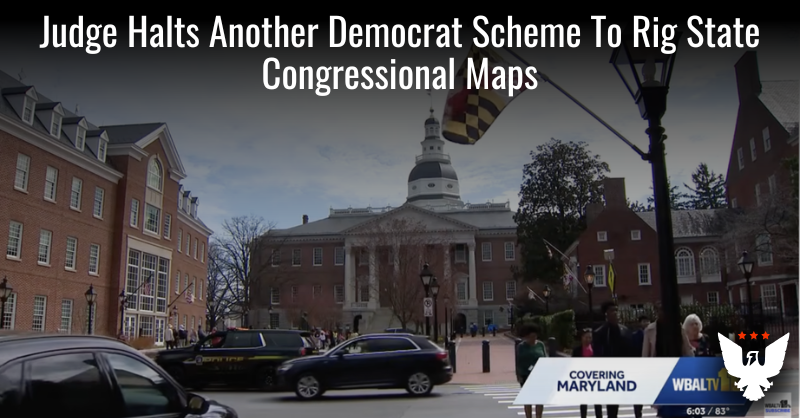
Judge Stops Blue State From Rigging Congressional Maps
Democrats have done a lot of weaselly things in the pursuit of power, but their ploy to grab a congressional seat by a quick and crooked change to Maryland’s constitution is a real doozy.
A Maryland judge this week saw through the legally tortured redistricting scheme and put the kibosh on the hastily made ballot question.
Anne Arundel County Circuit Court Judge Robert J. Thompson on Wednesday enjoined the Maryland State Board of Elections from putting an amendment question on the Nov. 3 ballot that the legislature unlawfully conceived.
“Because the legislature did not follow the very laws it enacted, the court finds the enactment of HB2100 to be legally deficient,” Thompson wrote in his pointed opinion. The Board of Elections immediately appealed the decision to the Maryland Supreme Court.
Shrugging Off the Law
The rushed plan effectively seeks to wipe out the Old Line State’s sole Republican-held congressional district, just as Democrats tried and failed to do in Virginia earlier this year.
As court records spell out, the General Assembly just last session passed a bill that established new content requirements for statewide ballot questions and set a July 1 deadline for amendment questions to be submitted to the Board of Elections. Gov. Wes Moore, a Democrat with presidential aspirations, backed the Senate bill. The law went into effect on June 1.
A month and a half later, Moore issued a proclamation calling the General Assembly into “Extraordinary Session” to begin on Aug. 3. The purpose? To “pass legislation to amend the State constitution to clarify and reaffirm that the provisions which govern the requirements of our State legislative districts to not apply to Maryland’s congressional districts.”
But the special session convened more than a month after the July 1 ballot certification deadline. The General Assembly disregarded a law that it recently had passed. It was fresh of mind. They couldn’t have forgotten about it.
The General Assembly did forget about the state constitution, or ran roughshod over it, according to the judge’s ruling. The proposed amendment would give the Maryland Supreme Court original jurisdiction to review the state’s redistricting plan, and declares the state constitution says nothing about congressional redistricting.
Attorneys for the Oversight Project, a government watchdog group, the Maryland Freedom Caucus, and other Republicans immediately challenged the Democrats’ power trip. The lawsuit asked the court to enjoin the proposed amendment from appearing on November’s ballot, arguing the legislature failed to comply with the law it had recently passed.
Thompson agreed with the plaintiffs, signaling that the General Assembly contorted the law to advance their redistricting scheme.
“Even if the legislature’s reading of the constitution is correct and they are exempted from following the laws they impose on all other Marylanders, the court finds the ballot question itself to be deficient,” the judge wrote.
‘Nothing in the Record’
For an amendment question purportedly aimed at clarifying the law, the language is as clear as mud. The proposed ballot question reads:
“The proposed Constitutional Amendment clarifies that certain standards in the Maryland Constitution apply only to districts used to elect members of the General Assembly; authorizes the General Assembly to grant original jurisdiction to the Supreme Court of Maryland to review the congressional districting plan of the state; and requires the criteria for boundaries of congressional districts to be determined by applicable federal law.”
Huh?
Thompson found the use of the word “clarifying” misleading.
Indeed.
As the judge notes, a previous ruling that the Board of Elections is pinning its legal arguments on does not make a distinction between state and federal congressional districts.
“There is nothing in the record to suggest that was ever the common understanding,” Thompson wrote. “The ruling of the court was that the same rules apply to legislative districts and congressional districts.”
‘Victory for the Rule of Law’
The proposed amendment sets up the kind of map-rigging Democrats — in Maryland and nationwide — have employed in the march to take back the U.S. House of Representatives next year and the White House in 2028. Blue and red states have spent the past year engaged in a mid-decade redistricting war ahead of November’s critical midterm elections. Democrats have picked up some victories, but Republicans have won the maps war.
Maryland gave Demsa reasonable chance to manipulate its congressional maps and pick up a House seat by squeezing out the lone district represented by a Republican.
The circuit court just said no.
“The court finds that the process used by the General Assembly to propose ballot Question 3 was deficient,” Thompson wrote. “Further, in the General Assembly rush to pass the measure in a hastily called special session, the presumptions and thus the wording of the question are deficient.”
A statement from the governor’s office asserts Maryland voters have the right to weigh in on the ballot question.
“At a moment when states across the country are manipulating congressional maps to silence voters and undermine fair representation, Maryland cannot afford to sit on our hands,” the statement said.
Maryland Senate Minority Leader Steve Hershey said in a statement that the ruling is “an important victory for the rule of law.”
“This lawsuit simply asks whether the government must follow the laws it passes before asking the voters to amend the Constitution,” the Republican wrote on his X account.
‘Manipulating District Lines for Political Gain’
Virginia Democrats met a similar fate.
In May, the commonwealth’s Supreme Court struck down a sweeping gerrymandering scheme that would have given Democrats a 10-to-1 advantage in the House, erasing Virginia’s present political split of six Democrat House members to five Republicans.
As in Maryland, the matter came down to a rigged process.
Virginia’s constitution requires that a proposed amendment be passed by two separate legislatures, with an intervening election, allowing voters to have a say on the referendum before it even makes it to a vote for the next legislature.
“From Maryland to Virginia to Missouri, Republicans are stopping Democrats’ attempts to rig congressional maps,” said Republican National Committee Election Integrity spokeswoman Ally Triolo.
“The RNC is leading the fight to stop these partisan redistricting schemes, defend fair representation, and make sure elections are decided by voters, not politicians manipulating district lines for political gain,” she added in the statement.
Matt Kittle is a senior elections correspondent for The Federalist. An award-winning investigative reporter and 30-year veteran of print, broadcast, and online journalism, Kittle previously served as the executive director of Empower Wisconsin.