
America’s 140-Year War on Anarchists – The Washington Standard
The US has a long history of persecuting anarchists for what they read and write. Prairieland is just the latest chapter.
This week, two federal judges in Fort Worth, Texas, handed down a combined 450 years in prison to a group of activists who showed up at an ICE detention center on the 4th of July to make noise for the people locked inside. One person, Benjamin Song, shot and wounded a police officer that night, and he got 100 years for it. The bullet that hit the officer was reportedly a ricochet, and the officer admitted that he was pointing his gun at a protester when he was hit. Other protesters were swept into the same conspiracy and labeled terrorists for things like wearing black, using the Signal app, and printing zines. One man, Daniel Sanchez Estrada, was not even at the protest. He got 30 years for moving a box of his own antifascist zines. If this is the first you’re hearing about the case, I covered the details in depth last week.
In many ways the Prairieland sentences set a dangerous precedent, but this type of persecution is nothing new for Anarchists living in the imperial core. The American state has been waging a war on anarchists for at least a hundred and forty years
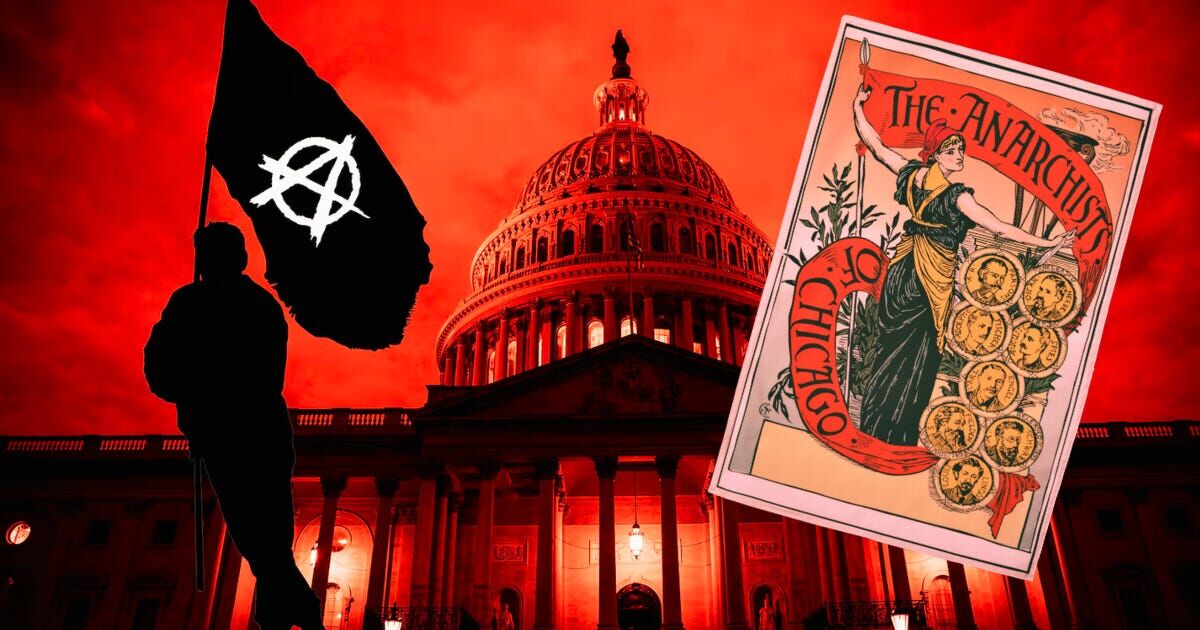
In the spring of 1886, there were massive protests and strikes in Chicago pushing for an eight-hour workday, escalating on May 1 when tens of thousands of workers walked off the job. At the McCormick Reaper Works, the company brought in scabs to break the strike, which resulted in a tense confrontation at the factory gates between the scabs and the strikers on May 3. That’s when police stormed in and opened fire on the workers, killing at least two people.
The next night, anarchist labor leaders planned a protest at Haymarket Square in response to the killings. The mayor of Chicago stopped by and called it peaceful. It was breaking up in the rain when a line of police marched in and ordered everyone to leave. Then someone threw a bomb. It killed officers, the police opened fire, and people on both sides died. The bomber was never identified.

Eight anarchists were arrested and tried anyway. Most of them had not even been at the rally, and the evidence never showed that any of them threw the bomb. They were convicted of conspiracy on the theory that their speeches and their newspapers had inspired whoever did. Seven were sentenced to death.
Four were hanged on November 11, 1887. A fifth, Louis Lingg, died in his cell the day before. Six years later, the governor of Illinois, John Peter Altgeld, pardoned the three survivors and admitted that the trial had been a fraud.

In 1901, a man named Leon Czolgosz shot President William McKinley at a public event in Buffalo. Czolgosz called himself an anarchist. He had acted alone, and the movement wanted nothing to do with him. Police arrested Emma Goldman and other well-known anarchists anyway, then let them go when no conspiracy could be found.
Congress answered with the Immigration Act of 1903, better known as the Anarchist Exclusion Act. It barred anyone who believed in or advocated the overthrow of organized government from entering the country. It was the first federal law since 1798 to exclude people for their political beliefs rather than for anything they had done.

When the United States entered World War I in 1917, the government went after the Industrial Workers of the World, the radical union known as the Wobblies, over their opposition to the war. They saw it as a fight that served the bosses, not the workers who would be sent to die in it, and they were one of the loudest voices speaking out against the war.
The government treated that message as a threat to the war effort and used the brand-new Espionage Act to move against them. In September 1917, federal agents raided IWW halls across the country, seized tons of the union’s documents and letters, and arrested around 165 of its leaders. They were charged with conspiring to obstruct the draft and undermine the war. An internal investigation had already failed to show the Wobblies were German agents or had actually broken the law, but the government built its case anyway, mostly out of the union’s own pamphlets and newspapers. At the 1918 trial in Chicago, 101 of them were convicted. Big Bill Haywood, the most famous Wobbly, got twenty years.
The states piled on. More than twenty of them passed criminal syndicalism laws, which made it a felony to belong to a group that advocated radical change, whether or not you had ever acted on it. In some states you could be convicted for having once been a member of the IWW; in others an employer could be prosecuted for hiring an anarchist.

After the war came the first Red Scare. Congress passed the Sedition Act of 1918, which made disloyal speech a crime, and the Immigration Act of 1918, which let the government deport immigrants simply for being anarchists.
In 1919, a group of anarchists called the Galleanists ran a bombing campaign against politicians, judges, and businessmen. They were followers of Luigi Galleani, who preached what anarchists of the era called propaganda of the deed, the idea that violence against the state was a legitimate political tool rather than a last resort, and they took it seriously. In June, one of them blew up the front of Attorney General A. Mitchell Palmer’s house in Washington and died in the blast. Palmer used the bombings as a pretext to build a new division to hunt radicals.
Then came the roundups, and they reached far past anyone connected to the bombs. On the night of December 21, 1919, federal agents loaded 249 people onto a ship called the Buford and sent them to Russia. Among them were Emma Goldman and Alexander Berkman, two of the most famous anarchists in the country, neither of whom was a citizen. Weeks later, in January 1920, agents raided dozens of cities in a single night and arrested thousands of people. Most were never charged with anything, and the actual bombers were never caught.

By the middle of the century, the open mass trials gave way to something quieter. From 1956 to 1971 the FBI ran a secret program called COINTELPRO that surveilled, infiltrated, and disrupted political movements it considered subversive. A Senate committee later described it as a campaign aimed directly at the First Amendment rights of speech and association. The Black Panthers were a central target, and some of their leaders were neutralized through informants, false charges, and worse.
As with many infamous government programs, the tactics live on even after the program is shut down. When the anti-globalization movement put anarchists back in the streets, starting with the shutdown of the World Trade Organization meeting in Seattle in 1999, the state answered with infiltration and conspiracy charges. In 2008, it charged eight members of an anarchist group at the Republican National Convention, the RNC 8, with conspiracy to riot in furtherance of terrorism. It was the first use of Minnesota’s state version of the Patriot Act. The case ran largely on paid informants, and the pre-protest raids on activist homes turned up household items like paint and tools for chopping wood. The terrorism charge was eventually dropped.

After September 11, the government turned the word terrorism on the radical environmental and animal rights movements. The FBI called the Earth Liberation Front the nation’s top domestic terror threat, even though the movement had never killed anyone. In a sweep called Operation Backfire, it arrested activists for a string of arsons going back years, all of them aimed at property and none of them at people.
The sentences were inflated with terrorism enhancements, a tool built after the Oklahoma City bombing that lets a judge add years to a sentence for property crimes meant to influence the government. Daniel McGowan got seven years for two arsons and was sent to a special prison unit designed to control his communication. Around the same time, a group of activists known as the SHAC 7 was convicted of terrorism for running a website that publicized protests against an animal testing company. They had not carried out the actions. They had just reported on them.

One of the things the government used to convict the Prairieland defendants was their membership in a book club. The club was named after Emma Goldman. In 1919, the government put the real Emma Goldman on a ship and deported her for the things she said and published. A hundred years later, the government used her name on a reading group as evidence in a terrorism case.
Article posted with permission from John Vibes