

UN peacekeepers prepare to exit Lebanon after 70 years – leaving behind a worrying security vacuum
For nearly 70 years, the blue helmets of United Nations’ peacekeepers have dotted the landscape of southern Lebanon. But those days may soon be over.
Under Israeli and American pressure, the U.N. Security Council unanimously voted in August to end the mandate establishing the United Nations Interim Force in Lebanon, or UNIFIL.
It means the 7,565 members of UNIFIL deployed in Lebanon – representing about 46 countries – will depart the country no later than Dec. 31, 2026.
The end of the U.N. presence comes at a pivotal time. Israel and Lebanon have already held seven rounds of negotiations aimed at bringing a lasting peace to a region that has suffered from decades of conflict.
Brokered by the United States, these talks that led to the signing of the Trilateral Framework in June 2026 call for the disarmament of Hezbollah, the Israeli withdrawal from all Lebanese lands and the settlement of all disputes over borders. Yet all of these conditions are still some way off from completion – and beset by a series of barriers.
As such, the departure of the United Nations peacekeeping forces raises serious concerns. The potential for a security vacuum looms large in south Lebanon, especially given that Israel continues to bomb Lebanon despite a ceasefire that has nominally been in place since April 16, 2026.
As a scholar of Middle East Studies, I know that UNIFIL has never been a permanent solution. But I fear that its termination creates more problems than it solves, especially when there are no clear replacements or post-UNIFIL security arrangements in place.
The UN in Lebanon
While the U.N. had had an on-the-ground presence in Lebanon to handle civil strife since the 1950s, its role in mediating between Lebanon and Israel started later.
In 1978, after a series of attacks on Israel organized by Palestinian fighters in Lebanon, Israel invaded and occupied the south in what was known as Operation Litani. As a result, the United Nations Security Council established UNIFIL to monitor Israel’s withdrawal from south Lebanon and to restore peace at the Lebanese–Israeli border.
Israel’s occupation of south Lebanon lasted more than two decades. Following its withdrawal on May 25, 2000, the U.N. set the Blue Line – a 75-mile (120 km) demarcation line created for the practical purpose of confirming Israeli withdrawal from south Lebanon. It was not an official border but a buffer zone monitored by the U.N. peacekeepers.
Jean-Claude Delmas/AFP via Getty Images
UNFIL and the Blue Line served as geographic and diplomatic focal points in the 2006 war between Hezbollah – an Iranian-backed militia operating from Lebanon – and Israel.
Resolution 1701 of the Security Council, which brought an end to the 2006 war, dramatically expanded the UNIFIL role in Lebanon; the number of troops went from 2,000 to 15,000 authorized military personnel.
Its mandate also changed to include monitoring the ceasefire and documenting its violations, coordinating with Lebanon’s military and functioning as the only direct communication channel between the Lebanese and Israeli militaries. UNIFIL also offered humanitarian aid to the affected civilian population of south Lebanon.
Yet UNIFIL’s role never altered the basic lack of peace on the Israeli-Lebanese border. Over 50 years, Israel invaded Lebanon numerous times. And since 2000, Hezbollah has flourished in south Lebanon.
A checkered history of interventions
As UNIFIL prepares to depart, it’s unclear what will fill the looming security vacuum. It could be filled by non-U.N. troops, but Lebanon’s past shows the risks inherent to international peacekeeping missions.
In 1982, after Israel invaded Lebanon and occupied Beirut with the intention of eliminating the Palestinian militant threat, Lebanese authorities called on Western powers for help. In August, the governments of the U.S., France, Italy and the United Kingdom created a multinational peacekeeping force designed to restore peace and stop the fighting between the Lebanese, Palestinians and Israelis.
But on Oct. 23, 1983, the multinational peacekeeping force was the target of a dual suicide attack that killed 241 American service members and 58 French paratroopers.
To this day, the attack – claimed by the pro-Iranian Islamic Jihad – remains the deadliest single-day incident for the U.S. Marine Corps since the Battle of Iwo Jima in 1945.
In addition to Israel, interventions in Lebanon have also come from another neighboring country.
In 1976, the Syrian military intervened during Lebanon’s civil war to put an end to sectarian violence. Nearly three decades of occupation followed, and troops were withdrawn only following the assassination of Lebanese Prime Minister Rafik Hariri in 2005 and the subsequent Cedar Revolution.
What next for Lebanon
With the absence of an internal Lebanese consensus, the arrival of any international peacekeeping force to replace the exiting UNIFIL will be perceived by many Lebanese as a top-down imposition.
Moreover, the situation on the ground makes it dangerous for any international force to successfully operate. Israel is reportedly occupying over 10% of Lebanon’s territories, including multiple permanent bases and outposts in southern Lebanese territory.
Hezbollah, meanwhile, refuses to disarm.
Finally, the fate of Lebanon-Israel direct negotiations is unclear. Recently, the countries held military talks in Florida, but little is expected from them.
Yet a number of efforts are ongoing despite the difficult circumstances surrounding UNIFIL’s withdrawal. On June 25, French President Emmanuel Macron and Italian Prime Minister Giorgia Meloni announced an “international coalition to support Lebanon” to reinforce Lebanon’s sovereignty and help prevent a security vacuum in south Lebanon.
In parallel, the European Union Foreign Ministers approved a new civilian-military mission aimed at advising and training the Lebanese military and police personnel.
But these appear to be limited operations that aren’t designed to replace UNIFIL.
U.S. President Donald Trump, meanwhile, has previously proposed that Syria enter Lebanon to help end the violence and execute “a surgical attack on Hezbollah.”
But given the past experience of Syrian occupation, this proposal would certainly not be welcomed by the Lebanese people.
Remaining questions
Although Lebanese security is a paramount concern regarding the impending withdrawal of UNIFIL, it’s not the only potential risk.
UNIFIL employs many Lebanese civilians and is a steady consumer of local goods and services. It also provides humanitarian aid to the region.
And the departure of UNIFIL may further erode Lebanon sovereignty by opening the door for the sharing of security by neighbors – and former occupiers – Syria and Israel.
This is all the more worrying given that the Lebanese armed forces are poorly trained, have a poor record as a fighting force and will be susceptible to attacks from Hezbollah fighters and sympathizers, which might trigger sectarian violence in the country.
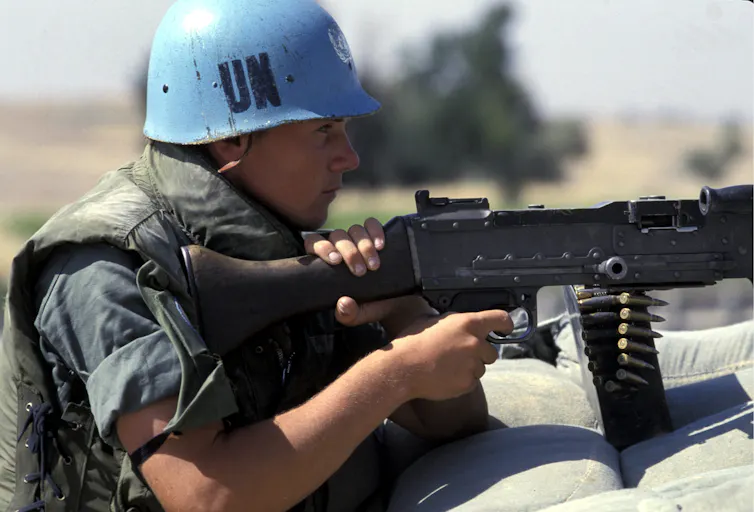
Roland Neveu/Gamma-Rapho via Getty Images
In the vacuum left by U.N. forces, some Lebanese military personnel might simply decide that opposing Hezbollah is too risky altogether.
All of these factors make what comes next for Lebanon after UNIFIL’s departure as opaque as it is worrying for those concerned about the country’s well-being.
For the sake of Lebanese sovereignty, the twin goals of disarming Hezbollah and ensuring Israel’s withdrawal from Lebanese territory remain paramount. Yet it’s unclear who will take on those duties absent a stronger Lebanese state.
For all of its inability to prevent wars, invasions and violations of ceasefires, UNIFIL’s presence guaranteed a degree of Lebanese sovereignty over its lands and served as a reminder of the international community’s commitment to peace in the region. An effective replacement force would at least have to do the same.