
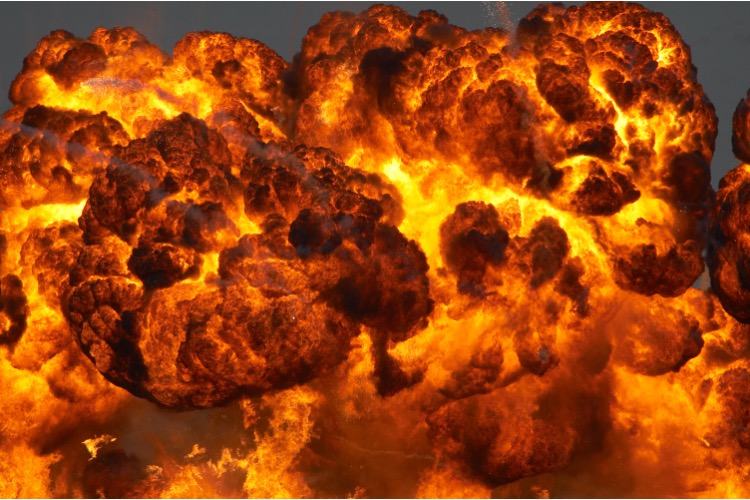
Army to Detonate Toxic Explosives in Iowa
The U.S. Army plans to destroy nearly five tons of unstable lead azide in Iowa, raising concerns among lawmakers, researchers, and residents about potential contamination of surrounding communities and farmland.
The Army postponed the planned detonation of 68 drums containing approximately 9,700 pounds of highly toxic lead azide at the Iowa Army Ammunition Plant in Middletown, Iowa. Originally scheduled for Friday, November 20, at noon Central Time, the two controlled explosions are now planned for Monday, November 23. Senator Chuck Grassley (R-Iowa) posted on X, “The Army is delaying the controlled detonation until Monday to further educate the public.” The operation, authorized under an emergency permit issued by the Environmental Protection Agency (EPA) on November 13, has raised concerns about potential lead contamination across southeastern Iowa and northwestern Illinois.
Lead azide, a highly sensitive explosive commonly used in military detonators, becomes increasingly dangerous when improperly stored or degraded. According to the EPA, the stockpiled material has recrystallized, making it dangerously sensitive to friction and shock. The Army maintains that transporting the material could trigger an uncontrolled explosion, leaving on-site detonation as the safest available option.
Property and Health Concerns
The Army’s environmental assessment, released November 18, predicts only minor, short-term environmental impacts, with no significant long-term consequences if mitigation measures are properly implemented. The Army plans to use earth-covered storage magazines, sand barriers, soil saturation, and water misters to minimize the release of airborne lead particles. Air and soil monitoring will accompany the operation.
However, lead is a poisonous heavy metal capable of damaging the nervous system, kidneys, and other organs. Children and pregnant women are particularly vulnerable to lead exposure. Unlike many other pollutants, lead does not biodegrade, and can persist in soil for generations, potentially contaminating farmland, livestock, and water supplies.
Researchers at the University of Iowa are preparing independent air and soil monitoring to evaluate the detonation’s environmental consequences. Scientists have questioned whether the Army’s modeling adequately accounts for potential contamination, particularly given the unusual nature of the operation. University researchers have also acknowledged that there is insufficient time to establish a comprehensive before-and-after blood-lead study.
The Iowa Department of Agriculture and Land Stewardship has advised nearby farmers to move livestock indoors or to alternate locations; protect feed and water supplies; and consider testing soil, forage, and animals for lead contamination before and after the explosions. The department also provided instructions for filing claims with the Army if livestock or property sustains damage.
Bipartisan Calls for Delay
Meanwhile, eight officials from Iowa and Illinois, including Republican Representatives Darin LaHood and Mary Miller and Democratic Senators Dick Durbin and Tammy Duckworth, urged the Army and EPA in a November 19 letter to consider delaying the operation. Their letter raised concerns about insufficient public communication, potential environmental contamination, and whether safer disposal alternatives have been adequately explored.
Although eliminating unstable explosives is a legitimate public-safety concern, the federal government must also respect the constitutionally protected rights of nearby property owners. Residents and farmers should not bear the financial or environmental consequences of improperly managed military hazardous materials. Public transparency and accountability for any resulting contamination are essential to protecting both individual liberty and private property.