
Trump’s Orders On Ranchers Might Be A Badly Needed Step In The Right Direction
It’s a definite maybe.
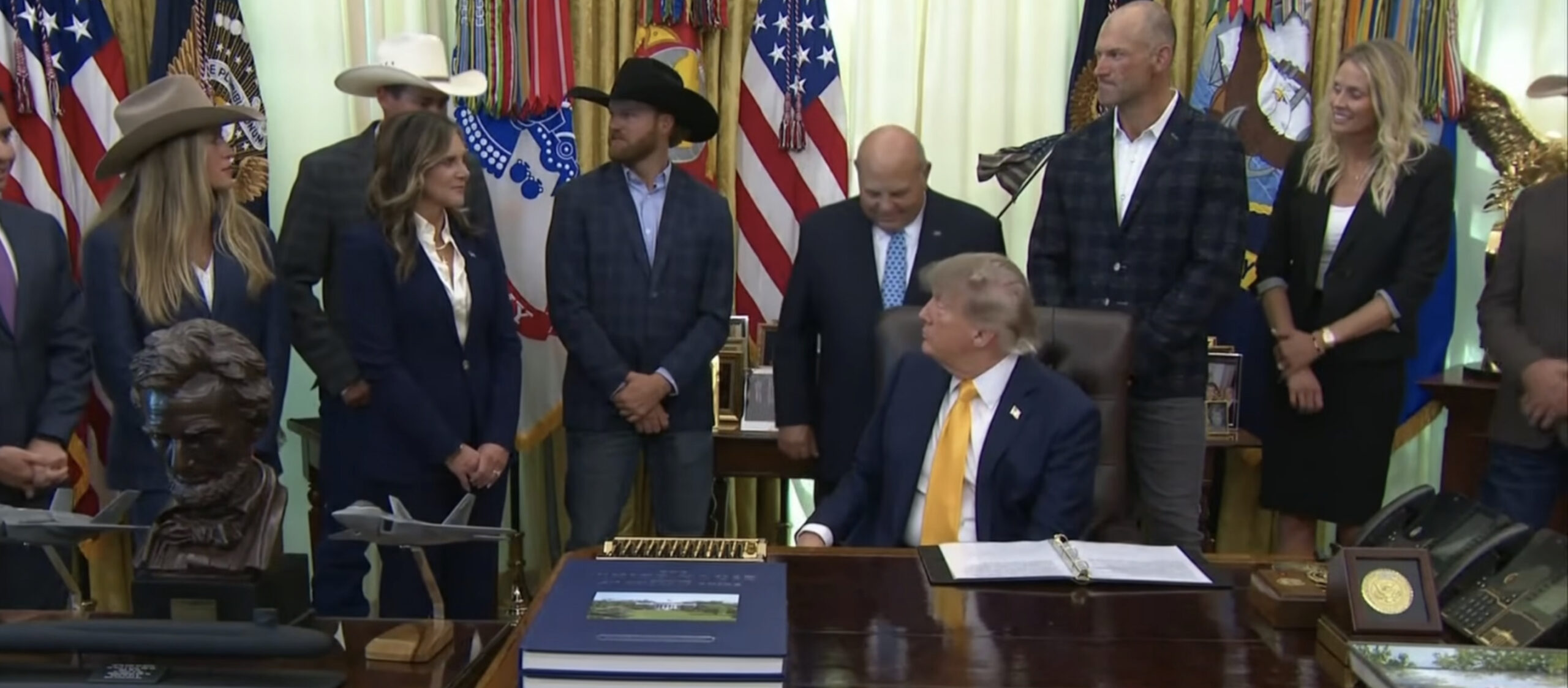
President Donald Trump met with ranchers in the Oval Office on Friday, signing two executive orders to incentivize the domestic production of beef: Supporting America’s Ranchers and Promoting Fair Competition In Livestock Markets And Expanding Market Access for American Meat Producers.
The orders were modest, and reactions were mixed. Rancher and advocate Amanda Radke wrote on social media that Trump’s orders “aren’t an overnight fix to the broken system that American beef cattle producers have had to operate under for so many years, but it’s a historic step in the right direction that we should all celebrate.”
The president’s orders cover topics of considerable interest to cattlemen, but they also look like this, one of several directives to Secretary of Agriculture Brooke Rollins: “Within 60 days of the date of this order, the Secretary shall submit to the President a report identifying Federal statutory provisions, as well as trade considerations, that restrict or prohibit State-inspected or custom exempt meat products from entering interstate commerce.”
So in substance, the president has ordered the executive branch to send him a bunch of reports: on wolves and cattle predation, on country of origin labeling, on independent meat processing and simpler interstate market access for meat products.
On social media, the White House explicitly framed the orders as an opening move, writing that Trump had “launched a whole-of-government effort to protect & fully support America’s ranchers.” Rollins echoed that theme: “MORE TO COME SO SOON,” she wrote.
Cattle herds have been declining in the United States for years, and the number of cattlemen has declined alongside that loss. An agricultural census from the Department of Agriculture reported that the US went from 729,046 farms with beef cattle in 2017 to 622,162 farms with beef cattle in 2021, while a more recent report estimated a total of “27.6 million beef cows in the United States as of Jan. 1, 2026,” down from 31.7 million in 2017. Drought and rising production costs have shrunk herds, as ranchers try to do the math on selling for immediate payment versus retaining cattle for breeding and growth.
Wolf predation has become a serious problem for cattlemen in the West, especially following the reintroduction of the gray wolf. Cows are becoming wolf food. In California, researchers at UC Davis concluded that “72% of wolf scat samples tested during the 2022 and 2023 summer seasons contained cattle DNA.”
Populations have rebounded significantly since the gray wolf was listed as an endangered species in most of the country in 1978, preventing ranchers from killing them in response to predation. The Arizona rancher Casey Murph has described “the feeling of having to ride away to the sound of a pack of Mexican Grey wolves tearing your border collie herding dog to pieces,” one of many examples of ranchers arguing that the threat of wolf attacks isn’t well understood outside of cattle country.
Again, Trump’s orders regarding wolves are mostly tentative and procedural, directing Rollins and Secretary of the Interior Doug Burgum to bring him more reports on the possibility of fully delisting gray wolves as an endangered species. But the final measure more directly suggests a return to a policy of killing at least some wolves in cattle country: “The Secretary of the Interior shall consider amending regulations or providing additional guidance, consistent with applicable law, to revise the Department’s criteria for authorizing lethal gray wolf and Mexican wolf removal and to enable greater emergency responsiveness, including precision targeting, for situations involving predator threats to human safety or threats to domestic livestock.”
Whatever the administration’s real actions turn out to be, somewhere past the sixty day mark when these orders might turn into policies, Congress continues to just sit there like a speed bump. A pilot version of the PRIME Act, allowing an expansion of meat processing for market into state-inspected facilities without USDA inspectors, passed the House and then died in the Senate. Similarly, legislation to require mandatory country of origin labeling for beef is advancing through the Senate committee process, but no one there seems to be in a hurry about it.
Whatever happens next, advocates for ranchers are taking the meeting in the Oval Office as a sign that the administration is at least aware that it has a problem to address after the unpopular decision to encourage the duty-free importation of 300,000 metric tons of foreign ground beef.
“That was a room of real ranchers, real rural Americans, real voices,” independent journalist Keely Covello wrote after attending the meeting. “And those voices were heard.”