
Supreme Court Recognizes Fourth Amendment Privacy Rights in Geofence Surveillance Case, Warns of Government’s Virtual Panopticon – The Washington Standard
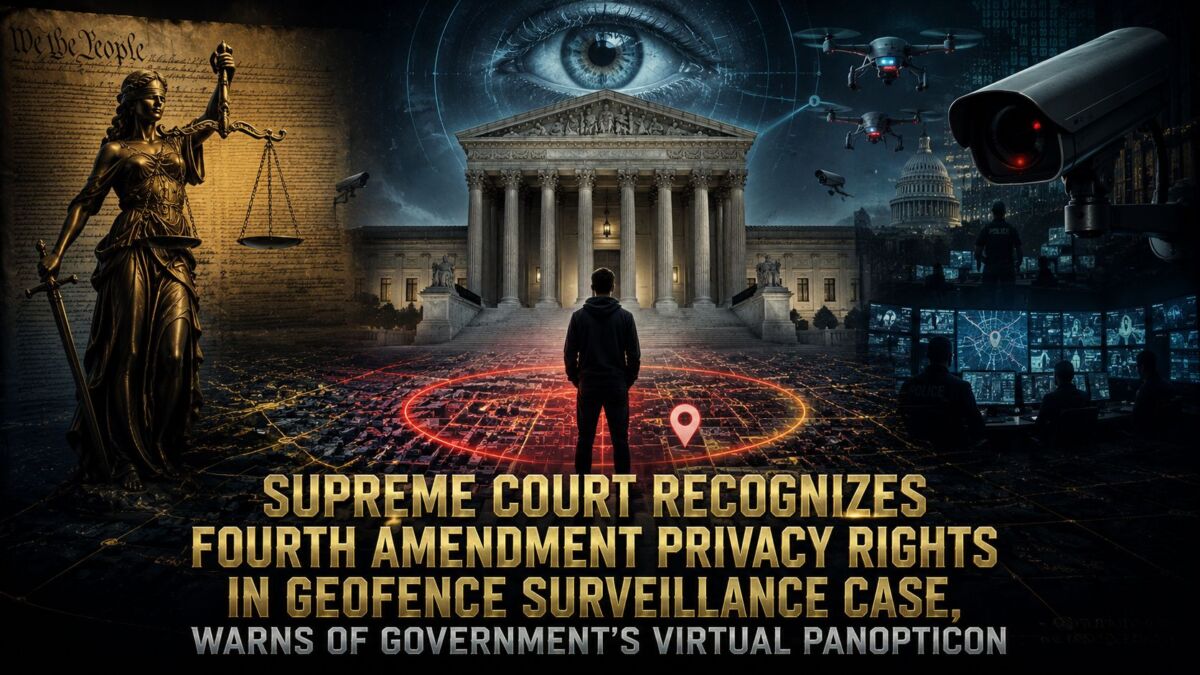
WASHINGTON, DC — In a major Fourth Amendment ruling, the U.S. Supreme Court has held that police conduct a “search” when they obtain cell phone location history data from a technology company through a geofence warrant.
In the digital age, simply having a smartphone in your pocket can lead to the government collecting your data to investigate you as a suspect for a crime. That is the constitutional danger posed by geofence warrants—sweeping surveillance orders that compel technology companies to disclose location data for every device within a defined area and time frame, regardless of whether the individuals involved are suspected of wrongdoing.
In a 6-3 decision in United States v. Chatrie, the Supreme Court vacated a lower court ruling that had denied constitutional protection for geofence location data and remanded the case for further review of whether the warrant used satisfied the Fourth Amendment’s requirements of probable cause and particularity. The high court’s ruling is significant because geofence warrants allow police to identify and investigate people based not on individualized suspicion but on whether their cell phones happened to be near the scene of a crime. As the Court recognized, “An individual has a reasonable expectation of privacy in records about his cell phone’s location, and police intrude on that constitutionally protected interest when they demand the information—even though for only a limited time, and from a third-party tech company.”
Get Daily Emails
“Geofence warrants invert the Fourth Amendment. They allow the government to cast a wide net over innocent people, track their movements, and then narrow the list until someone fits the bill. That flips the presumption of innocence on its head,” said constitutional attorney John W. Whitehead, president of The Rutherford Institute and author of Battlefield America: The War on the American People. “The Supreme Court’s ruling is an important reminder that constitutional rights do not disappear simply because the government obtains the information through Big Tech. This case is about whether constitutional protections keep pace with technology—or whether technological capability becomes an excuse to erode them.”
Unlike traditional warrants, which must describe with particularity the person or place to be searched, geofence warrants begin with a location and sweep in everyone who happened to be nearby. Law enforcement can then request progressively more detailed information—movement patterns, account data, subscriber identities—until individuals are singled out for investigation. In Chatrie, law enforcement obtained a geofence warrant directing Google to disclose anonymized device data for phones located within a 17.5-acre area surrounding the scene of a bank robbery. That geofence area was about the size of more than three New York City blocks, had a diameter longer than three football fields, and encompassed part of a nearby church. Three of the nine phones later singled out by police showed users’ movements to and from residences, a school, and a hospital—precisely the kind of private information that can reveal where Americans worship, seek medical treatment, attend school, gather with family and friends, or otherwise move through daily life.
In an amicus brief filed with the Court, The Rutherford Institute warned that geofence warrants represent a modern version of the general warrants that sparked the American Revolution. Rather than requiring law enforcement to identify a suspect and establish probable cause before conducting a search, these warrants reverse the constitutional order—authorizing the government to search first and decide later who might be suspicious.
Although the Supreme Court did not decide whether this particular geofence warrant ultimately satisfied the Fourth Amendment’s probable cause and particularity requirements, the Court made clear that those limits matter: the particularity requirement exists to prevent the “wide-ranging exploratory searches the Framers intended to prohibit.” Justice Jackson, joined by Justice Sotomayor, would have gone further and ruled that key stages of the warrant violated the Fourth Amendment.
The Rutherford Institute’s brief argued that permitting geofence warrants at all, or at least without significant restrictions to protect the privacy rights of innocent bystanders, would entrench a dangerous precedent in which digital convenience becomes a gateway to constant government oversight. The Supreme Court recognized this concern, warning that the government could use cell phone data as “a virtual panopticon with which to scrutinize its citizens’ activities.” The Court also determined that cell-phone location history is “not truly shared” in the normal sense of wanting a third party to see or use it, but is rather “the automatic price of conventional cell-phone usage.”
Although the ruling does not categorically ban geofence warrants, it rejects the government’s attempt to place this sensitive location data outside the Fourth Amendment simply because it is held by a technology company.
Ethan H. Townsend and Maura R. Cremin of McDermott Will & Schulte LLP advanced the arguments in the amicus brief. This filing builds on Rutherford’s earlier challenge to geofence warrants in Wells v. Texas.
Case History
February 05, 2026 • Rutherford Calls on Supreme Court to Prohibit Police Use of Geofence Warrants as Mass Surveillance Dragnets
April 29, 2026 • Rutherford Urges Supreme Court to Block Police Uses of Dragnet Cell Phone Surveillance
Chatrie v. United States:
Wells v. Texas: Amicus brief
Article posted with permission from John Whitehead