
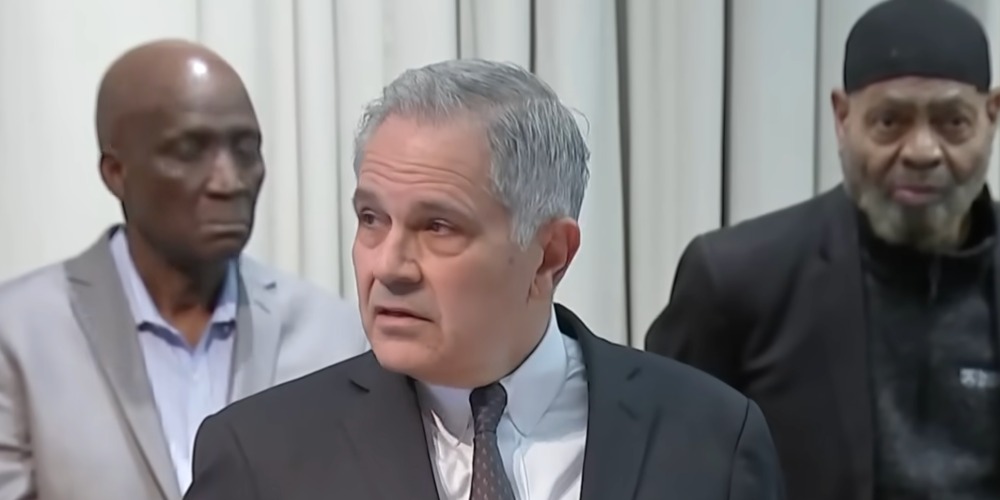
Philly DA Larry Krasner referred to DOJ for criminal probe after seeking to overturn 2009 murder conviction: federal judge
A federal judge found evidence that Krasner and a top deputy may have obstructed justice and engaged in other criminal conduct while attempting to overturn a murder conviction.
Soros-funded Philadelphia District Attorney Larry Krasner and one of his top deputies have been referred to federal prosecutors for a potential criminal investigation after a judge found evidence they may have obstructed justice and engaged in other criminal conduct while attempting to overturn a murder conviction.
According to NBC, US District Judge Paul S. Diamond on Tuesday referred Krasner, Assistant District Attorney Matthew Stiegler, and the Philadelphia District Attorney’s Office to the US Attorney’s Office for the Eastern District of Pennsylvania for “investigation and other appropriate action.” Diamond also disqualified Krasner and Stiegler from further participation in the case. Neither man has been charged with a crime.
“I have thus reluctantly concluded that Philadelphia’s highest law enforcement official and one of his top assistants may have violated the law,” Diamond wrote. “In these circumstances, with the issuance of this Memorandum, I refer the DAO, Mr. Krasner, and Stiegler to this District’s United States Attorney’s Office for investigation and other appropriate action.”
The referral grew out of the case of Dennis Johnson, who was convicted in 2009 of killing Kenyatta Smith and is seeking to have his second-degree murder conviction overturned. In 2022, Krasner’s office filed a brief agreeing that Johnson was entitled to federal habeas relief based on ineffective assistance of counsel.
Krasner, a former civil rights and criminal defense attorney, was first elected Philadelphia district attorney in 2017 with substantial outside financial support from billionaire George Soros.
Soros contributed $1.45 million to Philadelphia Justice and Public Safety, an independent political action committee supporting Krasner during the Democratic primary. The PAC ultimately spent approximately $1.6 million of Soros’s money supporting Krasner during the final weeks of the campaign, including television advertising, campaign literature, online advertising and canvassing.
The controversy surrounding Krasner’s handling of the Johnson case had already erupted publicly months before Diamond’s referral. In July, prosecutors Katie Ernst and Steven Wildberger alleged in a federal court filing that Krasner threatened “consequences” if they disclosed conflict concerns to the court. They alleged Krasner had instructed them to “litigate the case in a manner to protect the office,” a directive they believed was “incompatible with their ethical obligations and the interests of the Commonwealth.”
The filing came after another former prosecutor testified before Diamond that she had been used as a “pawn” and claimed the District Attorney’s Office had “colluded” with defense attorneys and the Innocence Project in the effort to overturn the conviction.
According to Diamond’s findings, supervisors in the DA’s Law Division reviewed the filing supporting Johnson and identified what they considered “material misstatements.” The supervisors sought to withdraw the filing and alert the court to the problems. The prosecutor who submitted it, Jaclyn Mason, instead resigned and later said she had filed the brief after being pressured by Stiegler.
Diamond said testimony during the hearings raised evidence of possible criminal wrongdoing by Krasner and Stiegler. Four prosecutors within the office testified about efforts to portray Mason as a “rogue” prosecutor and direct responsibility for the problems toward her. According to Diamond, Stiegler proposed reviewing Mason’s other cases for errors, while Krasner endorsed the proposal as a “good idea.”
Diamond concluded that Krasner “did not simply learn of the Stiegler proposal; he urged the Law Division supervisors — who serve at Mr. Krasner’s pleasure — to implement it and to present a false narrative to the Court.”
The judge further found that Krasner and Stiegler may have attempted to persuade four prosecutors to “urge the court to accept a false narrative,” conduct Diamond said could “amount to criminal conspiracy.”
Diamond was especially critical of Stiegler’s testimony, describing it as “contradictory, evasive, or outright dishonest” and raising the possibility that Stiegler committed perjury while testifying.
The dispute escalated when prosecutors within Krasner’s office recommended turning the Johnson matter over to the Pennsylvania Attorney General’s Office because of potential conflicts of interest. Krasner resisted the proposal and said the District Attorney’s Office needed to remain involved to “protect the office,” according to court documents.
The prosecutors argued that protecting the office was itself a conflict and that their responsibility was to address the merits of Johnson’s case. They also testified that Krasner warned of “consequences” if his orders were not followed, which they understood could mean losing their jobs. Diamond wrote that such a threat “could amount to obstruction of justice.”
The federal referral follows a separate rebuke of Krasner’s office from Pennsylvania’s highest court.
In June, the Pennsylvania Supreme Court ordered the state Attorney General’s Office to be given the opportunity to review cases in which Krasner’s office seeks to overturn convictions and ensure that an appropriate investigation was conducted.
The court cited “numerous instances of untrustworthy concessions, lack of candor, misrepresentations of fact, lack of adequate investigation, and avoidance of hearings,” and characterized the Philadelphia District Attorney’s Office as “unreliable.” The court noted that Krasner’s office had conceded relief in more than 100 cases since 2018.
Krasner criticized that decision at the time, saying, “Does that help democracy? No. It actually undermines the value of a vote in Philadelphia as compared to every other county.”
Krasner rejected Diamond’s findings Tuesday. “I respectfully and vigorously disagree with the court’s findings of fact and conclusions of law,” Krasner said. “I look forward to appealing to the higher court as soon as the law allows. This remains a pending matter, which limits for now my and my office’s ability to respond in the media.”
The US Attorney’s Office for the Eastern District of Pennsylvania declined to comment on the referral. Stiegler had not publicly responded as of Tuesday evening. Johnson’s effort to overturn his conviction remains on hold. Diamond ruled that the Philadelphia District Attorney’s Office itself may continue handling the case, but Krasner and Stiegler may not participate.