
Declassified: Michigan Voter Fraud and Chinese Influence Ops
This is a big one in both length and materiality – newly declassified documents from the White House (available for download here) that cover:
-
Democratic large-scale voter fraud in Michigan in 2020; and
-
China’s acquisition of voter data and Chinese plans of election interference;
-
Vulnerabilities in electronic voting systems; and
-
Noncitizens on state voter rolls.
We begin with Michigan.
In March 2021, the FBI was informed that the State of Michigan is investigating allegations of fraudulent voter registrations submitted to the Muskegon City Clerk’s Office. State investigators were estimated that between 8,000 to 10,000 voter registrations had been delivered by mail and by hand. (It should be noted that Muskegon City had a population of only 37,000 people per 2020 estimates.) Here is the link to the FBI’s Opening Electronic Communication.
The City’s Clerk determined that some (if not many) of the applications were fraudulent. The State’s investigation revealed that canvassers were paid to register voters in Michigan’s largest cities by reloadable debit cards. Canvassers refused to identify their employer to the authorities and changed their stories concerning whether they were paid for each completed form or paid hourly.
According to one canvasser interviewed by the FBI in 2023, some voters were registered multiple times. Some canvassers “had their friends sign duplicate applications.” The canvassers weren’t just “registering” voters – they were also “tasked to go door to door to hang fliers saying to vote for Biden.”

Another canvasser told the FBI that she suspected canvassers “might be forging signatures” based on the number of signed registration forms they were returning. Other interviewees stated that canvassers “would trade marijuana and/or money for voter registration applications.” Another canvasser stated that they were told by leadership – in a meeting with over 100 canvassers present – “if they couldn’t get enough applications, they should just fill them in.” Everyone at the organization, including its leadership, “was aware” the fraud was occurring.

The DOJ Public Integrity Section’s (PIN) cover-up of the Michigan voter fraud started from the beginning. At first, it only authorized an investigation into prepaid cards and not into voter fraud. In August 2021, four months after the DOJ PIN finally approved the voter fraud investigation, it ordered “no further action should be taken.”
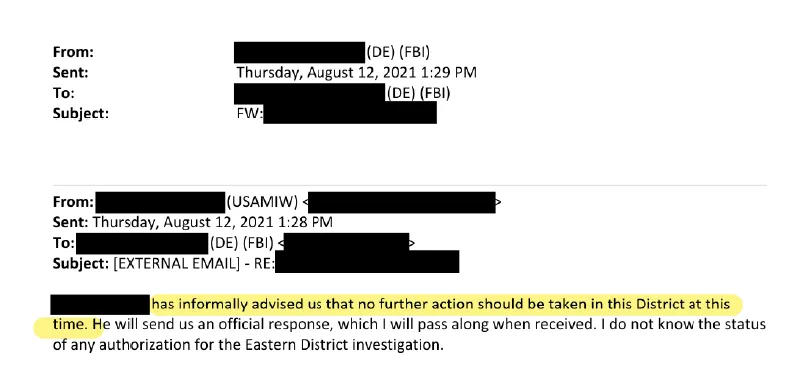
The DOJ PIN desire to close the investigation left a bad taste in the mouth of the FBI agents who were doing the work on the ground. Internal FBI emails from November 2021 discuss objections to closing the investigation (“I’m not really comfortable closing the case at this point”), noting that canvassers “submitted fraudulent voter registration applications.”
FBI emails also discussed the DOJ PIN’s shifting of responsibility for the closing of the investigation: “I’m also not thrilled with the wording from [redacted] stating that the PIN concurs with our decision not to pursue it as opposed to the PIN directing us not to pursue it.”

Eventually, according to this FBI timeline, the investigation resumed over one year later, though emails demonstrate that DOJ PIN did not approve investigations of some applications where the signatures could have been false (it only approved investigations of non-persons or visibly fraudulent signatures). The timeline also shows that while FBI agents were zealously pursuing the cases, DOJ prosecutors in Michigan really didn’t want to prosecute.
According to a brief FBI memo from September 2025, this investigation was closed because it “did not identify a criminal violation.” Yet FBI records clearly demonstrated that the agency possessed information that fraudulent voter registration forms were submitted – those with false addresses, false names, and false dates of birth. All in violation of federal law.
Records also showed that voters who did not register to vote were approached by canvassers in Biden shirts asking to collect their absentee ballots – only increasing the likelihood that false votes were submitted in the 2020 election.

How pervasive were the false signatures – or the applications for non-existent individuals? Nobody knows. The FBI investigation was hamstrung by DOJ leadership, leaving it unable to do a full accounting of the 8,000 to 10,000 applications submitted to the Muskegon City Clerk.
But it goes deeper than that. For the most part, the FBI’s investigation did not encompass other more populated jurisdictions within Michigan – namely Detroit. It seems that those at the DOJ Public Integrity Section didn’t want a true accounting of fraudulent voter applications and the absentee ballots that were issued (and submitted with votes) resulting from that fraud.
That’s the real question: now that we know of pervasive false voter applications, how many false ballots were submitted? And what effect did that have on the 2020 presidential election in Michigan?
And while nobody has the exact figure, maybe we can extrapolate. In one instance, the FBI searched through 107 voter registration applications that were in a box. Only four signatures matched the voters’ previous signature. Twelve of the signatures were forged and 91 of the individuals were non-existent – meaning out of 107 applications, only 4 were legit. Multiply that by the thousands submitted and you’ll begin to understand the picture of Michigan in 2020.

You might be curious – as well you should – about the financing of the canvassing operation. Who provided the millions of dollars for canvassing in Michigan and elsewhere? Was it the Democratic Party or groups associated with the Democrat? Was it an arm of the Biden campaign or a Super PAC? We don’t have answers from the FBI’s records. We can’t even be confident the FBI found out.
Onto China…
China’s hostility to President Trump’s platform is well-known. According to a CIA summary memo, since 2018, Chinese cyber actors “have targeted the personal e-mail accounts of senior US leadership, including officials in the Executive Office of the President and high-ranking officials in multiple Executive Branch organizations, Congress, and the federal judiciary.”

Targeting personal e-mail accounts isn’t just about intelligence. It’s about using the contents of those e-mails as a tool of persuasion.
In a Presidential Daily Briefing from June 2020, it was noted that a White House official was warned “that Beijing had derogatory information on him in an effort to compel him to take a restrained approach to China.” The blackmail threat was deemed as “credible.”

Overall, the CIA possessed very credible intelligence that China sought to reduce President Trump’s influence and ultimately his re-election chances through economic means. According to the CIA:
-
China’s “police was to leverage all domestic and foreign elements that were opposed to the U.S. President in an effort to reduce the U.S. President’s votes and make him resign or prevent his re-election.”
-
As the 2020 presidential election approached, China identified sectors within Republican states that voted for Trump and attempted “to make these sectors experience negative financial consequences by levying tariffs on exports to China from those sectors.”

But while the intelligence community was in agreement of China’s resentment towards Trump, they also took steps to hide certain Chinese intelligence from President Trump. In one email, an NSA intelligence analyst discusses how he “deliberately massaged” the pending Presidential Daily Briefing (PDB) “to avoid any direct links to the election.”

And while the CIA and the intelligence community as a whole knew that China was taking steps to influence how Americans would vote (see a few paragraphs above), the intelligence community manipulated its conclusions to claim that China was “NOT engaged in election influence” in 2020. Yet using that same information, the intelligence community would conclude in 2021 that China was “engaged in election influence.”

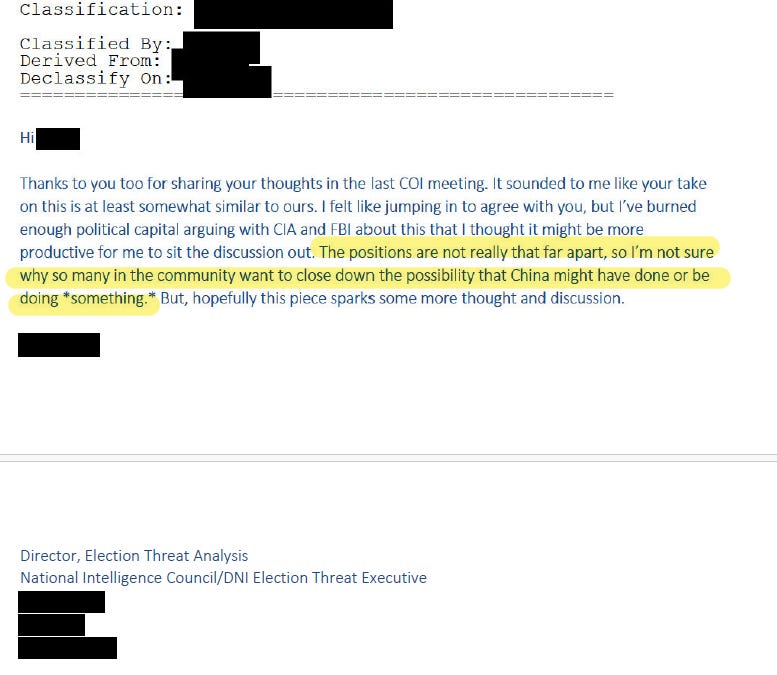
Leadership within the Intelligence Community would voice their concerns about the conclusions regarding China: “I’m not sure why so many in the community want to close down the possibility that China might have done or be doing *something.*”

We’ll probably never know the truth about China’s role in influencing elections – and whether that influence has ever been the nudge to tip the results. The means of influence might never be discovered.
One of the FBI’s Chinese sources with “indirect access” – meaning “information from an identified sub-source, who claimed they obtained the information from unidentified PRC government officials” – alleged “the Chinese government had produced a large amount of fraudulent United States drivers licenses that were secretly exported to the United States” to allow additional votes for Candidate Biden.
It was further alleged that China got this information from user data of TikTok accounts – to which the FBI commented that “a person’s address information was not a valid field when creating a TikTok account.” (The FBI is correct on that assessment.)
Those are pretty wild allegations. Not that they can’t be true. Just that intelligence that comes through sub-sources isn’t always accurate. (See Christopher Steele and his lying sub-source, Igor Danchencko.)

The response to the source’s allegations was curious. One FBI email expresses concern that the source “contradicts Director Wray’s testimony to Congress” and thus should prevent dissemination without additional corroboration or review.

In response, an FBI employee said he found this “troubling because it implied to me that one of the reasons we aren’t putting this out is for a political reason.” As he should.

Adding to the concerns are China’s possession of state voter rolls. A July 13, 2026 summary provided by the White House Task Force on Government Transparency concluded that declassified intelligence reveals that China compromised voter registration rolls “from at least 18 states” – including swing states like Georgia and Michigan. Additional records revealed that “more than 200 million voter records were also compromised by the PRC.”

This data potentially includes names, DOBs, addresses, political affiliation, and “detailed voter ballot and polling records.”

Since you’re down this far, I’ll briefly summarize the other findings from the White House relating to election security and non-citizens on voter rolls:
-
Approximately 278,000 non-citizens have been identified on state voter rolls. Democrat states refuse to share their date – the number is likely significantly higher.
-
Declassified assessments conclude that “U.S. adversaries, including at a minimum Russia, China, Iran, and North Korea, as well as non-state groups, have the capability to compromise U.S. election infrastructure.”
-
Intelligence indicated that Venezuelan Presidents Hugo Chavez and Nicolas Maduro had “sustained interest in manipulating electoral outcomes through electronic voting systems.”
Credit to the White House and the respective agencies for getting these documents out for public review.