
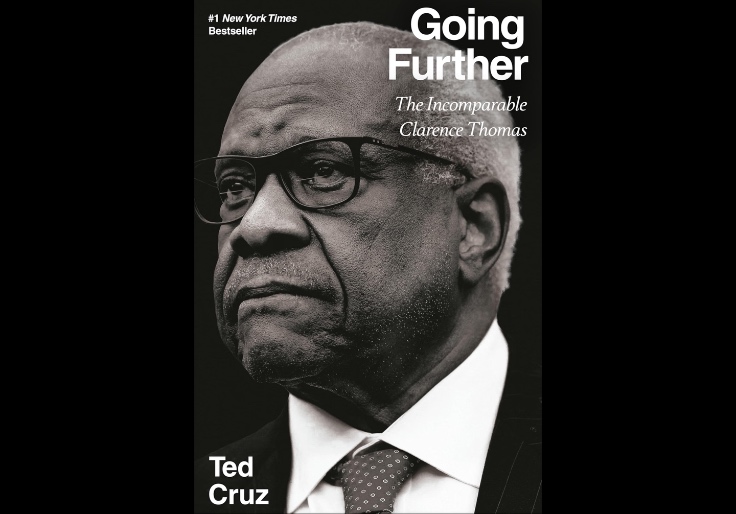
A Courageous and Consequential Justice
If you’re a fan of Supreme Court justice Clarence Thomas, this reviewer has a reading assignment for you. Go to the Court’s website, click on “Opinions,” and scroll down to the PDFs of U.S. Reports from 30 years ago. There, on page 400 of volume 516, you’ll find Thomas’s opinion for a unanimous Court in a 1996 case titled Norfolk & Western Railway Co. v. Hiles.
I’ve been writing about Thomas since even before that time, and I’ve read a majority of his opinions ever since he joined the Court in 1991, but I’d never looked at Hiles, no doubt because it’s about a railcar couplers incident involving a deservedly obscure 1893 statute named the Safety Appliance Act. Thomas’s historically rich decision cites such scholarship as “Development of the Semiautomatic Freight-Car Coupler, 1863-1893,” and how that congressional enactment quickly led to a dramatic decrease in workers’ injuries.
All of this merits notice because in Senator Ted Cruz’s informative new book on the justice, based on over nine hours of on-the-record interviews across the course of 2025, Thomas told Cruz that Hiles was his favorite among all the opinions he’s ever written! That surprising statement illuminates what an exceptionally scholarly and historically focused justice Thomas is, but this of course is not the big news in Going Further.
Instead, it’s a strikingly revealing comment Thomas made to Cruz in late 2025. Cruz is best known as a senator and likely 2028 presidential candidate, but 30 years ago he was a law clerk for then-chief justice William H. Rehnquist and later argued nine cases before the Court prior to joining the Senate. “Things have been crazy here,” Thomas remarked. “It’s not like when you were here. It’s a whole different world up here. You change the Court, the composition, it really changes the Court. … And the newest addition, it was quite a change.”
Thomas didn’t need to name the “newest addition,” Justice Ketanji Brown Jackson, but six months earlier, in Trump v. CASA, a majority opinion authored by the courteous Amy Coney Barrett and joined by five of her colleagues had stated with regard to a dissenting opinion that “we will not dwell on Justice Jackson’s argument, which is at odds with more than two centuries’ worth of precedent, not to mention the Constitution itself.”
Such an utterly unusual dismissal of a colleague was, as Cruz rightly observes, simply “devastating,” but now, more than four years since Justice Jackson first joined the Court, it is well-known among nonpartisan observers that the “newest addition” is marginalizing herself to such a degree that she’s the least successful and influential jurist to join the high bench since President Richard Nixon selected Warren E. Burger as chief justice more than 50 years ago.
Cruz hopes his book “will be the definitive account” of Thomas’s life, but that’s clear overreach. Instead, Going Further perhaps might best be read in tandem with Judge Amul Thapar’s compelling 2023 account of Thomas’s jurisprudence, The People’s Justice. Much of what Cruz relates about Thomas is already well-known to attentive students of his life, such as how there’s no other justice who’s “more beloved by the janitors, police officers, and staff of the Court.” Thomas talks “to all of them” and is “known for hundreds of acts of kindness.” Back during Cruz’s clerkship, a fellow clerk who was tutoring a black youngster asked all nine justices if they would meet him. Only Thomas and the late Ruth Bader Ginsburg agreed, with Thomas devoting two hours and gifting him a pro football item.
But other themes are both more original and, no doubt for many readers, more surprising. Not only did Thomas hire “openly gay employees” as a presidential appointee before joining the Court, but he also “became close with several law clerks who were gay.” Indeed, Cruz reveals, “some of his dearest friends over the years have been gay people in committed relationships, some of whom have children.”
Thomas’s focus on “originalism and historical accuracy” includes an impressive ability to accurately recite the entire text of the 14th Amendment from memory! Cruz correctly states that “no justice in our nation’s history has been more willing to overturn past decisions of the Court that were wrongly decided” and also rightly observes that “it is Justice Thomas’s contributions to racial equality in the United States that will stand as the centerpiece of his legacy for decades to come.”
Thomas’s friendly and upbeat temperament is a testament to a remarkable personal strength that reaches back to his challenging childhood, as the justice himself recounted in his powerful 2007 memoir, My Grandfather’s Son. And as Cruz writes, Thomas “has endured more adversity in his professional life than any other justice,” while “always managing to come out on the other side with his quiet resolve intact.”
Cruz notes “the vitriol directed at Justice Thomas is different in kind than that directed at any other member of the Court or even any other person in public life,” and we all know precisely why: solely because he’s black and has never shied from challenging liberal shibboleths that paternalistically patronize black people’s individuality and personal agency.
Soon after the initial leak of the Supreme Court’s 2022 Dobbs decision overturning Roe v. Wade, Washington abortion activists handed out leaflets advertising Justice Thomas’s suburban Virginia home address. Then a well-armed young man was arrested outside Justice Kavanaugh’s home in the middle of the night. “That man, the one who came to kill Brett,” Thomas told Cruz, “he was coming for all of us next. Me, Amy, and Sam” Alito, the author of Dobbs‘s majority opinion.
This writer’s not yet willing to make any in-kind contribution to Senator Cruz’s anticipated presidential campaign, but he should not hire whoever was supposed to fact-check this manuscript. Thomas’s undergraduate alma mater, Holy Cross, is in Worcester, not “his college hometown of Boston”; law professor and former clerk Amy Wildermuth is not “Amy Wilden”; and an accurately cited Pew Research Center report was authored by Jenn Hatfield, not her colleague Juliana Menasce Horowitz. AI’s not your friend, senator. Far more substantively, Going Further‘s nutshell summary of Griswold v. Connecticut (1965), which paved the way for Roe, is sloppy and inaccurate, especially in its assertion that the state statute criminalizing contraceptives “had never been enforced.” (Three decades ago this writer authored the “definitive” account of it.)
But those are passing flubs in a readable and instructive portrait. Justice Thomas is now 78 and has sat on the Court for more than 35 years; 18 months from now, come May 2028, just prior to his 80th birthday, he will have served longer than any justice ever. That will represent a grand triumph for a courageous jurist whom Going Further calls “one of the most consequential figures in the history of the United States.”
Going Further: The Incomparable Clarence Thomas
by Ted Cruz
Sentinel, 312 pp., $35
David J. Garrow’s books include the Pulitzer Prize-winning Martin Luther King Jr. biography Bearing the Cross and Rising Star: The Making of Barack Obama.