
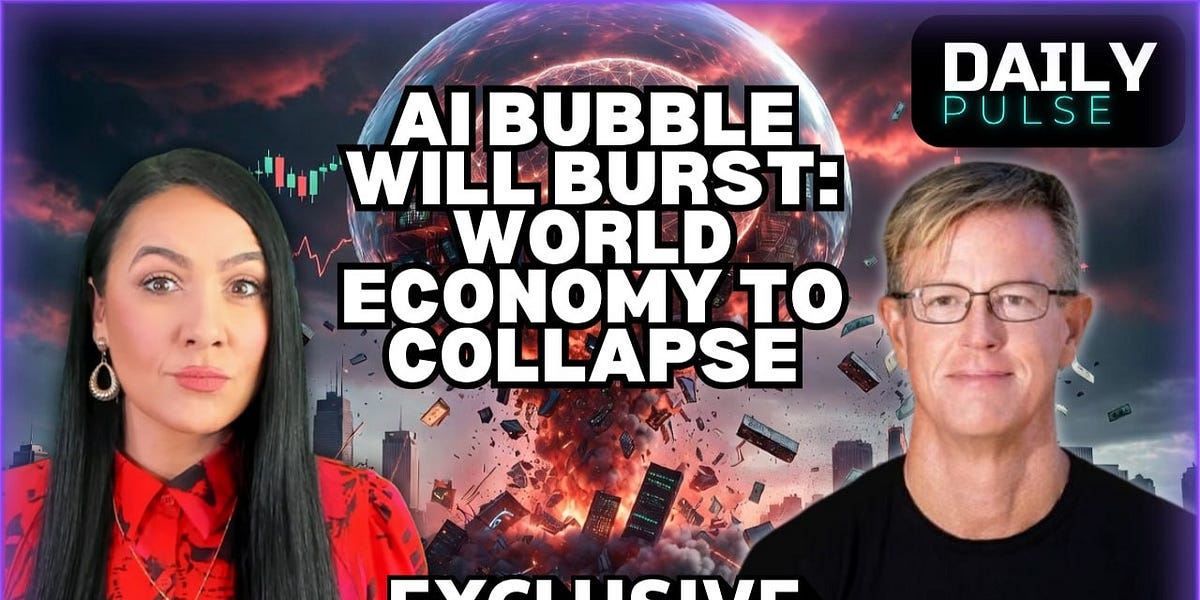
Fake Economy: The AI Bubble Holding Your Retirement Hostage | Daily Pulse
Pull up your 401(k).
If it’s in an S&P 500 fund, almost half of it is now riding on one bet: that AI pays off before the bill comes due.
Ed Dowd says it won’t.
The economist and former Wall Street fund manager lays out the math. 45% of the index is AI or AI-adjacent. The whole thing is built on borrowed money. And the people who manage your retirement already wired your savings in, without asking you.
From the outside it looks fine. Market’s up. Headlines say the economy’s healthy.
Meanwhile, the people who read credit markets for a living are quietly moving to cash.
So what happens to your account when the bet everyone’s leaning on turns out to be the bubble?
The jobs numbers everyone is celebrating are fake, and the government’s own data proves it.
Maria called it “a completely fake economy,” and Dowd didn’t really push back. “Fake is an interesting word,” he said, before laying out the evidence.
There’s a report most people never hear about, the Quarterly Census of Earnings and Wages, that quietly corrects the jobs picture about nine months after the headline number everyone reacts to. When the honest 2024 figures landed, they missed the estimate by eight standard deviations, a gap so far outside normal it shouldn’t be possible. A huge share of the jobs the country was cheering were never actually there.
“The numbers prove themselves out over time.”
Your cousin got laid off and the company blamed AI. Dowd says that’s just cover. Those firms were bloated and bleeding cash into their own AI spending, and they needed a reason to cut. AI is the alibi, not the killer.
And the tech itself? He’s not impressed. It was handed out cheap to get everyone hooked, the price climbed, and corporate America looked at the invoice and balked. An MIT study he cited found most corporate AI pilots delivered no return at all.
“AI is a great technology, but it’s been overhyped,” he said. “It’s a commodity.”
That’s exactly right. A commodity can’t carry trillion-dollar valuations. So who’s left holding the bag when the hype finally meets the spreadsheet?
#ad: Want to upgrade your health?
Richardson Nutritional Center has offered trusted, top-quality natural supplements for decades—supporting healing and wellness with everything from vitamins to therapeutic seeds.
Shop now at RNCstore.com and use code PULSE for 10% off sitewide!
DISCLOSURE: This post contains affiliate links. If you make a purchase through them, we may earn a small commission at no extra cost to you. This helps keep our work independent. Thank you for your support.
The cash funding the AI boom isn’t coming from billionaires. It’s the money in your retirement account.
When BlackRock’s Larry Fink said pensions would have to help fund the AI revolution, Dowd’s reply was that Fink is late. “It’s already occurred.” Pension funds, insurers, private credit, all of it has already been poured in. Your 401(k), your IRA, the index fund your employer picked for you, all wired in before anyone asked. You’re a participant who never got a vote.
Worried about the SpaceX IPO swallowing your fund? You don’t have to be. Yes, NASDAQ bent its rules to fast-track it. But the S&P held the line, and SpaceX has floated only about 5% of its shares. Too small to take up much room. If it gets cut in half, your fund barely feels it.
“So SpaceX isn’t the problem,” he said. “It’s just a symptom.”
We’ve seen this before. Bubbles are “a feature of capitalism, not a bug.” The dot-com boom built the cheap broadband that later ran your iPhone, but the companies that built it went bankrupt first and sold for pennies. The dreamers lost. The suppliers won.
“Who made the most money in the Gold Rush in California?” Dowd asked. “It was the pick and shovel guys.”
Today the pick-and-shovel guys are the chip makers. Dowd says Micron, a plain memory company, went from $60 billion to $1.1 trillion in about a year on a supply crunch. Not on profit. On debt, on the hope AI starts paying before the lenders want their money.
And lenders always want their money. What happens when they stop believing?
#ad: Want protection from surveillance, hacking, and even electromagnetic threats?
Escape Zone’s elite Faraday bags block GPS, Bluetooth, RFID skimming, and EMF—perfect for phones, laptops, wallets, and more.
Their premium ballistic backpack even combines Faraday shielding with Kevlar armor, giving you the upper hand in an unpredictable world.
Want to shield your body, too? Try their EMF-blocking beanies and blankets—because protection shouldn’t stop with your phone.
Whether it’s for you, your family, or someone you love—don’t leave it to chance.
Shop now at escapezone.com/pulse and protect what matters most.
DISCLOSURE: This post contains affiliate links. If you make a purchase through them, we may earn a small commission at no extra cost to you. This helps keep our work independent. Thank you for your support.
A $2-to-$3 trillion slice of finance you’ve never heard of just froze, and Dowd says it’s “the new subprime,” the same kind of hidden risk that blew up in 2008.
It’s called private credit. Regulators told banks to stop making risky loans, so the risky lending moved into private funds where nobody can see it. You put money in thinking you can pull it out. You can’t. Withdrawals get “gated” the second too many people ask.
“Private credit, unfortunately, is frozen,” he said.
It cracked open in late 2025 when lenders like First Brands and Tricolor Auto collapsed, some with fraud attached. Investors finally read the books and stopped writing checks. Dowd isn’t a lone voice here. He pointed to PIMCO’s chief investment officer, who warned “the credit default cycle has begun and it’ll be worse than people think.”
This reaches your street. Less credit, more defaults, a squeeze on the real economy. Housing’s already locked up. “Home prices need to contract 30% before people can really afford them,” Dowd said. Your kid can’t buy a house at today’s prices.
Then the war stacked on top. The oil shock pushed gas prices up, and the fertilizer disruption hasn’t reached the shelf yet. Both he and Maria expect it in food prices well into 2027.
People already feel it. Maria sees it firsthand: “I’m talking to people who say that they can’t afford tomatoes.”
Two economies now. The one on the ticker, and the one at your checkout line. How long can they stay this far apart?
The COVID-19 reckoning everyone was promised got quietly buried, and Dowd’s done waiting for anyone in power to dig it back up.
“I’m deeply disappointed in everything COVID and COVID vaccine related from this administration,” he said. He calls Trump “Mr. Operation Warp Speed” and notes “he’s never admitted that the vax caused any harms.” He points to a cancer-search-index spike he traces back to spring 2021, and to Senator Ron Johnson’s finding that the FDA hid safety signals.
It reaches your kitchen all the same. The new mRNA flu shots are headed for the pharmacy counter you pass on every grocery run. Dowd is worried enough that he told his own son, “don’t take the flu shot,” “you can’t take any shots anymore.”
His answer to all of it isn’t panic. It’s to exit. “Taking our own health into our own hands, opting out of the system.” Stop waiting for the people in charge, he says, because the deep state is “embedded like ticks.” He goes further, pointing to Catherine Austin Fitts and her warning that the AI buildout is really “the control grid, the slave system,” and to his own fear that if the bubble pops and the government buys the wreckage cheap, that theory stops sounding crazy.
He’s launching a Substack to keep swinging, fittingly named Beyond the Narrative.
The smart money is already moving to safety. What are you waiting for?
#ad: Health insurance in America is broken.
Over 200,000 Americans go bankrupt because of medical bills every year—and many of them already had insurance. On average, 20% of claims are denied, leaving families stuck paying massive out-of-pocket costs after spending thousands on premiums.
But there’s an alternative.
CrowdHealth is a community-powered model that has helped members fund over 40,000 medical bills at a fraction of the cost of traditional insurance.
So far, 30,000+ members have been helped, saving an estimated $73 million in medical costs.
CrowdHealth isn’t insurance. It’s a way to step outside the broken system and take control of your healthcare.
Get started today for $99 per member per month for the first three months.
Go to joincrowdhealth.com/promos/pulse and use code PULSE.

DISCLOSURE: This ad was paid for by CrowdHealth. Thank you for supporting our sponsors.
We want to thank Ed Dowd for joining us today—and more importantly, we want to thank you for watching and doing your duty to be informed when so many others choose not to.
Follow us (@ZeeeMedia and @VigilantFox) for stories that matter—stories the media doesn’t want you to see.
We’ll be back with another show tomorrow. See you then.