
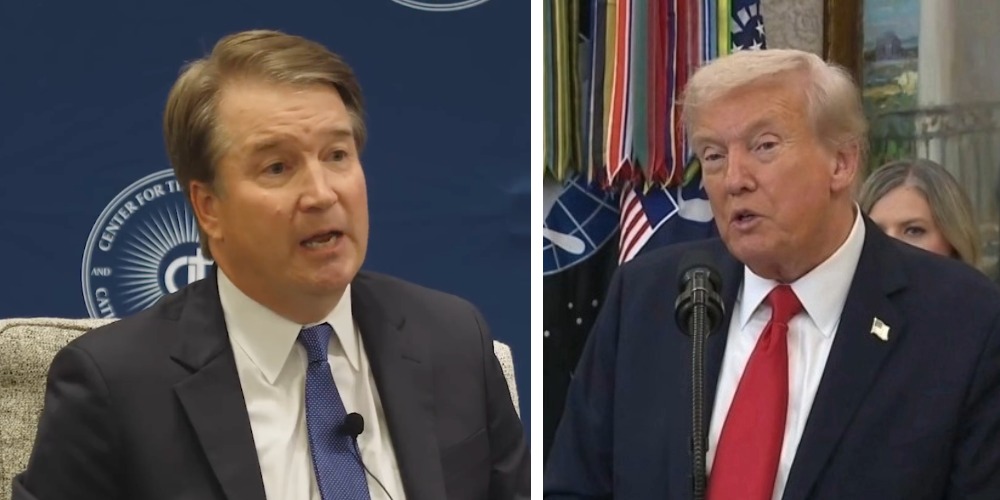
Kavanaugh leaves backdoor for Congress to pass law saying babies born to foreigners temporarily in US are NOT citizens
Congress could amend their statute “or otherwise enact new legislation to encompass those two new exceptions.”
Justice Brett Kavanaugh concurred in part with the Supreme Court ruling opposing President Trump’s ending of birthright citizenship and in part dissented, leaving an open door to Congress to make the necessary adjustments to refuse citizenship to children of illegal immigrants who have no permanent status in the United States. He said that the Executive Order from Trump “establishes new exceptions to birthright citizenship for children born to foreign citizens unlawfully or temporarily in the country.”
Those exceptions created by Trump were “for children born to foreign citizens who are either illegally or temporarily in the United States.” Kavanaugh does not believe that it violates the 14th Amendment, but that it violates a rule made by Congress based on a Supreme Court ruling in Wong Kim Ark. As such, Kavanaugh writes, Congress could amend their statute “or otherwise enact new legislation to encompass those two new exceptions.”
In other words, Congress could put an end to birth tourism and to those children of parents who have no permanent status in the US from becoming citizens. “As of now, Congress has not done so. Over the last 30 years, Congress has considered numerous proposed bills to alter birthright citizenship, but Congress has never actually passed such legislation.”
The Supreme Court, in a 6-3 ruling, struck down Trump’s executive order that stated the 14th Amendment was enacted to ensure that those who were children of enslaved persons, and enslaved persons were citizens of the United States. They were permanently “domiciled” in the US, had no foreign allegiance, and should be citizens of the nation they call home. Therefore, Trump said, those children born to foreigners who have allegiance to foreign nations should not be citizens.
In his dissent, Kavanaugh writes that while the Court’s previous interpretation of the 14th Amendment in Wong Kim Ark was one that believed there were only four exemptions to the birthright citizenship rule, he believes there can be more. He writes: “Considering the four exceptions as a permanently frozen or closed set as of the Fourteenth Amendment’s ratification in 1868—such that there can be no subsequent exceptions recognized based on new developments after 1868—is inconsistent with the Court’s longstanding approach to constitutional interpretation in a variety of areas.”
Trump reacted to the ruling, agreeing with Kavanaugh that the 14th Amendment allows for the exception to birthright citizenship and saying that Congress must act to make a legislative change.
Supreme Court strikes down Trump’s EO banning birthright citizenship by The Post Millennial