
What the Declaration of Independence does – and doesn’t – say about God
On the Fourth of July 1776, the congressional delegates in Philadelphia adopted the Declaration of Independence, then ordered that it be widely “proclaimed.” Couriers carried the printed version by stagecoach and horseback to every colony, where officials posted it and newspapers circulated it.
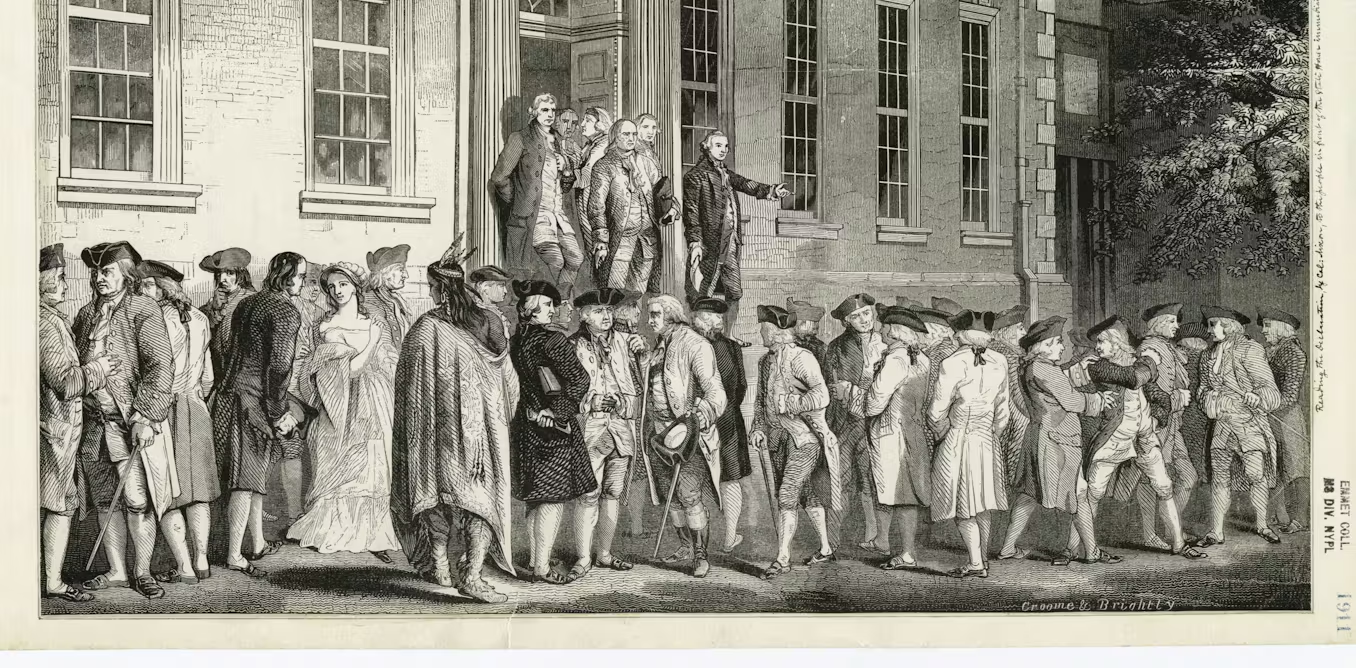
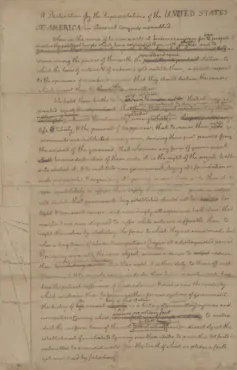
But the declaration was also meant to be read aloud. Thomas Jefferson’s rough draft has marks signaling where the reader should pause briefly, or take a longer pause. And there were ceremonial public readings: first in Philadelphia and then in town squares, courthouses, churches and taverns up and down the Eastern Seaboard.
Not everyone listening would have agreed with the declaration, and religion was one dividing point. Loyalists who sided with England and the official Church of England dissented on both spiritual and political grounds. Two-thirds of its ministers left for England after the Revolution began. Members of the historic pacifist churches like the Quakers, the Mennonites and the Brethren had tough choices to make after hearing the declaration’s call to arms. Even some who clearly sided with the patriots might have wondered if all the truths the document proclaimed were as “self-evident” as the delegates presumed – for example, that all men are “endowed by their Creator with certain unalienable Rights.”
Americans have continued to debate the declaration’s claims. In recent decades, its few references to God have been especially polarizing, as Americans defend starkly contrasting views of the United States. Some say the country is a secular republic founded on 18th-century conceptions of human reason and natural law. Others suggest that it is a Christian nation, chosen by God and founded on biblical principles.
In July 2026, Americans will celebrate the 250th anniversary of the Declaration of Independence. As a historian who has written about the Revolutionary Era, I thought it might help to clarify what the declaration does and doesn’t say about God – and what the readings of 1776 add to our understanding.
Four references to God
The Second Continental Congress appointed a committee of five delegates to write the declaration. Jefferson, the main author, penned the first draft in his rented room in central Philadelphia. John Adams and Benjamin Franklin offered suggestions before they sent the document to Congress for further revision and approval.
U.S. National Archives via Wikimedia Commons
The document that delegates adopted listed 27 complaints against King George III and explained the reasons for revolt. It used four terms for God as it made its case.
In its opening paragraph, Jefferson proposed that “the Laws of Nature and of Nature’s God” grant humans equal status and entitle Americans to dissolve “the political bands” with Britain. As historians have shown, Franklin added a phrase to suggest that those rights had been “endowed by their Creator.”
Congress then added two phrases to the final paragraph that portray God as a moral judge and a guiding hand. The delegates mention “the Supreme Judge of the world,” who punishes evil and rewards good – a description that almost all political and religious leaders would have agreed with.
They end by announcing that “with a firm reliance on the protection of divine Providence, we mutually pledge to each other our Lives, our Fortunes and our sacred Honor.”
Leaving room for disagreement
The reference to “Providence” doesn’t specify how divine influence works, however, leaving room for the founders’ diverging religious interpretations. The more conventionally Christian delegates, like John Witherspoon, believed that God intervenes directly in human history.
U.S. Library of Congress via Wikimedia Commons
Others were less conventionally Christian. Rationalists like Jefferson, for example, believed in a creator but rejected biblical miracles and Jesus’ divinity. They thought that God’s influence can be seen indirectly, in nature’s order and humans’ capacity to discern God-given rights.
Generic theism
As I show in my 2025 book, “Religion in the Lands That Became America,” the declaration became one of the “sacred texts” of U.S. civil religion: the loosely linked beliefs, symbols and rituals that many American leaders use to interpret political life in spiritual terms. But the revered text affirmed a generic theism – belief in a creator god – without mentioning Jesus or Christianity.
Nor did the declaration cite the Bible as a source for government policy or say that America is a Christian nation. Its central purpose was to explain the reasons for separation from Britain, not to detail the new republic’s governing principles.
Governing principles came in 1789 with the U.S. Constitution, which did not mention God. In 1791, states then ratified the First Amendment, with its “establishment” clause rejecting an official state church and its “free exercise” clause protecting personal religious liberty.
What the public readings reveal
Eyewitness accounts offer a few more details about religious language heard at ceremonial public readings of the declaration in 1776.
Some sources show that the declaration was read in churches and discussed by the clergy. Massachusetts, for example, ordered that ministers read it in every congregation. And a soldier’s letter to his father noted that his brigade’s chaplain offered “an excellent prayer” after the declaration was read in New York on July 9, though he gave no other details.
U.S. Library of Congress via Wikimedia Commons
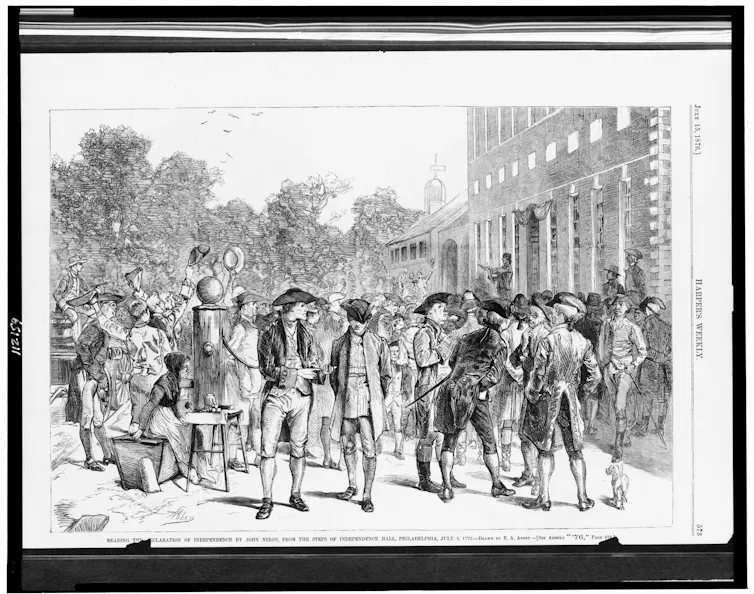
After the second public reading in Philadelphia on July 8 at the State House, now called Independence Hall, eyewitnesses said the crowd gave “three cheers.” And, as the editor of Philadelphia’s German newspaper reported, those cheers were followed by “the cry ‘God bless the Free States of North America.’”
The pattern apparently repeated at other public readings. Abigail Adams wrote to her husband, John, one of the drafters of the declaration, to report that the official reading at Boston’s State House ended with the speaker proclaiming, “God Save our American States.” After a reading for soldiers in Ticonderoga, New York, on July 28, an officer added, “God save the Free, Independent States of America.”
A prominent newspaper circulated a firsthand account from Savannah, Georgia, describing four public readings and a mock “funeral” for the king on Aug. 10. The presiding official ended by suggesting that “America is free and independent, that she is, and will be, with the blessing of the Almighty, great among the nations of the earth.”
In short, attendees at the public readings did hear mentions of God – but apparently didn’t hear the potentially divisive theological language of sermons or creeds.
1776 and 2026
During the 2026 anniversary celebrations, too, the declaration will be read aloud – including in a simultaneous reading on July 8 in Philadelphia and in every U.S. state, commonwealth and territory.
Today, Americans might be even more sharply divided about religion than the colonists of 1776. According to the General Social Survey, 14% of Americans say they don’t believe in God or aren’t sure if there is a God, and 25% have “no religion.” About 11% now embrace a non-Christian faith. When asked if the federal government should proclaim that the U.S. is a Christian nation, Americans are almost evenly divided, a Pew study found, with most evangelicals agreeing and most atheists disagreeing.
Knowing what the declaration actually says, and how its first listeners reacted, might not sway Americans at the extremes. But it provides evidence for less polarizing, more nuanced views about the founding generation’s convictions and compromises as Americans commemorate their nation’s 250th anniversary.