
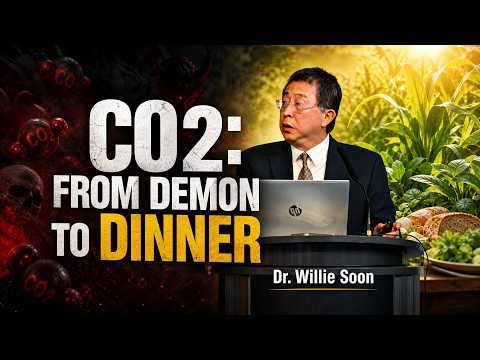
Watch: Fmr. Harvard Astrophysicist Dr. Willie Soon: ‘Plants Don’t Call CO2 a Pollutant — They Call It Dinner’
Plants do not call CO2 a pollutant. They call it dinner.
In this presentation from EIKE-17 in Halle an der Saale (26–27 June 2026), CERES co-founder Dr. Willie Soon makes a controversial but thought-provoking case for both CO2 and fossil fuels – “from demon to dinner.”
Many scientists and policymakers treat rising CO2 as a harmful air pollutant driven almost entirely by human industrial activity. Dr. Soon takes a polemical approach, systematically examining the main arguments and suggesting that the evidence may point in the opposite direction. You may not agree with every point, but the case he presents is worth hearing and considering on its scientific merits.
Dr. Soon starts with the U.S. Supreme Court’s classification of CO2 as an “air pollutant,” then walks through the evidence the official narrative usually skips:
• Cheap, dense fossil energy lifted more than a billion people out of extreme poverty – and “richer is cleaner”
• Every real energy transition in history went toward higher energy density, not back to diffuse, weather-dependent power
• U.S., German, Chinese and global human CO2 emissions have fallen or flattened — yet atmospheric CO2 keeps rising
• The atmosphere turns over its carbon inventory about every four years; natural ocean/biosphere fluxes dwarf the human 1% perturbation
• The seasonal CO2 cycle and declining δ¹³C are consistent with a living biosphere, not a unique fossil-fuel “fingerprint”
• New CERES work (with Jonathan Cohler) estimates the land biosphere gained ~55 Gt of carbon from 1961–2023
• Stomata and forgotten ice-core intervals show CO2 was never a flat Holocene 280 ppm
• Charles David Keeling himself rejected the idea that greenhouse forcing explains all of the warming
• A transparent seasonal calculation for Germany implies well under 1°C for a CO2 doubling — not 3°C or “global boiling”
• Satellite greening, higher crop yields, bigger Amazon trees, greener polar oceans — plus documented medical uses of CO2
Dedicated to the memory of Dr. Michael Connolly.
This talk was given at the 17th International Climate and Energy Conference (IKEK-17 / EIKE-17) in Halle (Saale), Germany, organised by EIKE:
https://eike-klima-energie.eu/2026/04…
In this presentation from EIKE-17, Dr. Willie Soon challenges the characterization of carbon dioxide () as a harmful air pollutant. Instead, he presents a scientific case for as the “gas of life” and essential “dinner” for plants (0:02–2:56).
Key arguments presented include:
- Energy and Prosperity: Dr. Soon argues that fossil fuels have been instrumental in lifting over a billion people out of poverty, noting that wealth leads to cleaner environments (3:22–4:06). He characterizes current shifts toward intermittent renewables as a regression to lower energy density (4:37–5:55).
- Carbon Cycle Dynamics: The presentation asserts that human emissions are a minor perturbation compared to the massive natural fluxes of carbon between the atmosphere, oceans, and biosphere, which turn over the entire inventory every four years (12:49–14:23). He contends the seasonal cycle of is driven by the biosphere, not fossil fuel consumption (14:23–16:29).
- Biosphere Growth: Dr. Soon cites CERES research estimating the land biosphere has gained approximately 55 gigatons of carbon since 1961, promoting global greening (21:47–23:39, 33:01–34:26).
- Climate Sensitivity: Using a simplified seasonal temperature analysis for Germany, he calculates a climate sensitivity to a doubling of well below 1°C, questioning the higher estimates reported by the IPCC (30:13–31:55).
- Medical Applications: The talk highlights peer-reviewed research exploring the therapeutic use of for healing chronic wounds and shrinking tumors in experimental models (39:14–40:38).