
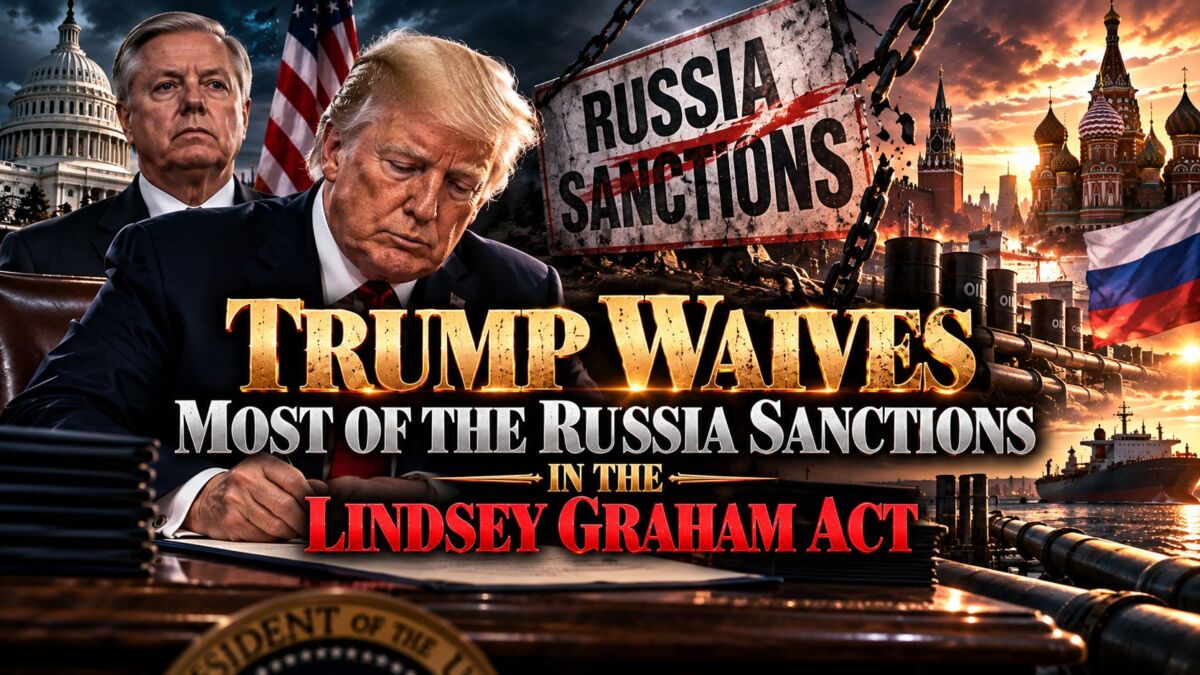
Trump Waives Most of the Russia Sanctions in the Lindsey Graham Act – The Washington Standard
Let’s review the Lindsey O. Graham Sanctioning Russia and Iran Act and Trump’s waiver.
Lindsey O. Graham Act Key Points
Tariffs
- On Russia (Section 112): Requires the President, within 30 days of enactment, to raise duties on all goods imported from the Russian Federation by up to 500% ad valorem (on top of any existing duties).
- Secondary tariffs on third countries (Section 113): Authorizes tariffs of up to 100% ad valorem on all goods from countries that (1) were among the top five importers (by volume) of Russian-origin crude oil or natural gas in the prior 12 months and knowingly make new purchases after a specified date, or (2) were among the top five facilitators of Russian oil sanctions evasion. A limited natural-gas exception applies for countries accounting for less than 15% of Russia’s total gas exports that are taking significant steps to reduce those imports. Rates can be adjusted for changes in behavior; determinations are reassessed periodically (generally every 180 days). These tariffs also stack on top of other duties.
Sanctions and Restrictions on Russia
- Blocking and visa sanctions on senior Russian government and military officials (including the president), oligarchs, and leaders/controlling shareholders in the defense, energy, and transportation sectors, as well as foreign persons supporting Russia’s defense industrial base, sanctions evasion, or activities undermining Ukraine.
- Sanctions on the Central Bank of Russia and major Russian banks (including Sberbank, VTB Bank, Gazprombank, and other government-affiliated institutions), plus secondary sanctions on foreign financial institutions conducting significant transactions with them.
- Measures targeting the Russian “shadow fleet” of vessels used for sanctions evasion (owners, operators, insurers, crew, servicing ports, etc.).
- Prohibitions on new U.S. investments in Russia, U.S. persons purchasing Russian sovereign debt, trading certain Russian government-linked securities on U.S. exchanges, and certain energy-product exports/reexports to Russia. Many of these codify or expand existing restrictions. paulweiss.com
Iran Provision
- Extends the Iran Sanctions Act of 1996 (targeting Iran’s energy sector and efforts related to weapons of mass destruction/advanced conventional weapons) through December 31, 2031.
Flexibility, Waivers, Termination, and Exceptions
- Broad presidential national-interest waiver authority for the sanctions, restrictions, and duties (requires a written certification and explanatory report to Congress).
- Authority to terminate Russia-related measures after certifying that Russia has signed a peace agreement accepted by the free and independent Government of Ukraine and has ceased military hostilities and efforts to overthrow, dismantle, or subvert that government (subject to congressional review and potential joint resolution of disapproval).
- Exceptions for humanitarian activities, intelligence/law-enforcement, certain nuclear cooperation and uranium imports, official government/UN business, pre-existing general licenses, good-faith wind-downs/divestitures (during a 270-day period), vessel/crew safety, and other specified cases. paulweiss.com
The Act’s Let Russia out of Jail Provision
| Mechanism | Basis | What it requires | Effect |
|---|---|---|---|
| Termination provision | Russia signs a peace agreement accepted by the free and independent Government of Ukraine and ceases military hostilities and efforts to overthrow/dismantle/subvert that government | Presidential certification + report; subject to congressional review and potential joint resolution of disapproval | Permanent termination of the Russia-related measures |
| National-interest waiver (Section 115) | Presidential determination that a waiver is in the national interests of the United States | Written certification to Congress that the waiver is in the national interest plus a report explaining the basis for the certification | Temporary or ongoing waiver of the application of the sanctions, restrictions, or duties (can be lifted later) |
Mish Position
Most cheered the Lindsey Graham Act.
Not me.
I was against the Lindsey Graham bill due to my often-stated position that sanctions don’t work. They have never in history resulted in a regime change for the better.
I was also fearful of the provision that Trump would find a way to do whatever he wanted with tariffs, and that Congress was foolish to give Trump more tariff toys to play with.
Eleven Senate members shared my concern.
Vote Overall Breakdown August 7, 2026
- Yea (for): 86
- Nay (against): 11
- Not voting: 3 (Marsha Blackburn (R-TN), Cynthia Lummis (R-WY), Mitch McConnell (R-KY))
Those Voting Against
- Republicans (1): Rand Paul (R-KY)
- Democrats/Independents (10): Lisa Blunt Rochester (D-DE), Maggie Hassan (D-NH), Mazie Hirono (D-HI), Ed Markey (D-MA), Jon Ossoff (D-GA), Alex Padilla (D-CA), Bernie Sanders (I-VT), Elizabeth Warren (D-MA), Peter Welch (D-VT), Ron Wyden (D-OR) govinfo.gov
Opposition centered mainly on the new tariff authorities granted to the President rather than opposition to Russia sanctions themselves.
An amendment by Rand Paul and Ron Wyden to strip the tariff provisions failed earlier that day 32–64.
Trump’s Executive Order Exempting Russia
Those, including me, fearful of tariff shenanigans have already been proven correct.
On October 16, Trump Issued an Executive Order on Implementing the Lindsey O. Graham Sanctioning Russia and Iran Act
The executive order waived the new tariffs and most of the new or codified sanctions provisions under the Act, certifying that the waivers were in the national interest.
Practical Result
The practical result of the Graham Act plus the waiver is that Trump has sided with Russia on the war.
That is my assessment.
I asked Grok and Grok disagreed. I then asked Grok to factor in Starshield throttling that started mid-October 2026.
Starshield Throttling
Reports indicate that around October 12–14, 2026, speed/connectivity limits were applied to moving terminals (roughly above 100–160 km/h).
Ukrainian officials said this hampered drone operations and air-defense intercepts against Russian Shahed drones and other strikes, and they linked it to political pressure over Ukrainian attacks on Russian energy infrastructure and related ceasefire or energy talks.
Connectivity was later reported as partially restored.
Also, Trump agrees to buy Russian diesel, giving Russia more ability to fight longer, potentially prolonging the war.
Grok Responded
The Starshield episode adds a contemporaneous restriction on a critical U.S.-controlled communications capability that Ukraine was using for defense. Combined with contemporaneous reporting of possible diesel arrangements with Russia and friction over energy strikes, the sequence is more consistent with the administration using leverage (or withholding tools) to shape Ukrainian behavior and pursue its preferred negotiation track than with maximizing immediate military/economic pressure on Russia.
Whether this amounts to “siding with Russia on the war” remains a judgment that depends on the weight one assigns to stated U.S. negotiation goals, energy-security considerations, and the continuation of prior sanctions versus the non-use of new tools and the temporary degradation of a key Ukrainian capability.
The Alleged Ceasefire
Russia Pounds Ukrainian Energy Despite Ceasefire
The Wall Street Journal reports Russia Pounds Ukrainian Energy Despite Trump’s Ceasefire Announcement
Ukrainian President Volodymyr Zelensky said Russian strikes had hit energy infrastructure across his country hours after President Trump declared an energy ceasefire between the warring sides.
The Russian attacks—including on gas infrastructure, a power plant and a substation—come as the U.S. heaps pressure on Ukraine to stop striking Russian oil refineries, and after Trump moved to allow Russia to export diesel to the U.S. in a bid to drive down American prices at the pump.
The Wall Street Journal Weighs In
Please consider Trump Waives Most Russia Sanctions Passed by Congress (Emphasis Mine)
President Trump is halting implementation of most of the sanctions that were to be imposed on Russia under a bipartisan bill he signed last month.
The announcement came in an executive order on Friday night, and was part of a broader pivot by Trump toward courting Moscow as he seeks to end the war in Ukraine and keep energy prices under control ahead of the midterm elections.
In the executive order, Trump stated that waiving implementation of most aspects of the law was “in the national interests of the United States.”
The decision follows Trump’s surprise announcement to buy Russian diesel fuel after striking a deal with Russian President Vladimir Putin and comes as he continues to pressure Ukraine and its president, Volodymyr Zelensky, to end the war that started when Russia invaded.
“A U.S. sanctions blackout, easing pressure on the aggressor, financial rewards for Putin—all of this only encourages him to keep attacking,” Zelensky wrote on social media Saturday morning.
Rep. Don Bacon (R., Neb.), who is retiring after this term said, “The President is prolonging the war, not ending it.”
The president has been facing bipartisan backlash in recent days over the diesel deal, his call for Zelensky to step down and his demand that Ukraine observe an energy ceasefire that Moscow promptly broke.
Siding With Russia? You Make the Call
Trump has threatened pressure on Russia countless times only to back down. Now Trump has undoubtedly removed pressure on Russia while putting one-sided pressure on Ukraine.
So, does this amount to siding with Russia or not?
Regardless, Trump’s pledge to end the war on day of his presidency is exposed as a hoax.
And the Lindsey Graham bill made a further mess of things as predicted in this corner. This is one of those things you prefer to be wrong about.
Backlash has begun, but it’s too late. The bill as written lets Trump do whatever the hell he wants.
Only one Republican Senator got this correct: Rand Paul.
Related Posts
October 12, 2026: Trump Humiliated by Putin Within Hours of His Ceasefire Announcement
Trump wanted a ceasefire so he announced one. Putin immediately ignored it.
October 12, 2026: We Export 48 Million Barrels of Diesel per Month, Why Import from Russia?
Importing Russian diesel is illegal. There is no real need anyway.
October 16, 2026: Trump Has a 91% Disapproval Rating from Voters Under 30 on Inflation
“The worst I have ever seen in any poll, on any issue for any president”
Article posted with permission from Mish Shedlock