
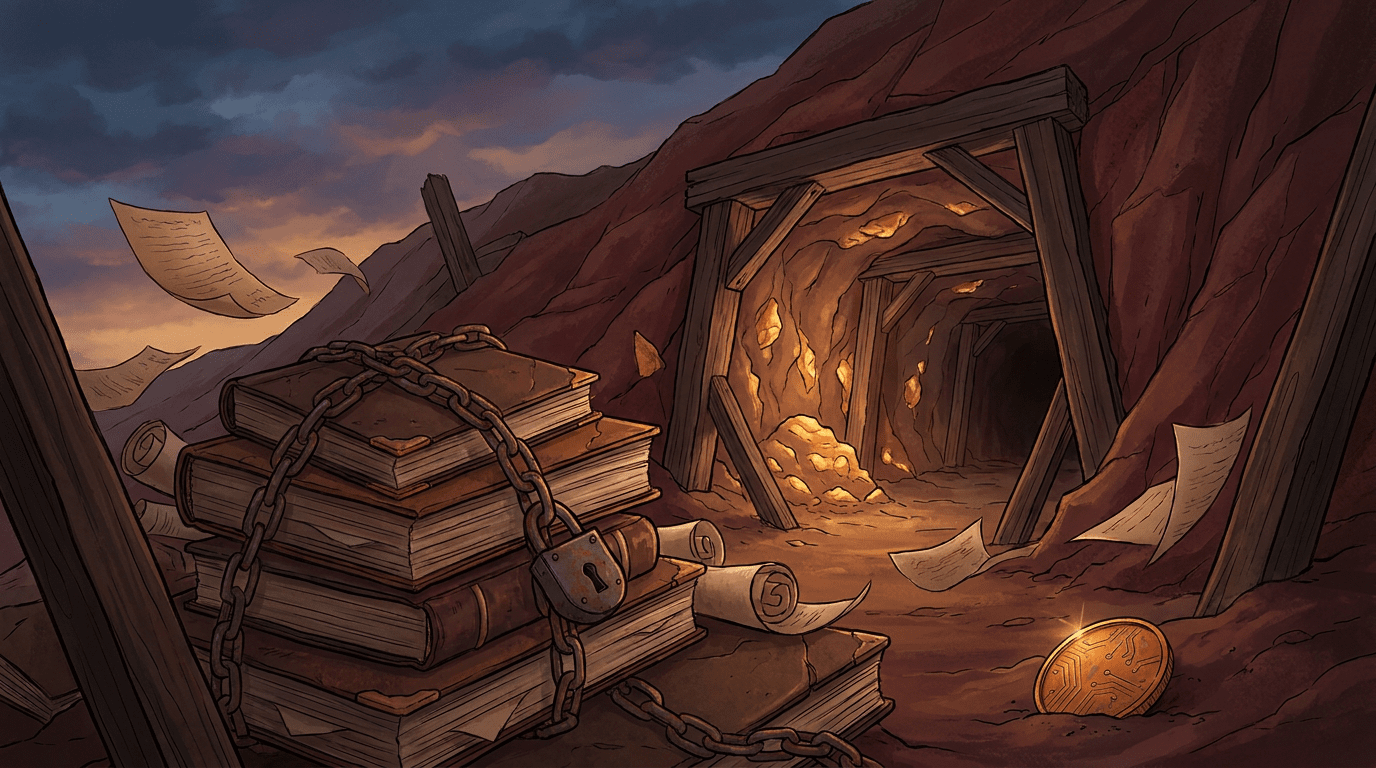
The Ashanti Lesson: Never Bet Borrowed Money Against Scarce Money
EDITORIAL, Exclusive Interviews
The Ashanti Lesson: Never Bet Borrowed Money Against Scarce Money
By
Matt Morgan – November 13, 2026
Matt Morgan – November 13, 2026
/script type=”text/javascript” src=”https://app.getresponse.com/view_webform_v2.js?u=S6bT5&webforms_id=A25R”>
Written by Matt Morgan at The Daily Bell:
Imagine owning one of the richest gold mines in the world and going broke because gold went up.
It sounds impossible, but it happened in 1999.
The Mine That Bet Against Itself
Ashanti Goldfields was Ghana’s pride. Gold was one of the country’s biggest exports, and Ashanti was one of Africa’s biggest producers. But on the advice of its bankers, the company had locked in future gold sales through a pile of complex contracts.
Swiss banker Ferdinand Lips told the story in his book Gold Wars. Ashanti had signed more than 2,500 derivative contracts with 17 banks. Now, as long as gold stayed cheap those contracts paid off.
Then, in September 1999, central banks agreed to limit their gold sales. Gold jumped from $269 to $307 in a single week. For a gold miner, that should have been a party. Lips explains why it wasn’t:
“There should have been much excitement about the sudden increase of the gold price, but there was nothing but despair when it became apparent that for some participants… a rising price meant ruin.”
At the end of June, Ashanti’s hedge book was worth $290 million. By early October, it showed a $570 million loss, with $270 million in margin calls coming due. The gold in the ground hadn’t changed, and the debt on paper nearly sank the company.
The Same Trap Can Happen in Bitcoin
Bitcoin is scarce money, too. And it punishes leverage the same way.
When news of the Binance hack hit last month, JP reported that $1.57 billion in leveraged crypto bets were wiped out, but Bitcoin itself only dipped. It was the borrowed money that did the real damage…
It cuts both ways. Companies that borrow to buy Bitcoin face the mirror image of Ashanti’s problem: they get hurt when the price falls.
Who Gets Forced to Sell?
Mark Jeftovic, publisher of The Daily Bell and The Sovereign Capitalist, has argued that not all Bitcoin treasury companies are created equal. What you need to look at is how much debt they carry and whether a bad month can force them to sell.
In June this year, he ran the numbers on Strategy, the biggest of the borrowers. His conclusion was that it has no single “liquidation price.” Bitcoin would have to fall to about $25,000 to put the common shares underwater, and to roughly $6,938 before the company couldn’t cover its debt.
Others weren’t so lucky. Mark notes:
“We saw miners sell their entire stacks on the last cycle (BITF, CBIT) and some of them never really recovered.”
Scarce money doesn’t kill youm but borrowed money does. Ashanti learned that with gold. Plenty of Bitcoin traders learned it last month.
Want the Full Picture?
Every month, Mark Jeftovic breaks down Bitcoin, gold and the wider macro picture in The Sovereign Capitalist, including the charts he’s watching and his model portfolio.
Take The Sovereign Capitalist for a $7 test drive on your first month with promo code SOVTRIAL.
Posted in EDITORIAL, Exclusive Interviews