
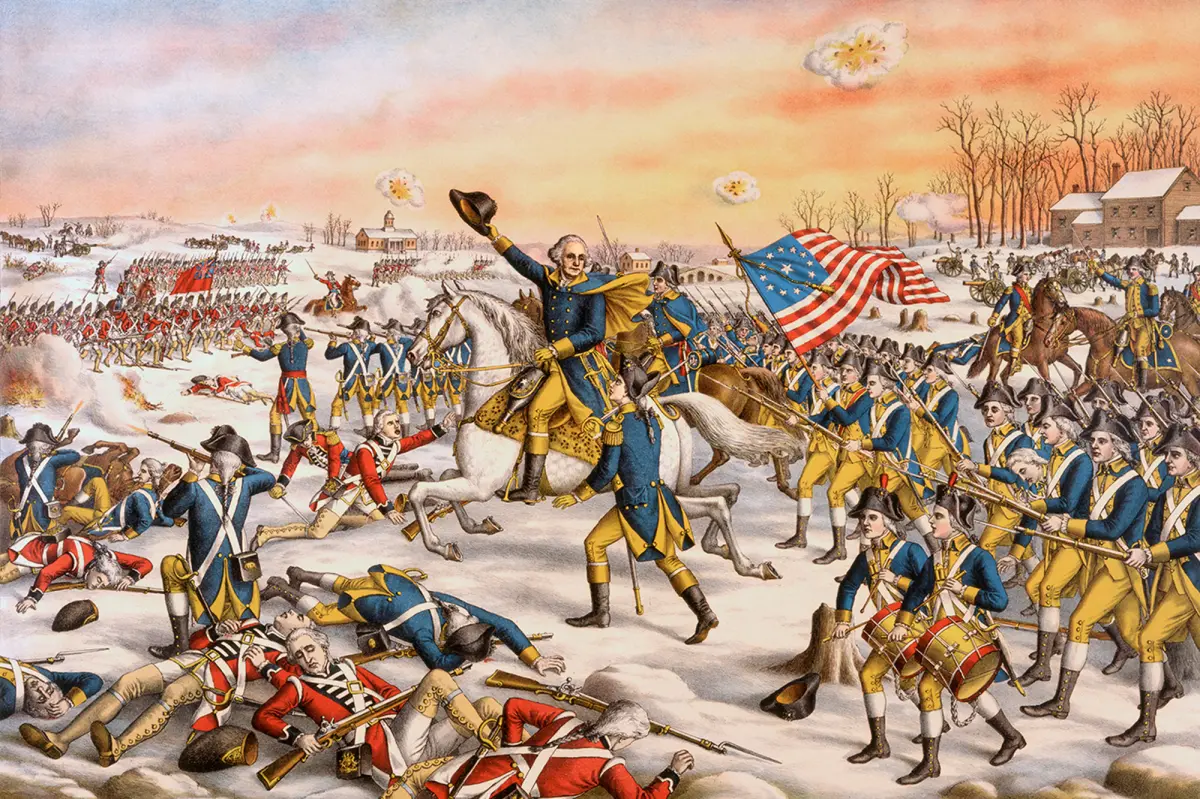
The American Revolution is the only one in world history that actually delivered on the promises it made
There’s never been another country like America. That’s not mere patriotic hyperbole for our 250th anniversary. It’s historical fact. But many of us have never really understood it. Or maybe we forgot what we heard in school on the subject a long time ago. Or did we ever hear it? Today most schools wouldn’t dare say anything along such lines, which is precisely why I wrote my book “REVOLUTION: The Birth of the Greatest Nation in the History of the World.”
But it’s something most Americans used to know —and it’s extremely important. We need to start with the American Revolution itself, which is the only revolution in world history that actually delivered on the promises it made, to create a country where the people were in charge, a country that — in Lincoln’s famous words — was “conceived in liberty and dedicated to the proposition that all men are created equal.”
Of course other revolutions claimed to be about the same thing, promising that when everything was all over “the people” would be in charge. But every one betrayed this, creating levels of misery and suffering that are almost unimaginable.
Take the French Revolution, which began just a few years after our own Revolution, and was championed by some of the figures involved in our Revolution — like Thomas Jefferson and Thomas Paine. They all seemed to think it would be a happy reprisal of what happened here. It was anything but that, ending in a nightmare bloodbath of terror.
What went wrong? Just like us, the French decided they didn’t like the idea of monarchy. So they beheaded their king and queen. But the radicals didn’t stop there.
They also decided to kill every priest and nun. Let’s just say it didn’t go well for anyone. Where the American revolutionaries were mostly people of faith — and saw their faith as the very reason they were doing what they were doing — the French revolutionaries saw faith and the church as the problem. The Americans declared that their liberties came from God, and that it was the role of government to protect those liberties. The French didn’t know where their liberties came from. So they traded King Louis XVI for a dictator named Napoleon—who crowned himself emperor.
Whatever happened to the noble French ideals of liberte, egalite, and fraternite?
Then there are the even worse nightmares of the Bolshevik and Maoist revolutions in Russia and China. The Soviets murdered the Tsar and his family, giving the Russian people the sadistic leadership of Lenin and Stalin and the hell of what Solzhenitsyn called “the Gulag Archipelago.” The Chinese communists got rid of the Emperor and — just like the Soviets — murdered millions of their own people.
Every one of these “revolutions” was a false revolution that actually replaced suffering with more suffering, and inequality with more inequality, creating dystopian worlds too awful to contemplate.
So how did these so-called revolutions get it so grotesquely wrong? And how did we in the American Revolution get it right, creating a nation where the people really did govern themselves, just as was hoped and promised, and are continuing to do so, 250 years later?
The answer couldn’t be simpler. The leaders of our Revolution understood that it wasn’t enough to get rid of a king or a tsar or emperor and hope for the best. You couldn’t just tear down what you didn’t like. You had to replace it with something else. But what?
The answer is so simple many people refuse to believe it. You can say it in three letters: “God.” I’ll bet you didn’t hear that in your public school social studies class. But it’s undeniable. Of course the men of the American Revolution knew they couldn’t force God on anyone, because they believed in liberty, especially religious liberty. So if faith was necessary, it would need to come from the people themselves, voluntarily. The whole thing was a gamble, or as many have said, “an experiment.”
But the reason they thought it might work in 1776 was because it had been working for the previous 150 years. Most of the Americans in the Revolution were descended from men and women who in the previous century had braved dangerous sea-crossings to live out their Christian faith as they saw fit. And during all this time they really had been self-governing. So faith in the God of the Bible was almost ubiquitous in Colonial America, and actually increased during the Great Awakening, under the preaching of the evangelist George Whitefield, who was the biggest celebrity of his time.
Three- quarters of everyone in the colonies heard him preach in person at least once. So the Americans were a decidedly faith-filled people.
When the British in the 1760s decided to crack down on the Colonies, and tax them and persecute them, they pushed back. Hard. They had the crazy idea that they were still free men and women who could govern themselves and tax themselves. After all, hadn’t they been doing so for over a century? And they knew that their liberties were God-given, not given to them by parliament or the king.
So when in 1776 they finally decided to declare independence from the monarch in Great Britain, they were simultaneously reaffirming their dependence on God. And they weren’t shy about saying so.
On August 1st, the day before the members of Congress officially signed the Declaration of Independence, they gathered to hear Samuel Adams give a speech on the steps of Independence Hall. In it he declared “We have this day restored the Sovereign, to whom all men ought to be obedient.” Adams — whom they called the “Father of the Revolution” — was saying it explicitly.
Here was a member of Congress telling every other member of Congress that God was the ruler of the brand new nation, and that if we looked to him for guidance, we could govern ourselves. We would do something that hadn’t been done in three thousand years. Just like the ancient Israelites in the Sinai wilderness, who escaped bondage under Pharaoh, we would look to God directly, and would rule ourselves without an earthly king. Everyone in Congress understood this.
When asked to create a seal for the new nation, Benjamin Franklin and Thomas Jefferson — often thought the least religious of the founders — both came up with images of this very event. Franklin’s image was of Moses watching God part the Red Sea while Pharaoh drowned and Jefferson’s was of the Israelites being led by a pillar of fire and a cloud. Could anything be more clear? So why haven’t most of us heard this before? Well, that’s another story.
Eric Metaxas is the author of “REVOLUTION: The Birth of the Greatest Nation in the History of the World.“