
Strong County Mayor’s Weak Performance And Miami-Dade’s Shrinking Budget Conversation – JP
Please Follow us on Gab, Minds, Telegram, Rumble, Truth Social, Gettr, Twitter, Youtube, Instagram
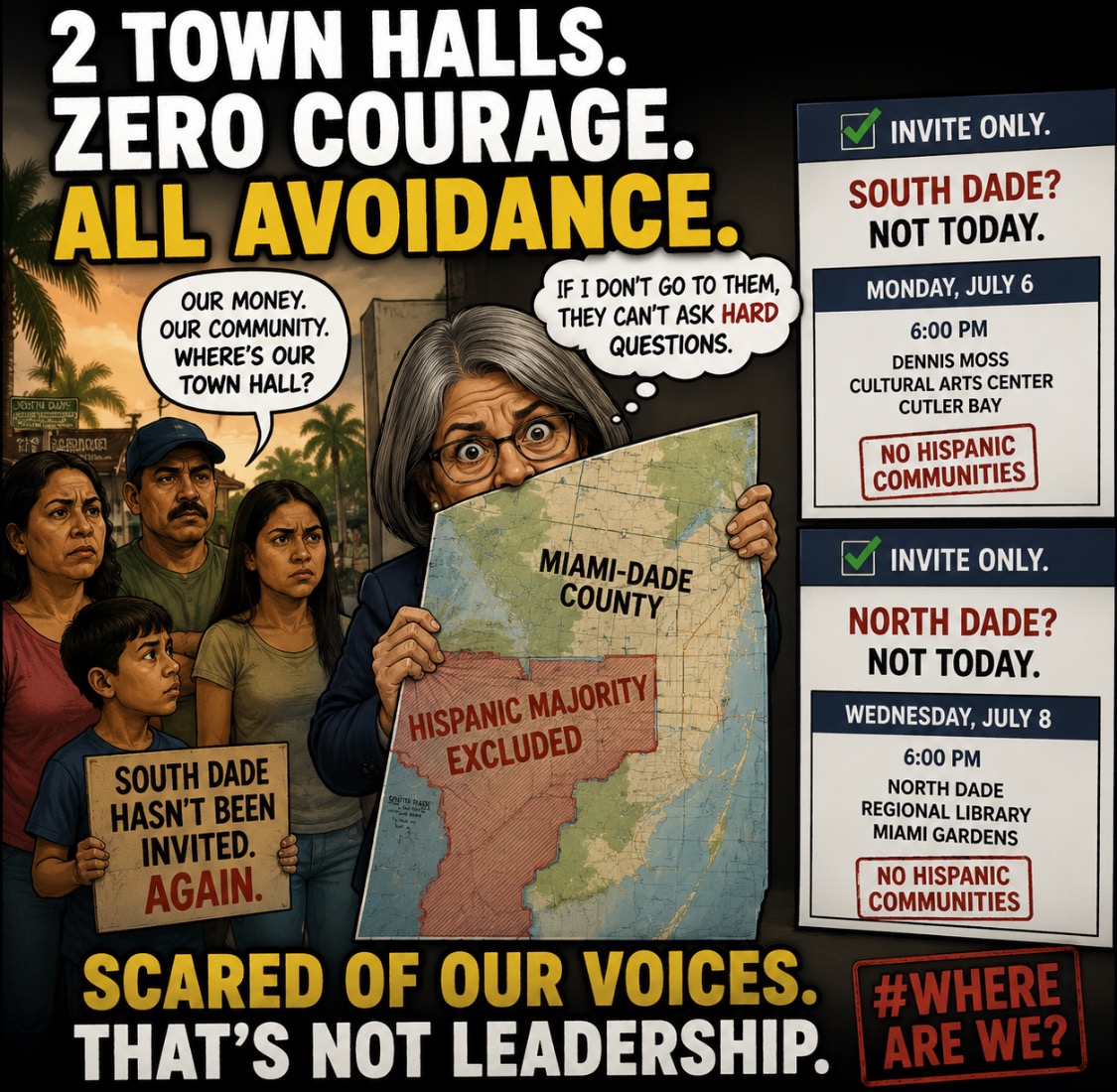
Miami, Florida – Two. That’s how many public budget meetings Miami-Dade County has advertised ahead of adopting one of the largest local government budgets in the country. A county of 2.8 million people and a budget of at least $13 billion. Two meetings. One in Cutler Bay, on the southern end of the county. One in Miami Gardens, on the northern end of the county. You’ll find more outreach at a “ventanita,” a side window in Cuban restaurants, where “colada” coffee shots and politics get shared in the same five minutes. Three years ago there were six meetings. Last year, three. This year, two. That’s not a trend — that’s a countdown. And nobody at County Hall has bothered to explain why the number keeps shrinking while the budget keeps growing.
The New Charter Gave Her the Power. It Also Gave Her the Job.
Miami-Dade County went to a “strong-mayor’ governing model back in 2007. One person, one office, all the executive authority — and all the responsibility that’s supposed to come with it. County Mayor Daniella Levine Cava knew the deal. She sat on the Miami-Dade County Commission for six years before she was elected County Mayor in 2020. She knows exactly what “reasonably convenient times and places” is supposed to mean under the County’s Home Rule Charter. Knowing the rule and following it, apparently, are two different things.
Watch the Map Shrink
The trend is one of diminishing transparency: (1) In Fiscal Year 2023-24: six town halls — North Dade, Aventura, Arcola Lakes, Westchester, West Kendall and Naranja. (2) In Fiscal Year 2025-26: three — Downtown, Miami Gardens and Cutler Bay. (3) In Fiscal Year 2026-27: two. Just Cutler Bay and Miami Gardens. No Hialeah. No Westchester. No West Kendall. No Doral. No Miami Lakes. No Miami Beach. No Aventura. No Downtown. No Kendall. Somebody in the County’s Office of Management and Budget drew that shortlist. Nobody’s said who, or why, or what got them crossed off.
Funny Which Neighborhoods Got Cut
Hialeah — more than 95% Hispanic — gone. Westchester, sitting inside District 10 with over 104,000 Hispanic registered voters and more Republicans than Democrats — gone. West Kendall, Aventura, Naranja — all previously on the schedule, all gone this year.Maybe it’s a coincidence. Maybe it’s logistics. But when the list of who got dropped lines up that neatly, taxpayers are entitled to ask the question out loud instead of pretending not to notice.
Remember 2024, When She Was Facing Reelection?
That’s the year Levine Cava floated the $2.5 billion “305 Future Ready” bond — one of the biggest borrowing proposals in County history — right in the middle of her own reelection campaign. It landed with a thud. Got postponed. Not enough public buy-in. You’d think that was the lesson: you don’t get to skip the conversation and then act surprised when people don’t trust the number. Apparently, the lesson didn’t stick.
The Money’s Different Now
When Levine Cava took office, COVID relief cash was still propping up the budget — CARES Act, ARPA, all of it. Even then, the County held more town halls than it does now. Now the federal cushion is gone, the County just closed a $402 million budget gap, Tallahassee’s CFO Blaise Ingoglia is publicly needling local governments over spending, and Amendment 3 could gut property tax revenue if it passes. In other words: this is the year public input matters most. And it’s the year the County offered the least public input.
July 15 Isn’t a Suggestion — It’s a Deadline, Not a Target
The Home-Rule Charter says that the County Mayor has to submit the budget by July 15 each year. It doesn’t say she has to wait until then. Drop it at the buzzer, though, and taxpayers, HOAs, business groups, reporters — even County Commissioners — get handed hundreds of pages with barely enough runway to read it, let alone challenge it. Publishing a document isn’t transparency. Giving people time to actually pick it apart is transparency.
Access Is the Whole Point
Earlier this year, WPLG-TV Local 10’s Jeff Weinsier kept pushing the County Mayor’s Office for answers on the electric bus program and ended up in a public run-in with a plainclothes member of her security detail — one that surfaced that MDSO has no written policy requiring plainclothes deputies to identify themselves before barking orders at people. Whatever you make of that incident, it’s the same story wearing a different hat: an administration that would rather not answer.
And understandably so, to a point — the County Mayor spent the first half of this year fending off a recall effort pushed by Alex Otaola of Hialeah. It ultimately fell apart in May, falling well short of the roughly 66,000 signatures needed. But when you’ve just spent months being told the voters want you gone, it’s not hard to see why an administration might get gun-shy about walking straight into more rooms full of the public. Understandable, maybe. Still not an excuse to shrink the one legally required conversation taxpayers are guaranteed every year.
Nobody Even Agrees on the Number
Here’s the part that should stop every taxpayer cold: County officials can’t even agree on how big this budget actually is. At an April 2026 Intergovernmental and Economic Committee meeting, Commissioner Danielle Cohen Higgins asked a simple question — how big is the county’s budget? The answer she got depended entirely on who was talking. The figure that Commissioners had actually voted on was $13.23 billion. But the County Commission auditor’s own newly built spending dashboard — pulling every transaction from every department — put real total spending closer to $17 billion. A $4 billion gap. Unexplained. On the record.
Commissioner Vicki Lopez called it “absolutely absurd.” She wasn’t wrong. If the County’s own Commissioners can’t get a straight answer on the true size of the budget from the County’s own administration, what exactly are the two remaining town halls supposed to accomplish? Before Miami-Dade County opens another jail diversion center, before it writes another check for a sports event, before it funds one more press conference, before it subsidizes another not-for-profit organization — it owes taxpayers a plain, public explanation of where that missing $4 billion is and why the number kept changing depending on who was asked. Housing. Taxes. Roads. That’s what the money should be measured against first.
It’s Not Her Budget
It’s not the County Mayor’s budget. It’s not the County Commission’s. It’s not OMB’s spreadsheet to guard. It’s the taxpayers’ money, and right now the County Mayor is the one deciding how much of a say they get in spending it. So here’s a thought for the Commissioners who’ll still be on the dais long after Levine Cava is gone — some of you already viewed as future countywide contenders: stop waiting on her. Hold your own town halls. Drag OMB into your districts yourselves. Explain the budget. Take the hard questions. Defend your votes before you cast them, not after.
If they want to lead Miami-Dade tomorrow, they should start leading today. If the Mayor won’t bring the budget to every community, then the Commissioners should. The budget belongs to the taxpayers, not to the county administration.