
Pentagon, BAE sign deal for up to 25,000 precision-guided munition kits a year
The Defense Department has signed a framework agreement with BAE Systems to buy up to 25,000 Advanced Precision Kill Weapon System, or APKWS, guidance kits a year for as long as seven years, the department announced Monday.
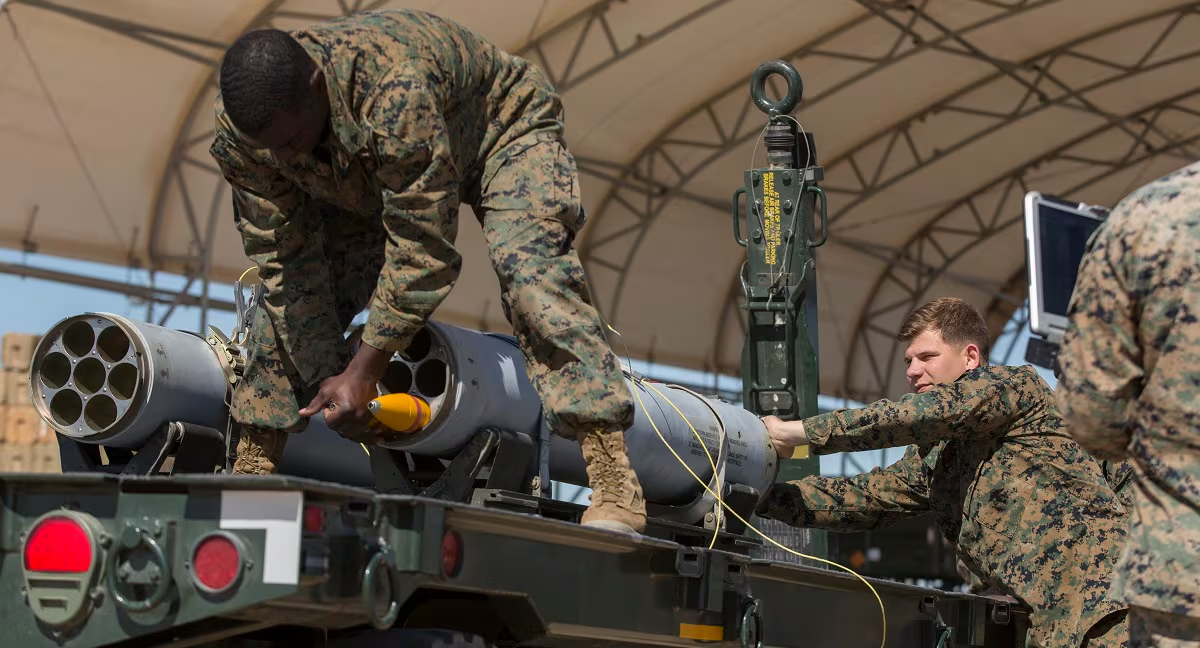
APKWS kits convert unguided 2.75-inch rockets into laser-guided munitions. All four services field them, and the weapon has become a cheaper alternative to air-to-air missiles for shooting down drones.
Congress still has to approve and fund the buy, the department said. BAE said it will increase production while the two sides work out a multiyear contract. Neither side announced the deal’s cost.
The framework also outlines a path to increase output to 35,000 kits a year for U.S. allies. The department said that added capacity will come online as partner nations formally request kits through the Foreign Military Sales program.
“By securing multi-year demand, this agreement keeps production lines running at capacity, provides our forces with interceptor inventory, and flips the cost calculus in the taxpayer’s favor,” Michael Duffey, the Pentagon’s undersecretary for acquisition and sustainment, said in the announcement.
BAE, which builds the kits in Hudson, New Hampshire, and Austin, Texas, said in February that it had delivered its 100,000th kit.
The 25,000 figure in this framework agreement matches capacity BAE has cited before. A company official said in 2023 that APKWS was in full-rate production with room to grow to 25,000 units a year.
“APKWS delivers proven, reliable and affordable precision at scale to counter evolving threats and ensure our warfighters maintain a decisive advantage,” said Tom Arseneault, president and CEO of BAE Systems Inc.
The Navy’s current five-year APKWS contract with BAE, awarded in August 2025, is worth up to $1.74 billion. It covers up to 55,000 kits for the Navy, the Army and foreign customers, with work expected to be completed by December 2031.
Among allied buyers, Saudi Arabia won State Department approval in July for a possible $1.96 billion package that includes up to 20,000 APKWS kits, split evenly between air-to-air and air-to-ground versions. Italy is also weighing a buy of 5,031 kits for counter-drone defense.
The APKWS agreement is the latest in a series of framework deals the Pentagon has signed this year to boost munitions production.
In January, Lockheed Martin agreed to more than triple production of the Patriot Advanced Capability-3 Missile Segment Enhancement, or PAC-3 MSE, interceptor.
In March, BAE and Lockheed agreed to quadruple production of seekers for the Terminal High Altitude Area Defense, or THAAD, interceptor. A separate THAAD framework signed in January led to a June contract worth more than $35 billion for the interceptors themselves.
Michael Scanlon is a defense journalist covering air and space warfare. A former U.S. Air Force A-10 crew chief, he has supported land and sea programs for the U.S. Army, Navy, Marine Corps and Coast Guard.