
Pentagon assures secure passage by way of Strait of Hormuz regardless of presence of mines
Defense Secretary Pete Hegseth told reporters Tuesday in the Pentagon that vessels transiting the Strait of Hormuz currently have access to a secure lane, as the U.S. seeks to restore freedom of navigation through the embattled sea passage.
The guarantee comes a day after U.S. Naval Forces Central Command issued a security warning regarding maritime explosive devices to vessels passing through the strait.
“Transit via or in close proximity to the traffic separation scheme should be considered extremely hazardous due the presence of mines that have not been fully surveyed and mitigated,” a memo with the warning read.
The U.S. instructed vessels to travel through an enhanced security area south of the traffic separation scheme in Oman territorial waters and coordinate with Oman authorities to ensure safe passage amid anticipated heavy traffic.
The traffic separation scheme refers to two lanes in the Strait of Hormuz that were previously deemed safe.
“Any follow-on effort if there are mines identified, would be something that some of our units could undertake or the world could undertake,” Hegseth said. “But right now we know we have a lane of safe passage that commercial shipping can flow through.”
Iranian naval mines have proven a constant threat throughout the Iran war.
While the U.S. military has destroyed a number of Iran’s mine-laying boats and storage bunkers for naval mines, the country has been previously assessed to have a stockpile of around 6,000 as recently as 2025, according to Congress.
CENTCOM announced April 11 that it had began “setting conditions for clearing mines” with the assistance of Arleigh Burke-class guided-missile destroyers USS Frank E. Peterson and USS Michael Murphy.
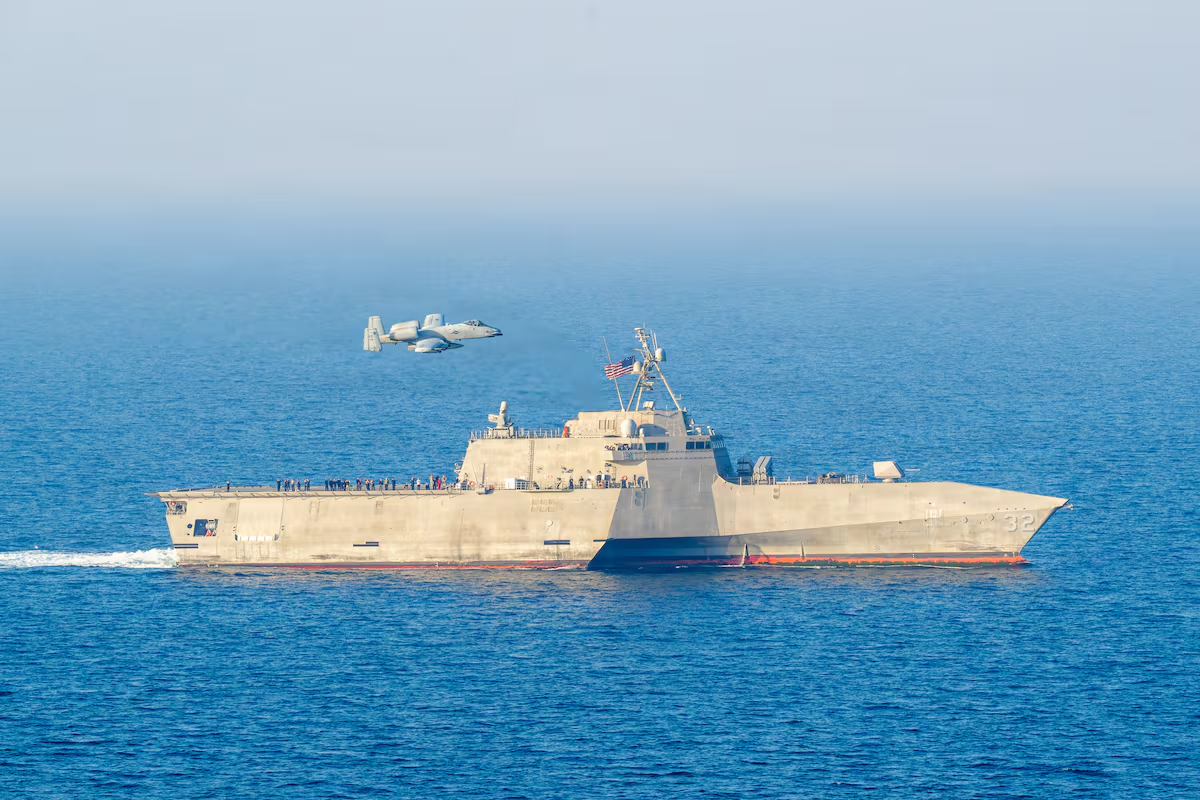
The U.S. Navy currently has several options to identify and neutralize mines, including Avenger-class minesweepers and lndependence-class littoral combat ships with a mine countermeasures mission package.
The Navy retired all four minesweepers home-ported in Bahrain, the only in the Middle East, in 2025.
The remaining four Avenger-class minesweepers are home-ported in Japan, with two on their way toward the U.S. Central Command area of responsibility as of April 20, according to Chief of Naval Operations Adm. Daryl Caudle, who confirmed the transport to reporters at the 2026 Sea-Air-Space exposition.
All three of the LCS with the MCM mission package are home-ported in Bahrain, but two of them — the USS Santa Barbara and USS Tulsa — left the CENTCOM area of responsibility and arrived in Singapore for scheduled maintenance in March.
U.S. Central Command began supporting Project Freedom on Monday, a military operation aiming to shepherd commercial shipping vessels attempting to pass through the Strait of Hormuz.
The U.S. Navy instituted a blockade of the Strait of Hormuz on April 12 after President Trump announced on Truth Social that the U.S. would intercept vessels that paid a toll to Iran for passage and begin destroying mines.
The nearly four-week-old ceasefire between the U.S. and Iran remains in effect, despite an exchange of artillery fire that saw the U.S. military destroy six Iranian small boats, as well as cruise missiles and drones.
Riley Ceder is a reporter at Military Times, where he covers breaking news, criminal justice, investigations, and cyber. He previously worked as an investigative practicum student at The Washington Post, where he contributed to the Abused by the Badge investigation.