
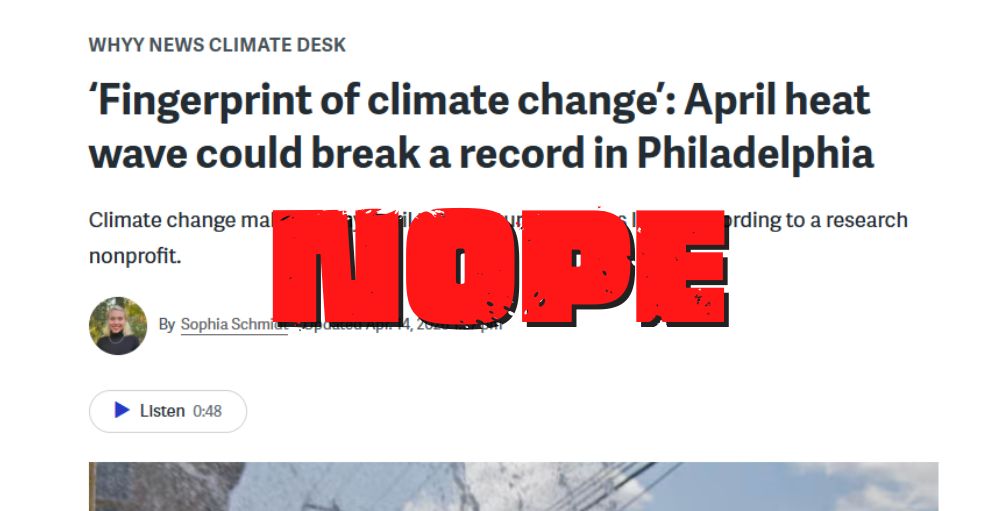
Factcheck: A Warmth Wave Is NOT a ‘Fingerprint of Climate Change’
A recent article from the climate desk at Philadelphia’s WHYY News titled “‘Fingerprint of climate change’: April heat wave could break a record in Philadelphia,” claims that warm temperatures in the Mid-Atlantic this week are evidence of long term global warming. This is false. While it is true that average, long term global temperatures have modestly increased since the Industrial Revolution, heatwaves like those forecasted for the East coast are not evidence of any emergency, and also are not becoming more frequent or severe.
A high-pressure ridge in the Atlantic Ocean is causing warmer air to sweep up the Southeastern United States and Mid-Atlantic, giving the region a springtime heatwave. That’s a short-term meteorological event, which is normally referred to as weather, not a long-term change in the average temperature and prevailing conditions for a region, which is climate.
WHYY News says “climate analysts say these hot temperatures fit into a trend of warming spring weather,” quoting a researcher at the climate action advocacy group, Climate Central, saying the heatwave has “a fingerprint of climate change,” as proof.
It is true that some data indicate that spring weather conditions are arriving a few days earlier in recent years than they did a hundred-plus years ago in some locations. However, this does not mean that severe spikes in temperature are the drivers of those changes. In fact, it is less severe cold driving the trend, not more severe warmth.
For example, the article and Climate Central point to Philadelphia as an example of one of the regions expected to see unseasonal warmth this spring, saying “since 1970, Philadelphia’s average spring temperatures have risen roughly 3 degrees, according to Climate Central.”
They say that climate change is what “makes this week’s high temperatures in Philadelphia twice as likely, according to the organization’s Climate Shift Index, which uses models to compare today’s world to a world without human-caused carbon pollution.”
There are major flaws in this reasoning, and bad science.
Data show that temperatures for Pennsylvania have only increased on average by around 2 °F since 1900, meaning that Philadelphia’s 3 ° F of warming since 1970 (if we assume Climate Central is correct) is higher over the past half-century than the average for the state as a whole over the past 125 years. This is actually not at all a surprise, but it has nothing at all to do at all with “human-caused carbon pollution.” The higher warming rate in a city like Philadelphia, like with other highly urbanized regions around the country, has everything do with increased population density and associated development producing the urban heat island effect. This effect was recently described by both an analysis of urban temperature stations in extremely hot places like Reno, Nevada by meteorologist Anthony Watts, as well as broader, summertime satellite-based measurement of temperatures by Dr. Roy Spencer, who found from 1895 to 2023:
[f]or the average “suburban” (100-1,000 persons per sq. km) station, UHI is 52% of the calculated temperature trend, and 67% of the urban station trend (>1,000 persons per sq. km). This means warming has been exaggerated by at least a factor of 2 (100%).
This analysis was for summertime temperatures, but what’s true of summer is true of spring because the built-up, heat retaining environment is the same.
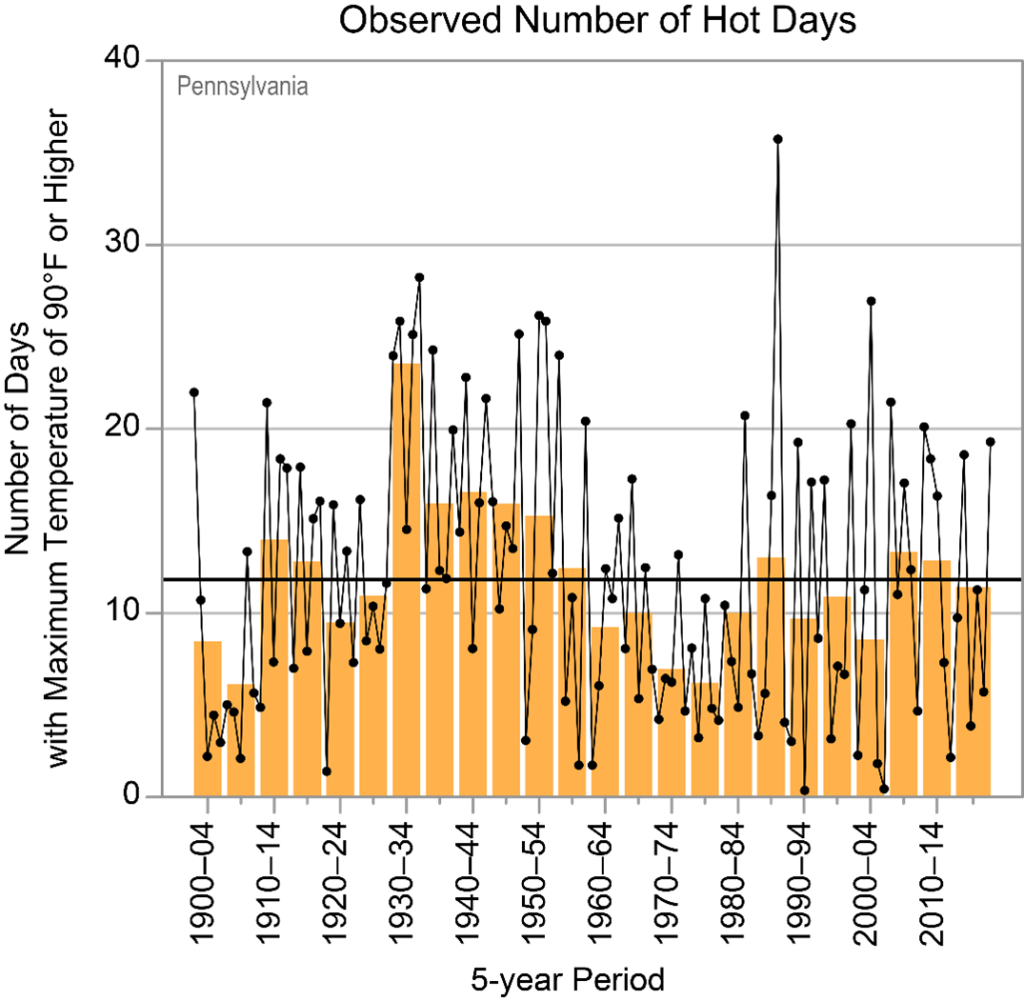
Additionally, data from the National Oceanic and Atmospheric Administration’s (NOAA) state climate summaries show that heat spikes are not getting more common. Rather, the long-term slight rise in temperatures is due to days and nights with extremely low temperatures becoming less common, and nighttime temperatures (which are particularly influenced by UHI) are modestly warmer than they were a few decades ago.
In fact, data indicate that instances of extreme warmth are actually less prevalent today than they were in the mid-1900s:
Climate Central and WHYY News fail to reference any real-world data, opting instead to simply assert without providing proof that it is warming in general. Instead, they point people to an attribution study that compares two models of the world—both fictional, both loaded with assumptions on the part of the researchers and other climate scientists—in order to prove climate change is causing heat waves. Models are not data, and, as such, attribution studies don’t provide evidence of warming. Climate Realism has discussed many times why it is invalid to use a model that assumes what it is setting out to prove; that climate change is responsible for any given weather event. Base models, which these attribution studies rely on, have failed to accurately predict real-world temperature change, and the vast majority of supposed extreme weather trends they predict have failed to materialize.
Just as a single month’s unusual cold is not proof that the planet is cooling, a single month’s unusual warmth is likewise not some “fingerprint” of a climate emergency.
It is shameful that WHYY News and other media outlets do not undertake some basic research before publishing alarming climate stories. Referencing long-term data would result in a fact-based and nuanced scientific view of weather. Instead, harming their audience, they produce hyperbolic stories based on fearmongering grounded in unscientific attribution modeling done by groups like Climate Central. A week of warm weather after months of dreary early spring cold is hardly alarming and certainly provides no evidence that catastrophic climate change caused by humans is underway.