
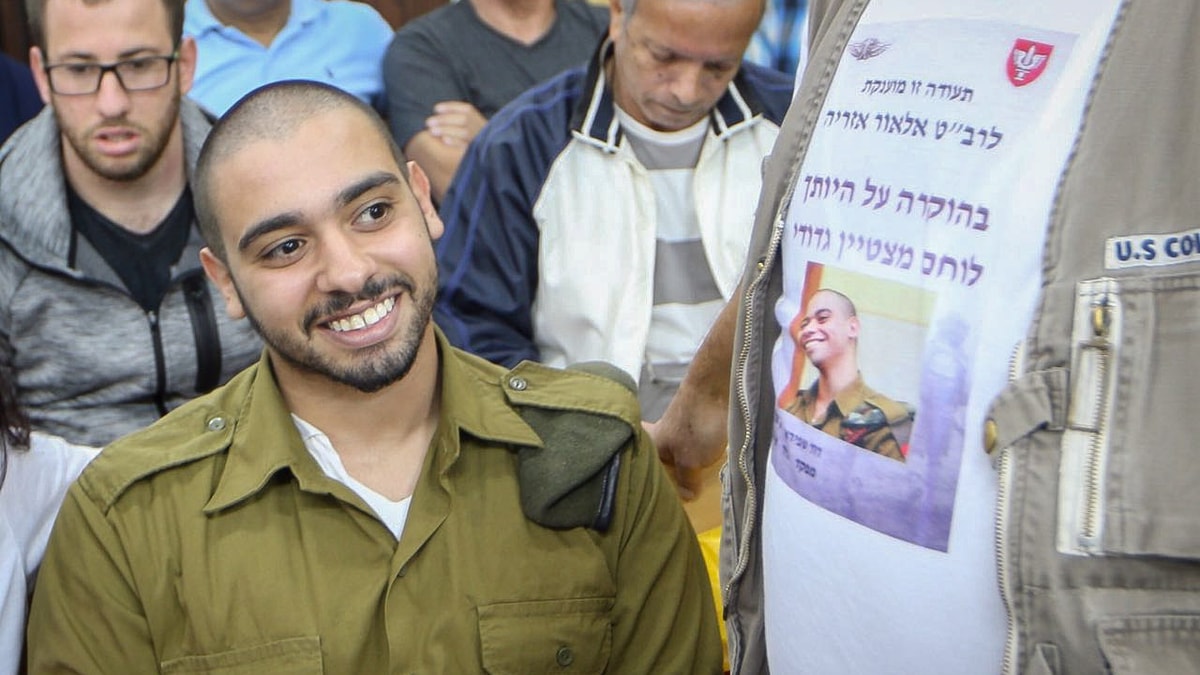
Elor Azaria Criminal Record: Katz Seeks Presidential Pardon | JP
Defense Minister Israel Katz submitted a formal request Tuesday to President Isaac Herzog asking that Elor Azaria be granted a pardon by shortening the waiting period before his criminal record is expunged, a decade after the Hebron shooting that convicted him made international headlines.
In his letter to the president, Katz wrote that it is unreasonable that, a decade later, an outstanding soldier convicted of an offense committed during operational service should continue to pay such a heavy price. He added that this sends a negative message to Israel’s sons and daughters sent to face danger and serve in combat units and dangerous areas, and said Azaria should be given the chance to rehabilitate himself and start a new life.
Katz emphasized that more than ten years have passed since the incident, that Azaria completed his full prison sentence in 2018, and that the request now before the president concerns only shortening the statutory waiting period before his record is erased, a period that has already run its course under the law. He asked the president to weigh Azaria’s record as an outstanding combat soldier and medic in the Kfir Brigade’s Shimshon Battalion, the complex operational circumstances of the incident itself, and the personal, family, and public price Azaria has paid in the years since, along with his efforts to rebuild his life, start a family, and reenter the workforce.
Katz also invoked October 7, writing that Israel’s experience since then illustrates starkly the brutal nature of the ideology Israeli soldiers confront and the way the country’s enemies act to murder civilians and soldiers without moral restraint, framing this as broader context for the conditions under which IDF soldiers have operated over the years. He noted that hundreds of terrorists have been released from Israeli prisons in recent years as part of hostage-return agreements, arguing this strengthens the case for expunging Azaria’s record as well. Katz added that this is not about erasing what happened, but about giving expression to the principle of rehabilitation after years in which Azaria bore the consequences of his actions.
According to Haaretz, the IDF has formally objected to the pardon in its own submission to the president, arguing that clemency is an exceptional step and that Azaria has not done anything to justify it and has not expressed remorse for his actions. The President’s Residence confirmed that Azaria himself submitted the request through standard procedure, and that it has been forwarded to the defense establishment for input from the relevant officials, including the defense minister and the IDF, with the chief of staff, the Military Advocate General, and the head of IDF Manpower Directorate’s opinions still pending. Herzog’s office said he would weigh the request responsibly and with due gravity once all opinions are received.
Katz noted that a previous request for clemency, submitted by then-Defense Minister Avigdor Liberman to then-President Reuven Rivlin, was rejected on the grounds that easing Azaria’s sentence would harm IDF and national resilience. Katz argued that reasoning does not apply here, since the current request does not concern shortening the prison sentence itself but only the separate waiting period for expunging the criminal record.
Azaria, a squad medic, was convicted in 2017 of manslaughter and improper conduct after fatally shooting Abd al-Fattah al-Sharif, a Palestinian assailant who had already been shot and subdued following a stabbing attack on IDF soldiers in Hebron in March 2016. The shooting was filmed by a Hebron resident and became one of the most polarizing legal cases in Israel’s recent history. Azaria was sentenced to 18 months in prison, later reduced to 14 months following a request to then-Chief of Staff Gadi Eisenkot, and was released in May 2018 after serving nine months.