
American Odyssey
To historian Craig Fehrman the 8,000-mile expedition (1804-06) indelibly associated with Meriwether Lewis and William Clark is nothing less than “our national Odyssey.” To this TCM junkie their epic crossing of the continent suggests a road picture with more perils than Pauline and more plot twists than anything starring Hope and Crosby. Fehrman spent five years crafting this frontier Rashomon (my last movie analogy—promise) in which the journey unfolds through multiple viewpoints distilled from 30 archives and a hundred Native and other oral histories. What in less skillful hands might have been a mere travelogue becomes a cross-cultural, stunningly rendered rethink of Discoverers and Discovered.
The author’s own discoveries include Clark’s college notebook—that he attended college at all is here revealed for the first time—and an eyewitness account of Lewis’s violent encounter with members of the Blackfeet tribe that challenges previous reporting of the incident. Flipping traditional chronology, Fehrman reminds us that long before the Louisiana Purchase doubled the size of his country, Thomas Jefferson had a “lifelong obsession” to know what lay beyond the mountains faintly visible from Monticello. From the books in his library Jefferson might have surmised that the trans-Mississippi region was filled with active volcanoes and blue-eyed Indians who spoke Welsh.
Operating in secret, Jefferson obtained a congressional appropriation of $2,500 to fund the ambitious enterprise variously sold as a trade mission, a scientific survey, and a chance to become better acquainted with Jefferson’s Mandan, Lakota, and Nez Perce constituents. (Fehrman calculates the final tab for the trip at $100,000 or more—roughly $2.8 million today.) The president’s stated objective was to find a direct water route to the Pacific, a modern variant of the fabled Northwest Passage long sought by European explorers. His larger goal was to frustrate any foreign power from contesting his vision of the United States as a continental republic. Lewis and Clark were advance agents of Manifest Destiny.
Federalist opponents mocked the venture as a boondoggle reflecting the airy proclivities of “a man better calculated to dissect bones and butterflies than to govern a nation.” The 33 permanent members of the Corps of Discovery faced a much greater threat from Spanish cavalry hot on their trail. The targets on their backs were put there by General James Wilkinson, first American governor of the Louisiana Territory, and a double agent who betrayed his countrymen for considerably more than 30 pieces of Spanish silver.
Nature and chance defeated the Spanish posse. The Corps was more fortunate, losing only one man, to appendicitis. That it should survive rattlesnakes, fearsome grizzlies, hostile natives, and a treacherous climate was due in no small measure to its leadership. Lewis and Clark were co-captains in name only, federal budget cuts having deprived Clark of the commission promised him by a government he had come to distrust even while wearing its uniform. It was a ticklish situation but Lewis was naturally tactful and well-schooled in diplomacy.
As Jefferson’s White House secretary, he had explained macaroni to dubious congressmen and discussed mammoths with the naturalist president. Jefferson trusted him sufficiently to make Lewis his agent in paying hush money to the slandering journalist James Callender (though it wasn’t enough to buy Callender’s silence regarding the president’s sexual liaison with Sally Hemings). Awesomely organized, a gifted botanist, and amateur astronomer, Lewis was an excellent marksman who could shoot a pelican, then calculate the capacity of its pouch at five gallons. Using a tape measure purchased in Philadelphia he recorded the 21-foot leap of a jack rabbit. And it was all recorded in journals that would influence the likes of Washington Irving and Edgar Allen Poe.
Harshly self-critical, Lewis was already exhibiting the depressive tendencies that led to his suicide in 1809 at the age of 35. Observant, amiable William Clark had insecurities of his own; the legacy, perhaps, of growing up in the shadow of his celebrated sibling George Rogers Clark. An expert surveyor, artist, and cartographer, Clark assembled 21 bales of gifts with which to tempt native chieftains from their allegiance to Spain or France. Native Americans fascinated Clark. His consuming interest did not, however, prevent the captains from misidentifying the pacific Yankton Sioux for the far more aggressive tribal branch known as the Brulé.
The ensuing confrontation in September 1804 near present-day Pierre, South Dakota, began with trash talk that rapidly escalated. “A single arrow or bullet would have led to horrifying casualties on both sides,” Fehrman notes. Only the shrewd diplomacy of Chief Black Buffalo defused tensions. Employing political skills unrecognized by Jefferson’s emissaries, the Lakota statesman stared down enemies in his own camp and persuaded the Brulé to form a trading alliance with the Americans.
Clark’s biggest contribution to the mission stemmed from his Army-bred aversion to uniformed brutality. Confronting the insubordination and eye-gouging combat generated by “an abundance of energy and an abundance of alcohol” in the ranks, Clark’s instinctive response was to lecture the miscreants. Instead of the 50 or 100 lashes prescribed in the military code, disturbers of the peace were ordered to build a hut for a seamstress who had been helpful to the Corps.
In the temporary absence of the captains, authority passed to Sergeant John Ordway, a New Hampshire Yankee whose by-the-book methods didn’t endear him to enlisted men. When a Kentucky troublemaker refused an Ordway order, he was threatened with flogging. The defiant soldier aimed his gun at the NCO, who backed down. Eventually more conventional punishments were imposed, but only after being voted on by courts martial comprised of the offender’s peers. Each man was asked to identify the squad he wished to join. Ordway’s tormenter chose the officer at whom he had pointed his rifle.
Reaching a fork in the broad Missouri River, members debated which of the two streams would point them to the Columbia River and the Pacific beyond. (They guessed wrong, but it didn’t take long for separate exploratory parties to realize their error and reunite.) A much greater obstacle awaited them in the Great Falls of the Missouri. From native informants the Corps had been led to expect a portage of “half a mile.” The reality was 18 miles and 31 grueling days, punctuated by savage hailstorms and prickly pear cactus that sliced their elk skin moccasins.
A born storyteller, Fehrman conveys the Edenic majesty of white sandstone cliffs and treeless prairies, but he is just as adept at re-creating sleepless nights caused by numberless beavers slapping their tails against the water. Most of all, Fehrman wants us to appreciate the rugged individualists engaged in collective heroism; the largely forgotten soldiers and hired guides, French-speaking oarsmen, Clark’s enslaved body servant York, and the most famous interpreter in American history, a young Shoshone woman named Sacajawea who was herself enslaved by Hidatsa kidnappers.
Lewis and Clark were “discoverers” in the Columbus mold—heirs to white European civilization encountering alien cultures with much deeper roots in the continent. The Corps depended on the kindness of strangers while running the continental gauntlet. Separate chapters introduce us to indigenous leaders like Piahito, an unlikely ally who accepted an invitation to visit Jefferson at the White House, only to die in Richmond, Virginia, in April 1806.
As strangers became comrades, their mutual reliance forged in common perils, one is struck by how many individual members of the Corps can be called lifesavers. Sacajawea offered credibility with potential enemies. Through her own Shoshone tribe the young mother helped secure desperately needed horses, enabling the Corps to conquer the Bitterroot Mountains. Lewis, more standoffish than his partner, credited “the Indian woman” with helping to avert the capsizing of a vessel laden with essential supplies. In recognition of her bravery he named a river for her.
Reunited with family and friends after several years with her Hidatsa captors, Sacajawea nevertheless chose to move on with the Americans. She had never seen the Pacific. Besides, writes the author, “her identity was becoming more nuanced.” The Corps proved even more transformational for York, William Clark’s slave and body servant. Once childhood playmates, Clark and York were permanently separated at adolescence, one to live in a pillared mansion, the other consigned to a dirt-floored cabin.
To Clark, York was property, but to natives who had never seen a black person he inspired godlike reverence (after they tried and failed to rub off what they took to be paint). York more than validated the rare decision to entrust a slave with a rifle, bringing down buffalo, deer, and geese to nourish men whose strenuous labors burned 5,000 calories a day. He rescued Clark, Sacajawea, and her infant son from a flash flood. To be sure, Clark was annoyed by York’s behavior around some children of the Arikara tribe. The bondsman pretended to be a bear, wild until his white owner “caught him.” But that same owner allowed York to enjoy an independence of sorts, steering a canoe as Clark scouted the forest—”both doing what was best for the expedition.”
Some heroes were of the four-legged variety. Seaman, Lewis’s sweet-tempered Newfoundland, saved a large part of the Corps one moonless night by diverting a 2,000-pound buffalo charging straight for some sleeping campers. In less dire circumstances Seaman’s appetite for squirrels and prairie dogs supplemented a diet of buffalo humps, deer meat, and trout pulled from turbulent streams, washed down with a variable government ration of whisky.
The sheer ingenuity of the Corps will astound readers who have never had to weave rope from animal skin. An improvised wagon moved on wheels fashioned from cottonwood stumps. Bear fat served admirably as insect repellent. The best agent for softening elk skins was a paste made from the animal’s mashed brains. Suffering severe stomach cramps, the resourceful Lewis dosed himself with an herbal drink made from chokecherry. It worked. So did the mercury and penile syringes brought along to combat diseases contracted in consensual sex with native women.
Fehrman has written a rousing adventure tale that may also qualify as the most lyrical of survival guides. Ultimately it is a Corps of Self-Discovery that he depicts, never more so than in the decision to give York a vote on where to locate the group’s winter quarters on the Columbia River. Frontier democracy had its limits. On returning to civilization each member of the Corps received double pay and 320 acres from a grateful nation. York came back to at least five more years of enslavement. Meanwhile the government paid Clark a monthly bonus of $7.60 for its use of his human property.
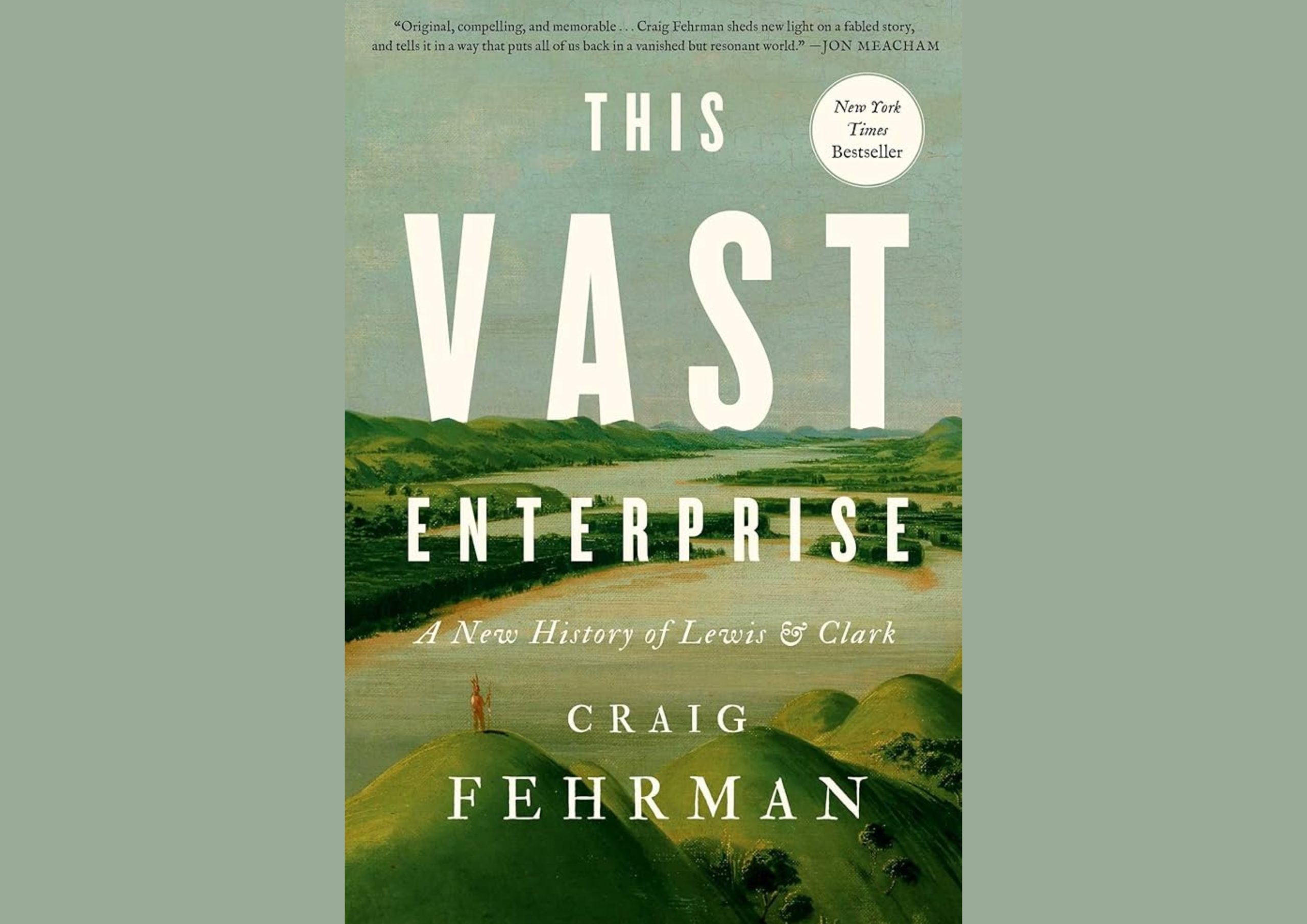
This Vast Enterprise: A New History of Lewis & Clark
by Craig Fehrman
Avid Reader Press/Simon & Schuster, 544 pp., $35
Richard Norton Smith is a Pulitzer Prize finalist and author, most recently, of Ordinary Man: The Surprising Life and Historic Presidency of Gerald R. Ford (Harper).