
Wonderful Abundance for All, Administered From Above
/script type=”text/javascript” src=”https://app.getresponse.com/view_webform_v2.js?u=S6bT5&webforms_id=A25R”>
Written by Matt Morgan, Editor at TheDailyBell.com:
The robot will not decide whether your future is free. The people who own the robot will. That is the question the optimists and the pessimists keep skating past while they argue about whether the machines are coming to save us or to replace us.
Elon Musk has given the optimist case its slogan. He calls the coming robot economy “amazing abundance for all.” But, an abundance promised to everyone is an abundance that someone has to hand out. And the moment goods are handed out rather than bought and sold, you have left the market behind and stepped into something much older and much worse.
An abundance you do not own, cannot price, and receive only at another man’s discretion is not freedom at all.
Watch Musk’s Pitch
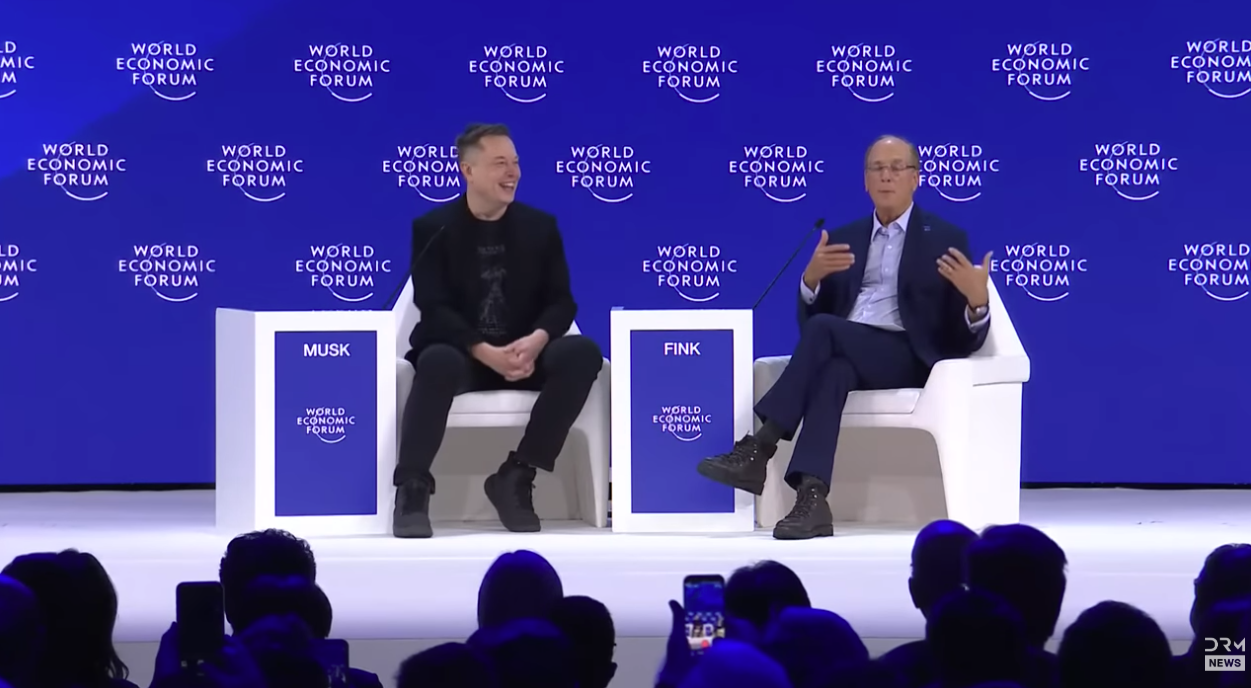
Here is Musk making the case to Larry Fink at this year’s World Economic Forum in Davos. Watch a few minutes before reading on. The vision is sincere, which is what makes it worth taking seriously.
This is the richest man alive, the great capitalist of the age, describing a world in which money stops mattering and goods pour out of a central productive engine faster than anyone can think to ask for them. He predicts there will be more robots than people, and that the machines will saturate every human need.
We have heard versions of this song for a century. Yet, it never plays the way the singer promises.
WION summed up the destination plainly in its report on Musk’s latest comments:
Musk even suggested that money could become less relevant in the distant future if abundance becomes widespread. However, he has not provided detailed explanations for how such a system would function economically or politically.
There is no coherent answer for how such a system would work.
Abundance Does Not Abolish Prices
Musk treats production as an engineering equation:
Total output equals productivity per robot times the number of robots. Build enough robots and you bury scarcity.
However, scarcity has never been the hard part of economics. The hard part is knowing what to make, for whom, and in what order, out of the endless things you could make instead. A factory full of robots can produce anything. It cannot tell you what is worth producing.
That information lives in prices. Friedrich Hayek made the point in 1945, paraphrasing:
“The knowledge a society needs to allocate its resources never sits in one place. It is scattered across millions of people, each of whom knows only his own circumstances, his own wants, his own trade-offs. Prices are how that scattered knowledge gets pooled and acted on without anyone having to gather it up. Strip the prices out and you have not cured scarcity. You have gone blind.”
Robots multiply how much you can make. They do nothing to tell you what any of it is worth. Prices are not a symptom of poverty that wealth finally cures. They are a signal that tells a complex society knows what to do next.
A World Beyond Money Cannot Compute
This is not a new objection, and it is not a small one. Ludwig von Mises wrote about it in 1920. Once you remove market prices for the means of production, rational economic calculation becomes impossible. You can no longer tell whether a given use of labor, steel, and energy creates value or destroys it, because you have abolished the only measuring stick. Mises was writing about socialism. The argument does not care what you call your system. It cares only whether prices exist.
“Universal high income,” the phrase Musk used at this year’s Abundance Summit, does not escape the problem either. It just relocates it. Somebody still has to decide what the robots build, in what quantities, and for whose benefit. If that somebody is not millions of buyers spending their own money, it is a planner spending everyone’s. The capitalist is selling central planning with a better logo.
So, Musk arguing that money becomes less important his future is a misunderstanding of what exactly money provides, which is the allocation of resources. Instead, with UBI, and in a machine operated future, money becomes the private instrument of whoever administers the machines.
The Promise is Old, and So is the Switch
In 1930, John Maynard Keynes told his readers that their grandchildren would work fifteen hours a week by 2030, freed by rising productivity from the ancient burden of toil. We are four years out. The productivity arrived, very nearly as he predicted, leaving us several times richer per head. The fifteen-hour week did not. The leisure utopia did not. The gains were real, and they were captured.
That is the pattern slowly creeping into the robot age, and it has nothing to do with the Terminator, which is the only danger Musk seems willing to name.
The real danger is this: a population that owns nothing, makes nothing, and receives everything at the pleasure of those who own the machines and the governments that license them. A high income handed down from that height is not a dividend on your own productivity. It is an allowance. And an allowance can be adjusted, means-tested, made conditional on good behavior, or simply withdrawn.
That is the bitter joke buried in the slogan, “Amazing Abundance for All.”
Conclusion
None of this means the robots are bad, or that abundance is a lie. Machines that make us genuinely richer are a wonderful thing, on one condition: that they are owned widely, priced honestly, and answerable to the people who actually use them. That is just the market doing what the market has always done.
What Musk describes is something else. Abundance as allowance, and plenty without property. He imagines a high standard of living detached from anything you own or control, dispensed from above by those who do.
The optimist cheers the abundance. The pessimist fears the robot. Both have their eyes on the wrong word…
In my opinion, the fight was never man against machine. It was, as it always is, the free man against the one who would administer him. Amazing abundance for all, perhaps. The trouble is always in the last three words:
Administered from above.