
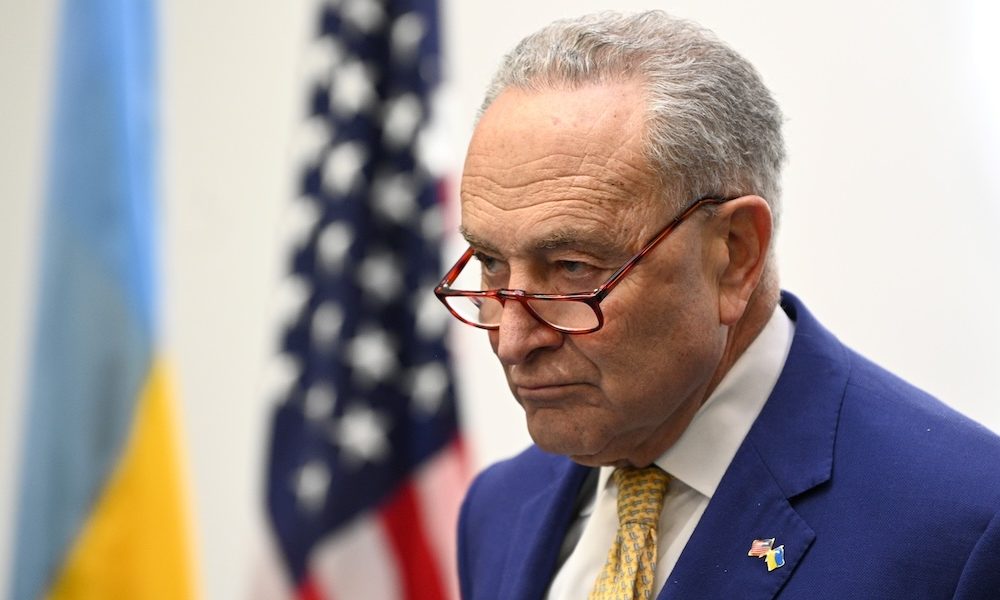
JUST IN: Dem Senator Announces Leadership Challenge to Chuck Schumer
Senator Chris Van Hollen (D-MD) announced Thursday that he will be launching a challenge to Senate Minority Leader Chuck Schumer (D-NY) for the conference’s leadership position. The announcement marks a shift for Van Hollen, who had earlier stated that he had no interest in a leadership bid.
Van Hollen (D-MD) had told CNN earlier in the day that he remained undecided about mounting a challenge to Schumer’s longtime hold on the Democratic Party conference post, stating he is “actively listening” to colleagues. When asked whether he would formally announce his plans soon, the senator responded by stating, “Stay tuned.”
Van Hollen, a two-term senator, described the situation as centered on “a demand in the country for change and bold leadership” rather than any individual. He confirmed he had spoken directly with Schumer, which followed an earlier statement that the two had not connected immediately after Election Day.
At the time of the CNN interview, Schumer had no declared opponent, with the Democratic Party caucus scheduled to hold its leadership vote on December 1, ahead of the new Congress.
The comments made in the CNN interview marked a shift from Van Hollen’s position days earlier. On November 6, he told Fox 5 DC that he was “not looking to be the next Democratic leader” and was instead “kicking the tires” on a possible 2028 presidential campaign.
Sources familiar with his thinking had later described him as entering an “active listening mode” after receiving calls about a leadership bid, with one stating that “the door is not shut.” Van Hollen has also publicly criticized Schumer and the Democratic Senatorial Campaign Committee for aligning with the crypto industry and the American Israel Public Affairs Committee (AIPAC) in certain primaries, arguing that two members of the incoming class would not have won without that dynamic.
Later Thursday evening, Van Hollen announced that he would run for Senate majority leader, citing a call from voters for change from the status quo and stating that the party needs new leadership to meet the moment. He referenced the scale of Democratic gains, which produced a sizable Senate majority, as creating an opportunity for significant action.
POLL: Will America Regret Giving The Democrats Power?
In this election, Americans called on us to unrig an economy rigged against working people & fueled by political corruption.
To deliver, we need new leadership. This isn’t about any one person – it’s about answering that call.
That’s why I’m running for Senate Majority Leader.
— Senator Chris Van Hollen (@ChrisVanHollen) November 13, 2026
“In this election, Americans called on us to unrig an economy rigged against working people & fueled by political corruption. To deliver, we need new leadership. This isn’t about any one person – it’s about answering that call,” the senator announced in an X post. “That’s why I’m running for Senate Majority Leader.”
Van Hollen is not the only Democrat who has raised questions about Schumer continuing in the top role after the midterm results, in which Democrats gained control of the chamber. Senator Bernie Sanders, an independent who caucuses with Democrats, said this week that he would not support Schumer’s reelection as leader, calling for a different direction focused on economic priorities.
Senator Elissa Slotkin (D-MI) has stated she would withhold support until she sees a concrete plan for the first 100 days of the new majority and has not ruled out seeking the position herself, emphasizing a desire for a new generation of leadership. Several senators-elect have also refused to back Schumer’s continued leadership, including Michigan’s Abdul El-Sayed, Kansas’ Adam Hamilton, South Carolina’s Annie Andrews, Illinois’ Juliana Stratton and Minnesota’s Peggy Flanagan.
Schumer, who has led Senate Democrats since 2017, has said he intends to seek the majority leader position and expressed confidence in his support within the caucus. Allies have pointed to the party’s midterm gains under his leadership.
The December vote will be conducted by secret ballot among current Democratic senators and senators-elect.