
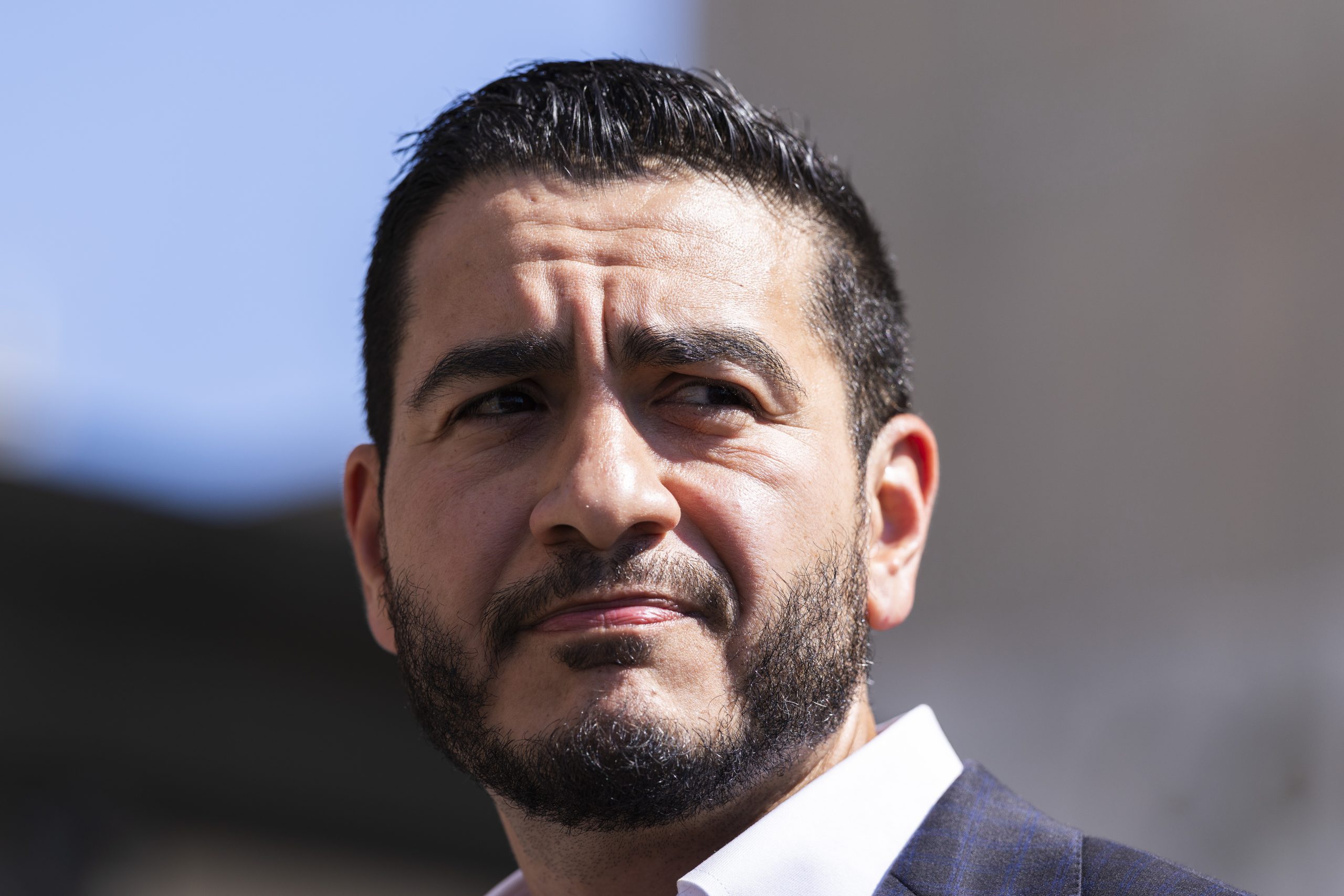
Abdul El-Sayed Railed Against ‘Disturbing’ Funding for Breast Cancer Research, Said Disease Affects People With ‘Social Power and Privilege’
The Michigan Democrat denounced ‘the Pink Ribbon Lobby’ in essay published during Breast Cancer Awareness Month
Michigan Democratic Senate nominee Abdul El-Sayed in a fiery essay railed against the “breast cancer lobby” and blasted breast cancer advocacy groups for creating the impression that women were “in imminent danger” from the disease.
In a 2012 essay entitled “The Pink Ribbon Lobby and Everyone Else,” El-Sayed, who has a medical degree and refers to himself as “Dr. El-Sayed” in political ads, bemoaned the increase in federal funding for breast cancer research, calling it a “disturbing” trend that diverts federal funding to study other serious diseases.
The culprit, according to El-Sayed, was the all-powerful “breast cancer lobby,” which he also derided as the “pink ribbon lobby,” a reference to the pink ribbons that commemorate Breast Cancer Awareness Month each October.
“The breast cancer lobby has done an incredible job raising my ‘awareness’ of Breast Cancer,” El-Sayed wrote for the 2×2 Project, a journal sponsored by Columbia University’s Mailman School of Public Health, where El-Sayed worked as an epidemiologist. El-Sayed noted that the George Washington Bridge in New York City was adorned with pink lights and that his alma mater’s football team, the Michigan Wolverines, were decked out “in pink cleats and arm bands.”
“If I weren’t an epidemiologist, it would have me believing that the women around me were in imminent danger,” said El-Sayed, who asserted that the significant funding for breast cancer created problems “for equity in health research allocation” by prioritizing funding for diseases that affect people with “social power and privilege.”
El-Sayed’s essay relied heavily on an American Sociological Review study on the lobbying of “single-disease interest groups,” in particular those dedicated to fighting breast cancer and HIV/AIDS. Curiously, El-Sayed omitted HIV/AIDS organizations from his scathing analysis, even though breast cancer killed more than three times as many Americans as HIV/AIDS in 2012.
Breast cancer will afflict around 1 in 8 women in their lifetimes and is the second leading killer of women in America, after heart disease. According to one estimate, 322,000 Americans will be diagnosed with the disease this year, and 42,000 will die.
But, in recent decades, breast cancer deaths have plummeted—amid advances in detection and treatment—even as the number of cases has steadily risen.
El-Sayed’s article raises questions about his current views of breast cancer research. El-Sayed, who last year accused Elon Musk of “gutting” cancer research at the Department of Government Efficiency, has expressed interest in serving on the Senate Health, Education, Labor and Pensions Committee, which oversees the budget for the National Institutes of Health, the main source of federal funding for disease research. Sen. Bernie Sanders (I., Vt.), a longtime El-Sayed ally, serves as ranking member of the committee. Sanders has stirred controversy in the past over his views about breast cancer, linking the disease to “inhibited sexuality” in women.
“The manner in which you bring up your daughter with regard to sexual attitudes may very well determine whether or not she will develop breast cancer, among other things,” Sanders wrote in an essay that resurfaced during his 2020 presidential run. “How much guilt, nervousness have you imbued in your daughter with regard to sex?”
El-Sayed, who is running against Republican Mike Rogers in one of the most heated Senate races in the country, has long faced allegations of sexism. In 2019, eight female employees at Icahn School of Medicine at Mount Sinai, where El-Sayed briefly worked, named him in a gender and age discrimination lawsuit against the school and its director, the Washington Free Beacon reported.
According to the complaint, El-Sayed told a 41-year-old female colleague that he refused to work with “anyone over 40.” El-Sayed also told the woman that he furnished his office at the school with “very high-end furniture” he purchased with “leftover grant money” that he obtained while at Columbia University, according to the lawsuit.
Supporters of Rep. Haley Stevens (D., Mich.) accused El-Sayed of sexist rhetoric during the Democratic primary. El-Sayed referred to Stevens as “the least capable candidate in America” and said she was unable to “string two coherent sentences together.”
While El-Sayed acknowledged in his essay that breast cancer is “an incredibly important disease” and said the social focus on it “is warranted,” he asserted that “the reallocation of public funds disproportionately to breast cancer is certainly not.”
El-Sayed’s campaign did not respond to a request for comment.