
Order Does Not Come From Government
/script type=”text/javascript” src=”https://app.getresponse.com/view_webform_v2.js?u=S6bT5&webforms_id=A25R”>
![]()
By Matt Morgan
—
Order and the state are two different things.
Almost nothing that keeps your day running was ever commanded by a government, and you already trust order without a ruler in a hundred places. You have been taught not to notice.
“Anarchy” Misconception
The word “anarchy” calls up broken glass, black masks, a city on fire. That picture is why the idea gets dismissed in a second. It is also wrong.
Anarchy comes from the Greek for “no ruler,” not “no rules.” The popular definition slips the conclusion into the setup. If statelessness means chaos by definition then there’s nothing left to discuss. But it doesn’t. Anarchy doesn’t need to mean chaos, violence and a city on fire. It can mean something else…
Look at it a different way:
Does order need a single ruler with a monopoly on force, or does most of it arise on its own, from people solving problems with each other?
Once you ask it that way, the evidence is all around you.
The order you already trust
No ministry writes the language you are reading right now. English grew over centuries from millions of small choices by ordinary people, with no committee in charge. The economist Carl Menger showed that money appeared the same way. Nobody decreed that gold or paper would be accepted. People started taking what others would take, and a currency emerged. Menger called language and money organic. Neither was invented by a state.
Prices work like this too. When beef gets scarce, the price rises, and shoppers and ranchers change their plans without anyone ordering them to. Friedrich Hayek described the price system as a kind of shared signal, one that coordinates millions of strangers who will never meet. No planner could gather that much information. The market does it every day, without a plan.
The pattern holds for newer things. The technical rules that let this page load, the standards that make email and websites talk to each other, are written by open groups like the Internet Engineering Task Force, not by any parliament. The safety mark on your phone charger or your kettle most likely comes from Underwriters Laboratories, a private company that tests products because makers and buyers both want the assurance. No law forced it into being.
None of those were planned from the top. All of it works.
Even the law grew this way
Now take the hardest case, the one people assume must come from the state. The law itself.
Even the law did not start with the State. For centuries, merchants trading across Europe faced a problem. They came from different towns with different rules, and no king governed the road between them. So they built their own body of commercial law, the “law merchant,” out of custom and fair dealing. It was voluntarily made, judged, and enforced by traders and their own courts, long before any government claimed the job. A merchant who cheated was not fined by a state. He was shut out of the network, which was worse.
English common law has a similar root. Much of it was never written by legislators. It was discovered by judges settling one real dispute after another, building rules from the ground up. The serious machinery of law did not wait for a state to invent it.
People needed order, so they made it.
The trillions that answer to no one
Here is the largest example.
There is no world government. Above the level of individual countries there is no ruler at all, no global police, no planet-wide court that can force anyone to obey. So, by the popular definition, the whole world is in a state of anarchy.
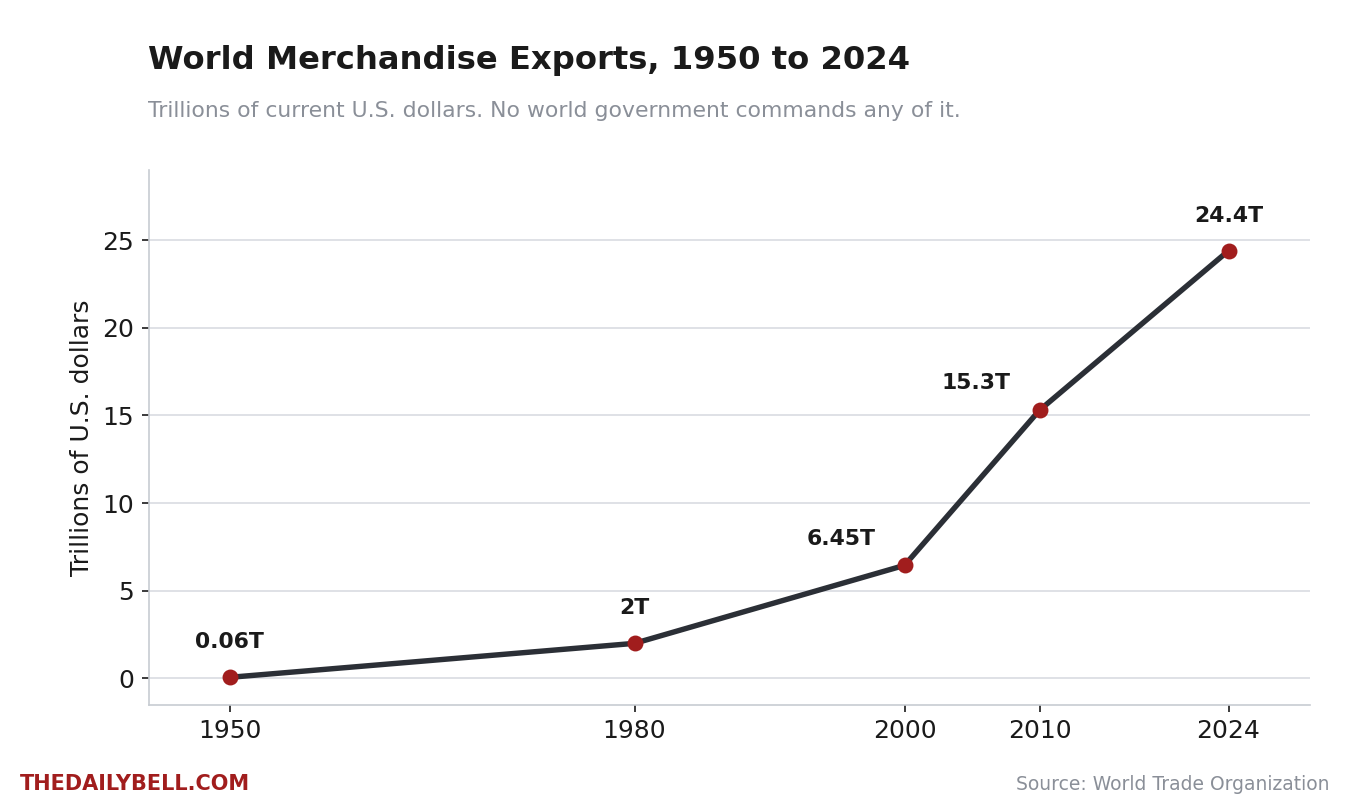
And yet look at what happens in that anarchy. Ships sail, contracts hold, debts get paid, all without a global sovereign commanding it. World merchandise trade was worth about 24 trillion dollars in a single recent year, and the value of world trade has grown roughly 400 times since 1950. No one is in charge of it. It runs on contracts, reputation, and private arbitration.
You already accept a stateless order running the entire world economy. You just do not call it that.
The one exception you are asked to make
So here is the concession you are asked to make. After watching order arise on its own in language, money, prices, technology, trade, and even law, you are told that one area is different. Law and defense, we are assured, must be handed to a single organization with a monopoly on force, because without it there would be chaos.
So, why does that one area escape every rule we accept everywhere else? A monopoly with no competition tends to grow lazy, expensive, and abusive. And, power draws the kind of people who misuse it. If that holds for a phone company or a post office, why would it stop holding for the one organization that keeps all the guns?
The record answers
It does not stop holding. It gets worse.
The domain we are told most needs a single ruler is the very domain where the ruler has done the most killing. Political scientist R.J. Rummel spent decades counting the people killed by their own and other governments in the twentieth century, deaths outside of battle: executions, forced famines, camps, purges. His total comes to about 262 million. That is roughly six times the number who died in combat in all the wars of the same century.
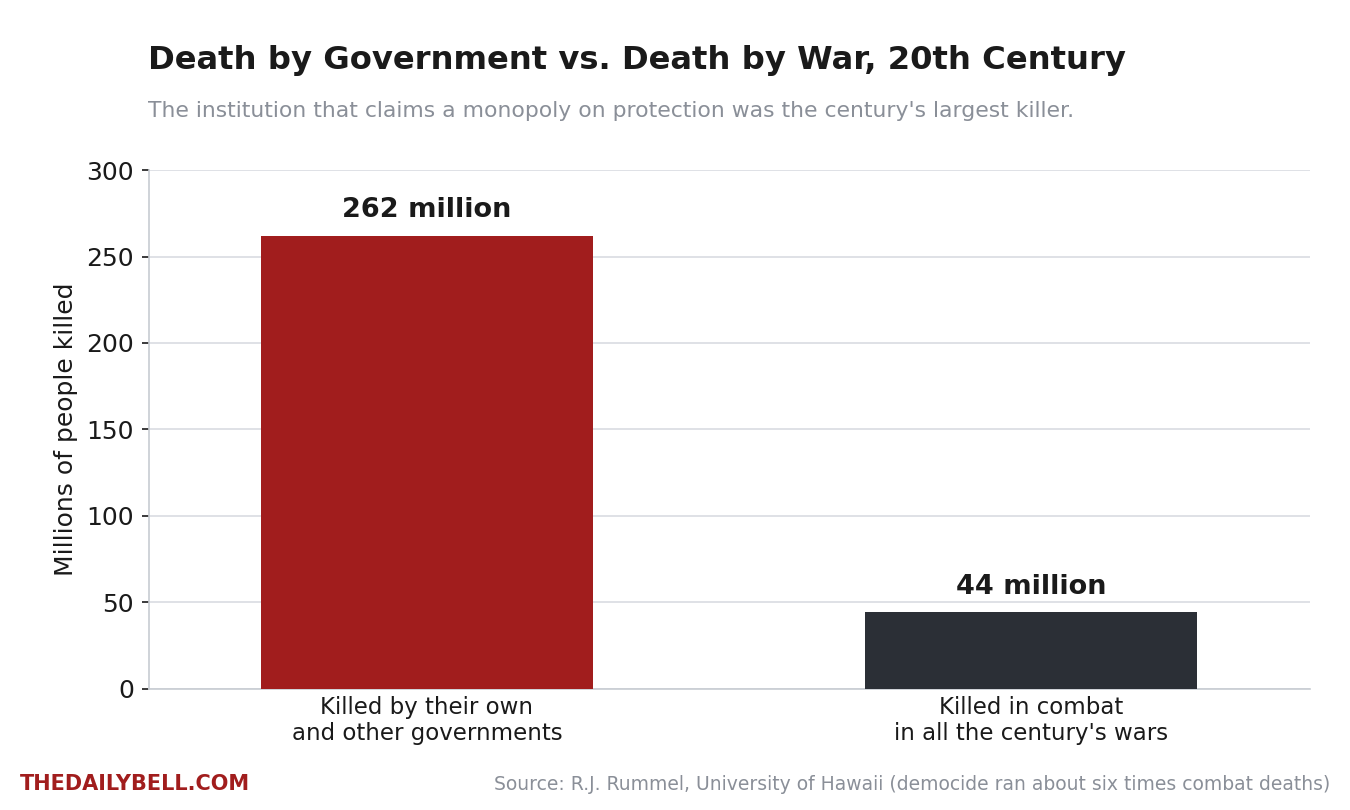
Government killing far outran the wars it claims to protect us from. Source: R.J. Rummel, University of Hawaii.
Rummel drew one plain lesson from the numbers:
“Power kills, absolute power kills absolutely.”
As it turns out, the institution sold to you as protection from violence turned out to be the largest source of it.
I’m not saying that people are angels, or that a free society would be free of crime. The point is, you already trust order without a ruler in nearly every corner of your life. The one place you are told you cannot trust in everyday life…
That’s the place the ruler has failed most completely.
Order does not come from government. It never did.
Posted in EDITORIAL, STAFF NEWS & ANALYSIS