
Kushner’s Albanian Dream Ignites A Nationwide Firestorm: Paradise Or Plunder? – The Balkan
Please Follow us on Truth Social, X , Youtube , Minds, Telegram, Rumble, GETTR, Gab
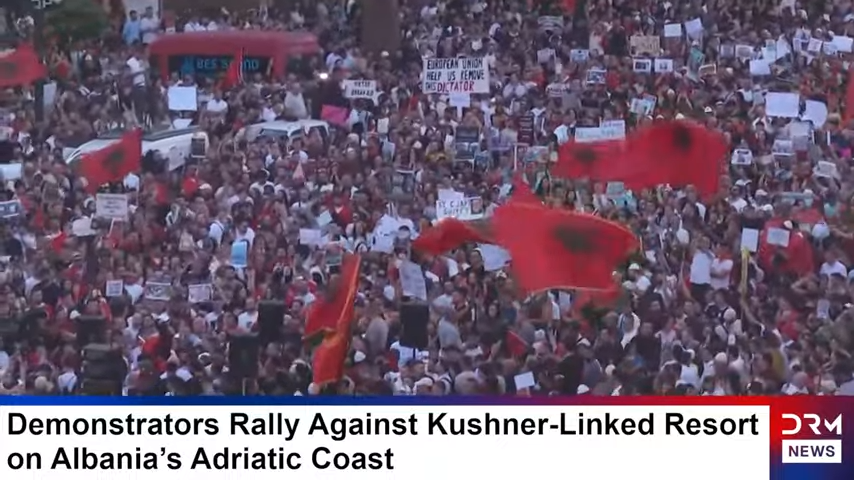
Massive protests swept across Albania in late May and early June 2026 against a high-profile luxury tourist megaproject valued at approximately 1.4 billion euros, spearheaded by Jared Kushner’s investment vehicle Affinity Partners. The ambitious development aims to transform the uninhabited Sazan Island — a strategically located former communist military base off the southern coast — along with adjacent sections of the protected Vjosa-Narta coastal region, including the ecologically vital Zvërnec lagoon and wetlands. Plans include thousands of hotel rooms, luxury villas, upscale apartments, a marina, and supporting infrastructure across a significant area, positioning it as one of the largest foreign investments in Albania’s history.
Prime Minister Edi Rama’s government has thrown its full weight behind the initiative, awarding it strategic investor status in late 2024 and early 2025. Albanian authorities argue that the project will inject critical foreign capital — primarily from Gulf investors — create thousands of jobs, stimulate tourism, and accelerate economic development in a country that remains one of the poorest in Europe. They emphasize that the development will respect protected zones and bring long-term prosperity to underdeveloped coastal areas. Ivanka Trump’s visit to the site in early 2026, accompanied by architects, and her description of Sazan as a “private island they discovered,” further intensified public emotions and turned the project into a lightning rod for controversy.
The protests, which drew thousands of demonstrators in Tirana and southern coastal towns over several days, were fueled by deep environmental and anti-corruption concerns. Environmental organizations and local residents contend that construction on this sensitive ecosystem would cause irreversible damage: destruction of wetlands, disruption of migratory bird routes, threats to flamingos, Mediterranean monk seals, sea turtles, and other protected species, as well as potential degradation of water quality in the lagoons. Critics also accuse the government of fast-tracking approvals with insufficient environmental impact assessments and questionable land acquisition practices. In response, Albania’s special anti-corruption prosecutor’s office (SPAK) opened an investigation, freezing accounts linked to companies involved in the project. Clashes between protesters and police, including the deployment of water cannons and private security forces, added to the tension, with demonstrators carrying symbolic pink flamingos and chanting “Albania is not for sale.”
This conflict goes beyond a single real estate development. It exposes deeper structural challenges in Albania: the tension between the desperate need for foreign investment and the protection of unique natural heritage, weak institutional oversight, and public distrust in decision-making processes. While the government frames the project as a bold step toward modernization and EU-aligned economic growth, opponents see it as emblematic of elite-driven deals that prioritize short-term gains over long-term sustainability and transparency.
As of now, the project remains active with no official indication of cancellation. However, ongoing investigations, domestic political pressure, and potential scrutiny from European Union institutions — as Albania pursues membership — could still shape its trajectory. The episode illustrates a classic dilemma for developing nations: how to attract large-scale investment without compromising environmental integrity, rule of law, and public trust. The outcome in Albania may set a precedent for similar high-stakes projects across the Balkans in the coming years.