
U.S. Allies Verify Participation In ‘Defensive’ Operations Following Iran Strikes
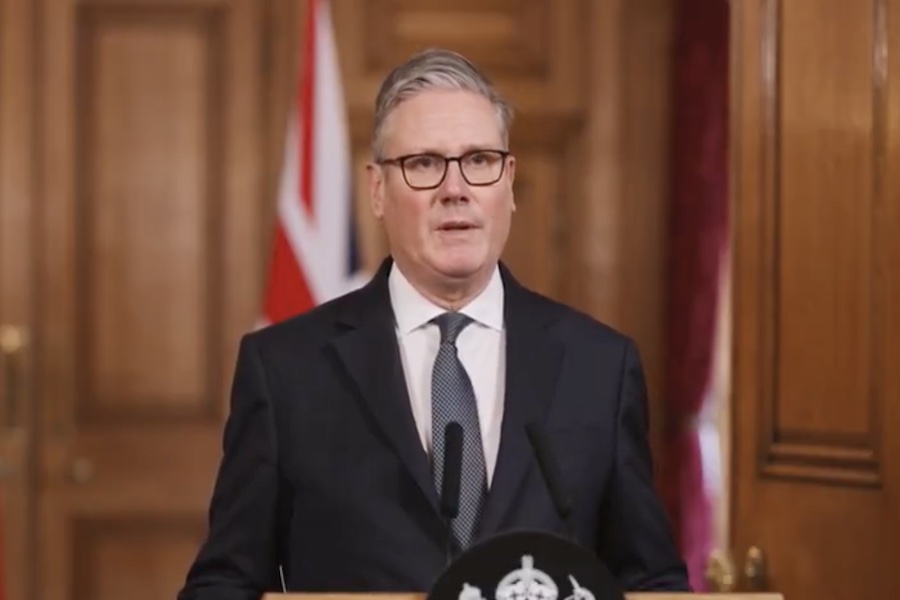
The United Kingdom has deployed military assets to support coordinated regional defensive operations in the Middle East, Prime Minister Keir Starmer confirmed Saturday morning. The announcement comes after U.S. and Israeli forces launched a joint military operation targeting Iranian military installations and leaders, which led to retaliatory strikes launched against U.S. military installations and several regional allies.
Starmer announced that British planes and missile defense systems were active throughout the day Saturday, but noted that U.K. military assets did not take part in any offensive operations.
“I condemn Iran’s attacks today on partners across the region, many of which are not parties to this conflict, we extend our support and solidarity to them as part of our commitments to the security of our allies in the Middle East,” the prime minister said following an emergency Cobra meeting.
“We have a range of defensive capabilities in the region, which we’ve recently strengthened. Our forces are active and British planes are in the sky today as part of coordinated regional defensive operations to protect our people, our interests and our allies, as Britain has done before, in line with international law.”
He added that the United Kingdom has stepped up protections for British bases and personnel to their highest level and is providing consular assistance to UK nationals in the region.
Starmer also stated that the United Kingdom has bolstered its defensive posture, including the deployment of RAF Typhoon fighter jets to Qatar to protect the al-Udeid airbase and other allied facilities. Additional F-35 aircraft, air defense systems, radar, and counter-drone capabilities have been positioned at RAF Akrotiri in Cyprus for potential support to regional partners, according to a report from The Guardian.
French President Emmanuel Macron and German Chancellor Friedrich Merz also vowed to participate in defensive operations in a separate statement in conjunction with Starmer.
The day’s events unfolded rapidly. U.S. and Israeli forces carried out strikes on Iranian military and leadership sites, including locations tied to the supreme leader, the presidential office in Tehran, and an advanced aerial defense system near Kermanshah. Multiple senior Iranian military commanders, including the commander go the Revolutionary Guard Corps (IRGC) and the nation’s defense minister, were killed in the opening salvo of the attack.
U.S. President Donald Trump described the operations as major combat actions and called for regime change in Iran. According to a report from Fox News, citing multiple senior officials with knowledge of the strikes, military strikes in Iraq could last “days, not hours.”
Iran responded with a barrage of missiles and drones targeting Israeli territory and U.S. military facilities across the region. Explosions and sirens were reported in Haifa, while U.S. bases came under attack at al-Udeid in Qatar, Ali Al-Salem airbase and Kuwait International Airport in Kuwait, a naval facility in Bahrain, and sites near Dubai in the United Arab Emirates.
Qatar, the UAE, Kuwait, Bahrain, and Jordan all reported successfully intercepting incoming projectiles. Limited damage, minor injuries, and at least one civilian death from falling debris in the UAE were confirmed as a result of the counterattacks.