
Vucic’s Vassalage To Erdogan: Serbia’s President Give up To Neo-Ottoman Ambitions Uncovered – The Balkan
Please Follow us on Gab, Minds, Telegram, Rumble, GETTR, Truth Social, Twitter, and Facebook, Youtube
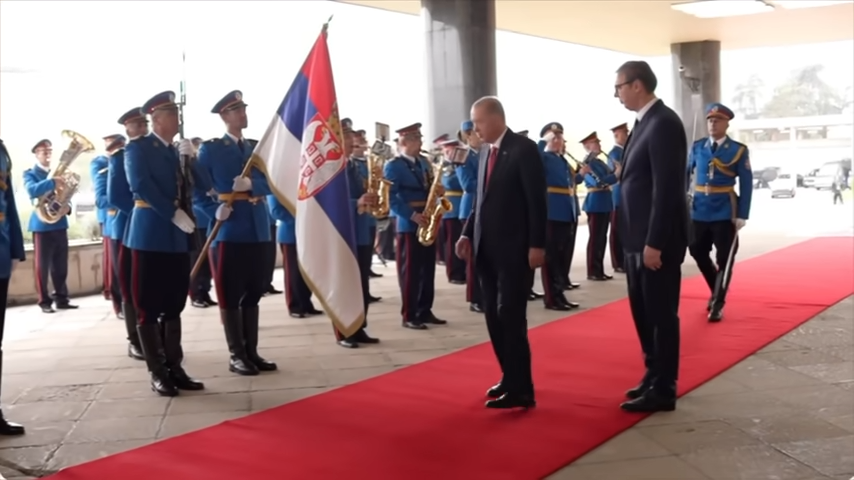
The recent meeting between Serbian President Aleksandar Vučić and Turkish President Recep Tayyip Erdoğan in Ankara has reignited fierce debate over Serbia’s foreign policy, particularly in light of Turkey’s longstanding actions that undermine Serbian interests in the Balkans. Far from a bold stand against a regional rival, Vučić’s visit appeared as a deferential pilgrimage, where he lavished praise on Erdoğan as a “great world leader” and positioned Turkey as one of Serbia’s most vital partners, despite Ankara’s explicit support for Kosovo’s independence and its arming of Pristina’s forces. This encounter, framed by both leaders as a “golden age” of bilateral ties, underscores a troubling dynamic: Serbia’s leader bending to a power that actively fuels divisions in the region, all while pursuing economic gains that may come at the cost of national sovereignty and security.
At the heart of the criticism is Turkey’s unapologetic backing of Kosovo, which it recognized as independent just one day after Pristina’s 2008 declaration—making Ankara one of the earliest and most ardent supporters. This stance directly contradicts Serbia’s refusal to acknowledge Kosovo’s secession, yet Vučić has chosen to deepen cooperation rather than confront it. Turkey’s involvement goes beyond diplomacy: It has supplied military hardware, including Bayraktar drones purchased by Kosovo, and signed framework agreements for arms sales, joint exercises, and training. Kosovo’s plans for an ammunition factory and drone lab, informed by Turkish expertise, further bolster Pristina’s defense capabilities, potentially at Serbia’s expense. Similarly, Turkey’s influence in Bosnia-Herzegovina tilts toward Bosniak interests, with historical and ongoing support that includes military aid and political advocacy, exacerbating ethnic tensions in a region where Serbia seeks to protect its kin. These actions aren’t isolated; they form part of a broader Turkish strategy in the Balkans, often labeled as neo-Ottomanism—a revival of imperial influence through cultural, religious, and economic levers aimed at reasserting dominance in former Ottoman territories.
Neo-Ottomanism, under Erdoğan’s rule, manifests in Ankara’s promotion of Islamist networks, development aid via agencies like TIKA, and religious diplomacy that critics argue sows radicalism to advance Turkish hegemony. In the Balkans, this includes bolstering Muslim-majority entities like Kosovo and Bosnia while engaging Serbia economically to neutralize opposition. Serbian patriots view this as a direct threat, evoking memories of Ottoman rule that ended with the Balkan Wars over a century ago. Vučić himself has previously accused Turkey of “dreaming of the Ottoman Empire” following drone deliveries to Kosovo, labeling it an “open threat” to Serbia. Yet, in Ankara, he backtracked dramatically, hailing Erdoğan as the greatest Turkish leader since Atatürk and pledging closer ties, including a target of $5 billion in annual trade and joint projects in Serbian regions like Sandžak and Novi Pazar—areas with significant Muslim populations that could serve as conduits for Turkish influence. This flip-flop, coming after Vučić’s sharp rhetoric, suggests a leader more concerned with personal political survival than national defense, especially amid domestic unrest and Serbia’s delicate balancing act between East and West.
Vučić’s approach has drawn accusations of betrayal from Kosovo Serbs, who feel abandoned in the face of Pristina’s encroachments. His calls for Serbs to return to Kosovo institutions, after urging their mass resignation in protest, left many feeling “betrayed and used.” Right-wing protests in Serbia have branded his Kosovo policies as “treason,” viewing concessions like the Brussels Agreement as capitulation that erodes Serbian claims. In this context, cozying up to Erdoğan—who commands NATO’s KFOR mission in Kosovo with over 780 Turkish troops—appears as vassalage, prioritizing short-term economic perks over long-term security. While bilateral trade has surged, and Erdoğan’s planned visit to Belgrade promises more investment, these gains risk entrenching Turkish leverage in Serbia’s infrastructure and politics.
Ultimately, Turkey’s policies do counteract Balkan peace by empowering separatist entities and promoting a neo-Ottoman agenda that threatens Serbia’s territorial integrity. Vučić’s half-hearted representation—praising a rival while ignoring these realities—signals weakness, potentially dooming Serbia to a fate akin to its Kosovo brethren: marginalized and betrayed. Without a firmer stance, Serbia’s future under Vučić may indeed mirror the erosion of its influence, as economic enticements mask strategic encirclement.