
Venezuela’s Pale Oil Glory: Unpacking Prosperity, Corruption, And Sky-Excessive Perils – JP
Please Follow us on Gab, Minds, Telegram, Rumble, Truth Social, Gettr, Twitter, Youtube
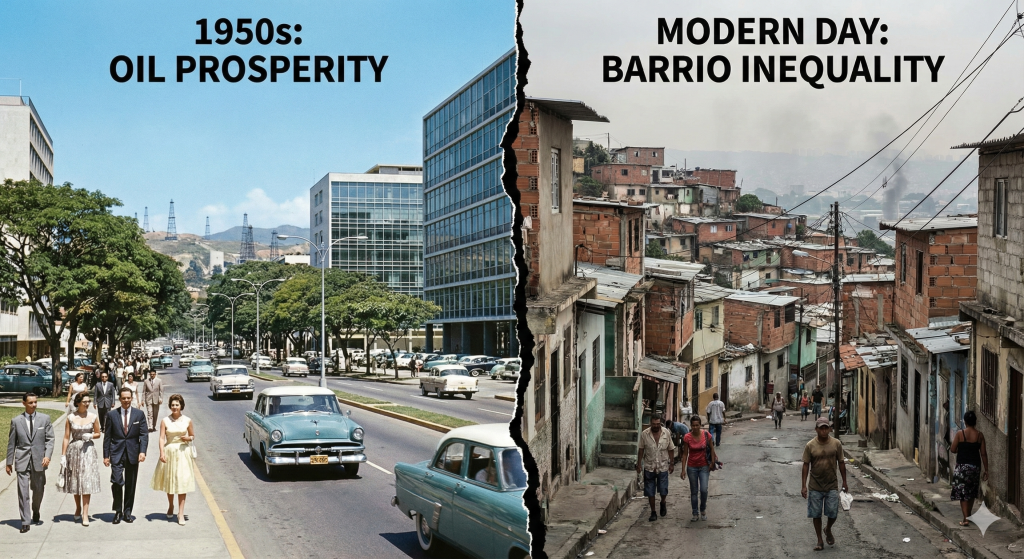
Senator Ted Cruz has often invoked a striking historical fact to critique modern socialism in Venezuela: in 1950, the country had the fourth-highest GDP per capita in the world. This claim, frequently used in his speeches and social media posts, paints a picture of a once-thriving nation undone by leftist policies. But is it accurate? What does it reveal about Venezuela’s economic past? As a retired Delta Air Lines captain with firsthand experience navigating the region’s turbulence, I’ve long questioned such narratives, especially given the corruption that deterred my company from deeper involvement back then. Let’s dissect this, blending economic data, historical context, and aviation insights to uncover the full story.
First, the claim holds water—sort of. Historical datasets from sources like the Maddison Project Database and NationMaster confirm that Venezuela ranked fourth in nominal GDP per capita in 1950, at around $7,424. It trailed only the United States ($9,573), Switzerland ($8,939), and New Zealand ($8,495), while outpacing powerhouses such as Australia, Canada, and the United Kingdom. This surge was fueled by an oil boom that began in the early 20th century, transforming Venezuela into a petro-state. Foreign companies like Standard Oil poured in, extracting vast reserves and boosting national output. Even in purchasing power parity terms, Venezuela hovered in the top 5-7 globally.
However, this metric—mean GDP per capita—tells only half the tale. As I’ve pointed out, it’s an average that can be wildly skewed by wealth concentration. If riches are jammed into the pockets of the top 1%, the figure soars, but the average citizen sees little benefit. Venezuela in the 1950s exemplified this: Oil wealth flowed to elites, government officials, and multinational firms, while rural poverty and urban slums persisted. The Gini coefficient, a measure of inequality, likely exceeded 0.5 during this era, based on Latin American trends and later data from the 1960s-1970s. By comparison, the U.S. Gini in 1950 was about 0.38, indicating a more even spread.
‘NO AD’ subscription for CDM! Sign up here and support real investigative journalism and help save the republic!
To get a truer sense of “typical” prosperity, we’d look to median income or GDP per capita equivalents, which filter out billionaire outliers. Unfortunately, precise 1950 median data for Venezuela is scarce, but economic historians estimate it could have been 40-60% below the mean, around $3,000-$4,500. This adjustment might drop Venezuela’s ranking below the top 10, revealing a prosperity illusion. Fast-forward to today: Venezuela’s mean GDP per capita lingers around $3,500, but median monthly incomes dip under $100, underscoring persistent disparities amid hyperinflation and economic collapse.
Corruption has been the rot at the core, evident even in the 1950s under the dictatorship of Marcos Pérez Jiménez (1952-1958). His regime was notorious for embezzlement, cronyism in oil contracts, and extravagant projects that lined insiders’ pockets while quashing opposition. Transparency International now ranks Venezuela among the world’s most corrupt nations, scoring a dismal 13/100 in 2023. This endemic graft extended to aviation, influencing operations like those of Delta Air Lines. Contrary to initial assumptions, Delta didn’t shy away entirely; it entered Venezuela in 1953 through a merger with Chicago and Southern Air Lines, launching its first international route from New Orleans to Caracas. Early schedules featured 2-3 weekly flights on Lockheed Constellations or Douglas DC-6s, often with stops in Havana or Montego Bay.
Over the decades, Delta expanded amid Venezuela’s oil-fueled growth. By the 1950s-1960s, service ramped up to daily flights on DC-7s, shifting hubs to Atlanta in the 1970s-1980s with Boeing 727s and L-1011s handling 1-2 daily nonstops. The 1990s-2000s saw modernization to 757/767s, adding Miami routes and peaking at 7-14 weekly flights systemwide, emphasizing cargo for the oil trade. Yet challenges mounted: In 2006, under Hugo Chávez, currency controls and issues with revenue repatriation began eroding profitability. By 2014, trapped funds reached $3.8 billion industry-wide, prompting Delta to slash Atlanta-Caracas flights to 3-5 weekly. Safety concerns and civil unrest led to a full suspension in July 2017. As of early 2026, with U.S. strikes against the Maduro regime and his arrest creating airspace disruptions (temporarily halting nearby routes to Aruba), Delta shows no signs of resuming service to Venezuela.
This aviation lens highlights broader U.S. entanglements in Latin America, where democracy-building efforts have a notoriously poor track record. Interventions often prioritized American interests—anti-communism, resource security—over sustainable governance, fostering resentment and instability. Haiti stands as a prime example: The U.S. occupation (1915-1934) aimed at debt enforcement but entrenched corruption; backing the Duvalier dictators (1957-1986) enabled horrors; the 1994 Aristide restoration via invasion failed to prevent coups; and post-2010 earthquake aid was plagued by mismanagement, leaving gangs and poverty unchecked. Similar missteps dot the map: The 1954 CIA-orchestrated coup in Guatemala, support for Pinochet in Chile (1973), and Contra funding in Nicaragua (1980s) replaced elected leaders with authoritarians, exacerbating inequality.
In Venezuela, U.S. sanctions and recognition of figures like Juan Guaidó in 2019 aimed to oust Maduro but arguably prolonged his grip until recent escalations. These patterns reveal a cycle: Resource-rich nations like Venezuela attract exploitation, inequality festers under corrupt rule, and foreign meddling backfires.
Ultimately, Cruz’s statistic spotlights an absolute historical peak, but it glosses over the inequities and corruption that sowed the seeds of decline. As a former pilot who witnessed the region’s volatility firsthand, I see parallels today—opportunities lost to graft and geopolitical games. Venezuela’s story isn’t just about failed socialism; it’s a cautionary tale of uneven booms, persistent kleptocracy, and the high costs of intervention. With recent shifts post-Maduro, perhaps reform beckons, but history urges skepticism. With a marginal record of political democracy, Venezuela’s actual progress demands addressing the median, not just the mean, and building from within.
The post Venezuela's Faded Oil Glory: Unpacking Prosperity, Corruption, And Sky-High Risks appeared first on JP.