
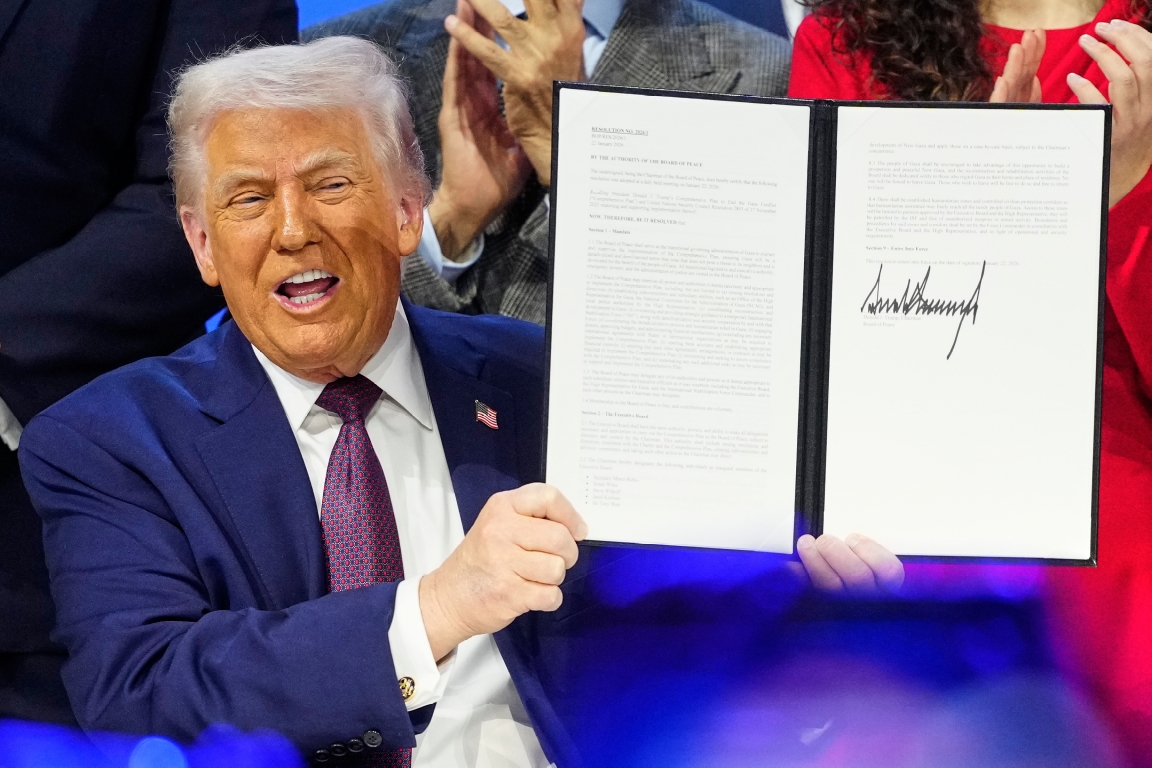
Trump “Ratifies” Board of Peace Constitution in Davos
President Donald Trump on Thursday announced a new international organization during the World Economic Forum (WEF) in Davos, where political and corporate elites gather annually to shape global policy.
According to the White House,
Today, in an historic ceremony in Davos, Switzerland, President Donald J. Trump formally ratified the Charter of the Board of Peace — establishing it as an official international organization.
The statement framed the moment as decisive. It described the Board of Peace as the engine of a postwar transformation of Gaza and a mechanism to deliver “lasting peace, stability, and opportunity for its people.”
The declaration, however, rests on clearly unconstitutional grounds. Under the Constitution, international treaties require the consent of two thirds of the Senate. No such vote has taken place. Moreover, the charter designates Trump as chairman of the new international body, a role not among the powers enumerated to the presidency under the Constitution.
At the same time, the charter itself tells an ambiguous story. Its full text was not released by the White House or the State Department. Instead, it was published by The Times of Israel, which said it “obtained and verified” the document after it was circulated privately to invited leaders.
What the text contains, and what it omits, has become central to the controversy now unfolding.
Contradictory Messaging
The White House announcement left little doubt about intent. It explicitly tied the Board of Peace to “President Trump’s vision of transforming Gaza.” The page links to the RapidResponse47 page on X describing Trump’s “Comprehensive Plan to End the Gaza Conflict,” reported on by JP here.
The text of the charter posted by The Times of Israel, however, does not reference Gaza.
As the outlet stressed,
It notably makes no mention of Gaza, bolstering The Times of Israel’s reporting that the US wants the Board of Peace to assist in the resolution of other conflicts around the globe.
The omission is particularly striking since
the mandate of the board approved in November by the Security Council is limited to Gaza and only until the end of 2027.
Additionally, while the sixth point of Trump’s original plan focuses on Hamas, the reported charter has no mention of it either. It does not address disarmament in Gaza. It also makes no mention of war crimes allegations facing either Hamas or Israel. And it does not limit the board’s scope geographically or politically.
Instead, the preamble frames the board as an alternative to existing institutions. It speaks of the need for “the courage to depart from approaches and institutions that have too often failed.” It also calls for “a more nimble and effective international peace-building body.”
The contradiction is now impossible to ignore. Public messaging casts the board as Gaza-focused. The legal text — if authentic — leaves the door wide open to a global mandate.
Mission
The charter opens with a broad mission statement:
The Board of Peace is an international organization that seeks to promote stability, restore dependable and lawful governance, and secure enduring peace in areas affected or threatened by conflict.
It adds that the board will undertake “peace-building functions in accordance with international law.” It will also develop best practices “capable of being applied by all nations and communities seeking peace.”
The language is expansive and aspirational. It also raises immediate questions.
The charter does not specify which bodies or legal frameworks will define compliance with international law. It describes no enforcement mechanism.
The claim to “secure enduring peace” also sits uneasily alongside heavy-handed foreign policy of the Trump administration. During the past year alone, the United States has been directly involved in military operations or strikes across multiple countries. After the Nicolás Maduro regime in Venezuela, it has issued explicit military threats against several other states, including long-standing allies.
The charter does not address how those realities align with its stated mission. It offers no criteria for what constitutes “lawful governance,” no benchmarks for peace, and no process for evaluating success or failure.
In that sense, the mission sets the tone for the document as a whole. It emphasizes authority and ambition while leaving key legal and practical questions unresolved.
Chairman
The charter defines the Board of Peace as a fully fledged international organization with international legal personality. It may enter contracts, acquire and dispose of property, open bank accounts, receive public and private funds, and employ staff.
At the center of this structure sits a single office. Article 3 states,
Donald J. Trump shall serve as inaugural Chairman of the Board of Peace, and he shall separately serve as inaugural representative of the United States of America
The chairman holds final approval authority over all major decisions. These include budgets, international agreements, the creation of subsidiary entities, and the initiation of new peace-building missions.
While member states may vote on proposals, all decisions require the chairman’s approval to take effect. In the event of a tie, the chairman may cast the deciding vote. In disputes over the meaning or application of the charter, the chairman is explicitly designated as the final authority.
Removal of the chairman is tightly constrained. The charter states that replacement may occur only following “voluntary resignation” or “incapacity,” and only if the Executive Board votes unanimously. In such a case, the chairman’s pre-designated successor would immediately assume all duties and authorities of the role.
The charter also grants the chairman exclusive authority to create, modify, or dissolve subsidiary bodies. These decisions are not subject to review by any external institution. No independent oversight mechanism is established.
In addition, the chairman is empowered to invite regional economic integration organizations to participate in the Board’s proceedings. The terms, scope, and conditions of such participation are left entirely to the chairman’s discretion.
Rules for Admission and Tenure
Membership rules reinforce the board’s transactional design.
Article 2 restricts membership to states invited by the chairman. Each member state must be represented by its head of state or government. Membership terms are limited to three years and may be renewed only at the chairman’s discretion.
The charter then introduces a key exception.
The three-year membership term shall not apply to Member States that contribute more than USD $1,000,000,000 in cash funds to the Board of Peace within the first year of the Charter’s entry into force.
The charter does not specify how those funds are allocated, administered, or audited.
Exit rules are minimal. A member state may withdraw at any time by written notice to the chairman. Removal is also uncomplicated. The chairman may terminate a state’s membership, subject only to a potential veto by two-thirds of the remaining members.
The resulting structure more closely resembles a private club than a multilateral institution, with membership fees, duration, and expulsion managed from the top.
The Executive Board
The charter creates a second tier of governance beneath the board of member states, called the Executive Board.
The Executive Board is responsible for operational oversight, implementation, and the day-to-day direction of the Board of Peace’s work under the chairman’s authority.
Article 4 of the charter provides that the Executive Board shall be “selected by the Chairman and consist of leaders of global stature.” Its members serve two-year terms, are removable at the chairman’s discretion, and may have their terms renewed. The board is led by a Chief Executive, nominated by the chairman and confirmed by a majority vote of the Executive Board itself. Decisions by the Executive Board are made by a simple majority of members present. They go into effect immediately, subject to veto by the chairman.
Members of the Executive Board
On January 16, the White House announced the formation of the founding Executive Board tasked with carrying out the Board of Peace’s mission. It comprises a mix of political and business figures with experience in “diplomacy, development, infrastructure, and economic strategy” under the umbrella of the board’s mandate.
The appointed members include:
- Marco Rubio, U.S. secretary of state
- Steve Witkoff, special envoy to the Middle East
- Jared Kushner, Trump’s son-in-law and private investor
- Sir Tony Blair, former prime minister of the United Kingdom
- Marc Rowan, CEO of Apollo Global Management
- Ajay Banga, president of the World Bank
- Robert Gabriel, Jr., American political advisor
Who’s on Board?
JP reported on Thursday that Trump invited about 50 countries to join the Board of Peace.
A White House official said they expected about 30 counties to join. The administration has not published a complete invite list or a definitive roster of members.
Some governments said yes quickly. Among early joiners are
Israel, Saudi Arabia, the United Arab Emirates, Bahrain, Jordan, Qatar and Egypt … Turkey and Hungary, … Morocco, Pakistan, Indonesia, Kosovo, Uzbekistan, Kazakhstan, Paraguay, and Vietnam [and] Armenia and Azerbaijan….
More controversially, Belarusian President Alexander Lukashenko … has accepted Trump’s invitation.
European participation looks thin. Antiwar.com reported,
French, Scandinavian, and other Western European governments have been among the most vocal in declining invitations, citing concerns about the board’s mandate, structure, and potential to undercut established international institutions.
The United Kingdom, Germany, Italy, and 27 countries sitting on the European Commission “have not yet committed.”
Russia signaled it was willing to participate, indicating that it could use state assets frozen by the United States and allies in 2022 under sanctions to cover the board’s required initiation fee.
Canada became a public warning shot. Trump reportedly withdrew his invitation to Mark Carney after a Davos dispute.