
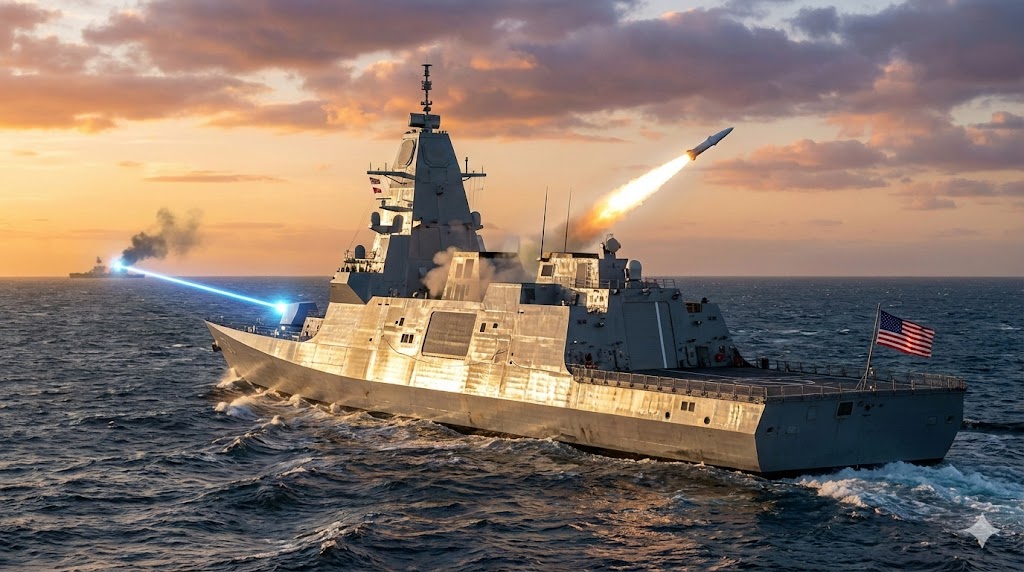
Trump Administration Unveils ‘Trump-Class’ Battleships: Revival Of Naval Energy Or Excessive-Stakes Gamble? – JP
Please Follow us on Gab, Minds, Telegram, Rumble, Truth Social, Gettr, Twitter, Youtube
In a dramatic announcement at Mar-a-Lago on December 22, 2025, President Donald Trump unveiled plans for a new class of U.S. Navy warships, dubbed the “Trump-class” battleships, positioning them as the cornerstone of a “Golden Fleet” initiative to modernize and expand American naval capabilities.
Flanked by Defense Secretary Pete Hegseth, Navy Secretary John Phelan, and Secretary of State Marco Rubio, Trump described the vessels as “the fastest, the biggest, and by far 100 times more powerful than any battleship ever built,” emphasizing their role in restoring U.S. military supremacy and countering global adversaries.
The lead ship, USS Defiant, is set to begin construction immediately, with the first two vessels targeted for completion in about 2.5 years, potentially scaling to 20-25 ships overall.
Ship Specifications and Design
The Trump-class ships are projected to displace 30,000-40,000 tons—larger than current U.S. destroyers like the Arleigh Burke-class (9,000-10,000 tons) but roughly half the size of World War II-era Iowa-class battleships (58,000-60,000 tons). These stats place them more in the category of heavy cruisers or advanced guided-missile combatants rather than traditional battleships, despite the nomenclature. Armament includes 128+ vertical launch system (VLS) cells for missiles, hypersonic weapons, electromagnetic railguns (a technology the Navy previously shelved), high-powered directed energy lasers, and potentially nuclear-armed sea-launched cruise missiles.
Conventional guns are limited to 5-inch (127mm) Mark 45 mounts, a far cry from the 16-inch (406mm) guns of historic battleships. Armor details remain undisclosed, but experts note a shift from thick steel plating (up to 19 inches on Iowa-class turrets) to modern defenses like stealth design, compartmentalization, and active systems. These characteristics reflect evolving warfare priorities, where missiles and drones dominate over gun duels. Trump highlighted the ships’ integration of artificial intelligence for command and operations, serving as hubs for manned and unmanned vessels, while personally influencing their aesthetic design.
Strategic Rationale: Deterrence and Offensive Potential
Administration officials frame the initiative as a deterrent against rising threats, particularly from China, though Trump stressed it’s a “counter to everybody.” The plan replaces the canceled DDG(X) destroyer program and aims to revitalize domestic shipbuilding, creating jobs and accelerating production. Proponents argue it aligns with Alfred Thayer Mahan’s 19th-century “Sea Power” doctrine, which emphasized capital ships for controlling sea lines, projecting power, and achieving decisive victories. In this view, the Trump-class could concentrate force for blockade operations or commerce protection, deterring aggression through visible strength without necessarily engaging in major conflicts.
However, the ships’ potential as primary offensive weapons in peer-to-peer wars raises questions. Mahan’s ideas, while foundational, predate modern threats such as hypersonic missiles, submarines, and cyberattacks, prompting adaptations toward “distributed lethality”—spreading capabilities across smaller, resilient platforms to avoid single points of failure.
Vulnerabilities and Criticisms
A key concern is the “eggs in one basket” risk: these high-value targets, estimated at $10-15 billion each, could make entire naval forces vulnerable if sunk.
Historical precedents, such as the loss of the Russian cruiser Moskva in 2022 or WWII battleships like the Yamato, illustrate how asymmetric weapons can neutralize capital ships. In simulations of conflicts with China, large surface combatants often face early attrition from anti-access/area-denial systems, potentially disrupting fleet operations and morale.
Critics, including defense analysts, argue that the design revives outdated concepts in an era that favors unmanned systems and carriers. Social media reactions have been polarized: some hail it as a symbol of American dominance, with one X user calling it “MASSIVE” and a step toward “strength and dominance,” while others deride it as “bonkers” or “going full North Korean,” questioning the feasibility amid budget strains and shipyard delays. Republican Rep. John Rose praised the move as fulfilling promises to bolster defense. Still, progressive outlets like Common Dreams labeled it “exactly what we don’t need,” citing environmental and fiscal costs.
Supporters counter that the ships’ advanced defenses and speed could mitigate risks, enhancing deterrence in gray-zone scenarios. Defense contractors like Huntington Ingalls Industries saw their shares rise 4% post-announcement, signaling market optimism about contract awards. Yet, with no congressional funding secured, skeptics predict overruns or cancellations, echoing past programs like the Zumwalt-class destroyers.
Broader Implications
The announcement comes amid heightened U.S.-Venezuela tensions, with naval buildups in the Caribbean, underscoring its timing for power projection. As the Navy grapples with recruitment and maintenance issues, the Trump-class could inspire innovation or strain resources. Experts urge rigorous studies to balance Mahanian concentration with modern dispersion, ensuring the “Golden Fleet” strengthens rather than exposes U.S. sea power. Whether a visionary leap or a symbolic misstep, the Trump-class battleships signal a bold pivot in U.S. naval strategy, sparking debate on the future of maritime dominance in an uncertain world.