
Transatlantic Experts Urge Activation Of UN Snapback Sanctions Amid Iran’s Nuclear Escalations – JP
Please Follow us on Gab, Minds, Telegram, Rumble, Truth Social, Gettr, Twitter, Youtube
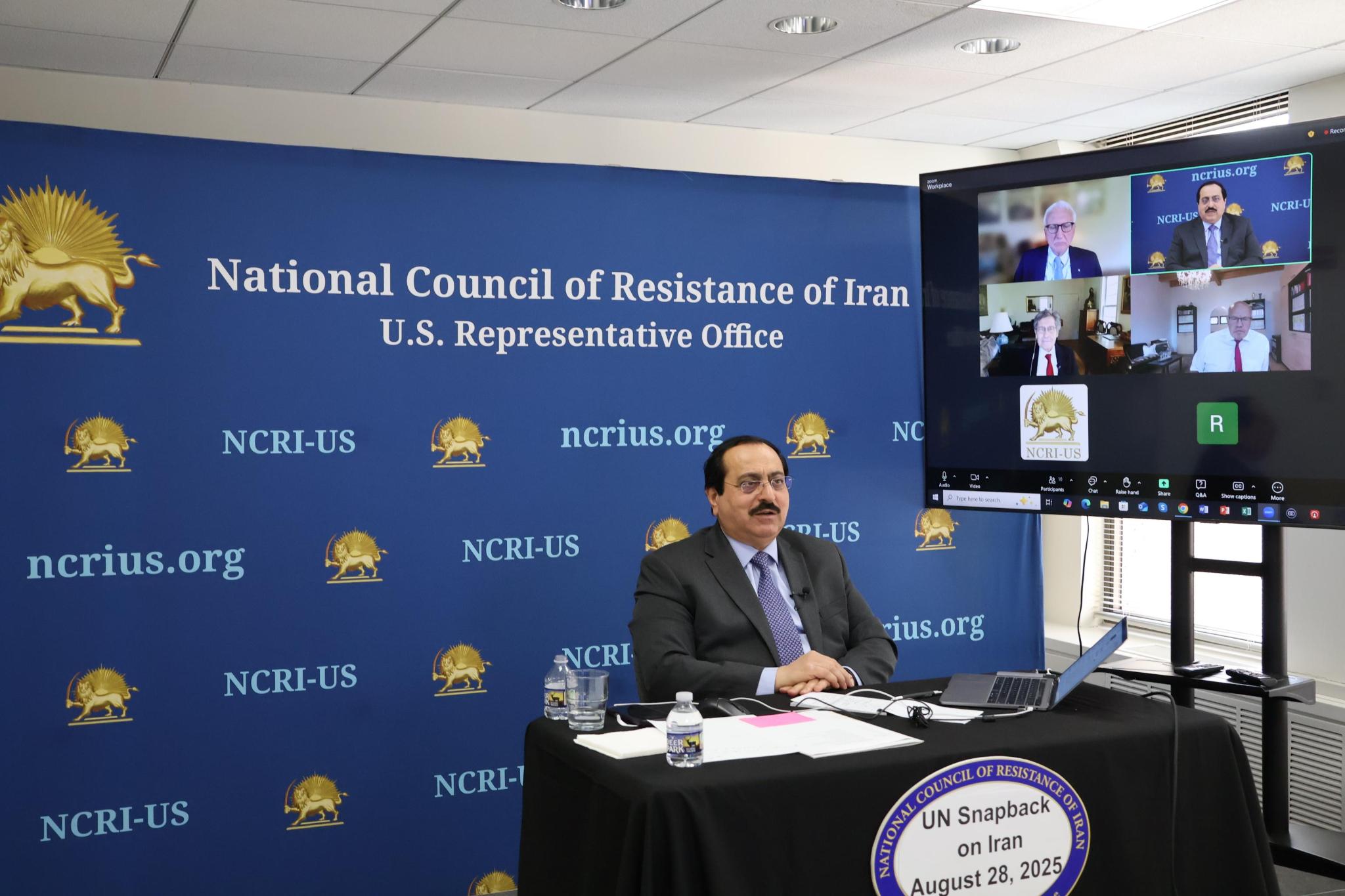
Washington, D.C. – August 28, 2025 – At an online policy forum titled “UN Snapback Sanctions on Iran: Necessity, Effectiveness, and Consequences,” hosted by the Washington Office of the National Council of Resistance of Iran (NCRI-US) on Thursday, prominent American and European diplomats, along with leading non-proliferation experts, expressed strong support for the recent move by France, Germany, and the United Kingdom (E3) to activate the UN “snapback” mechanism, reinstating international sanctions against Tehran.
The event was moderated by Alireza Jafarzadeh, Deputy Director of NCRI-US and author of “Iran Threat.” It featured four distinguished speakers with extensive experience handling Iran’s nuclear dossier at senior levels. Ambassador Robert G. Joseph, former U.S. Undersecretary of State for Arms Control and International Security; Ambassador Joseph DeTrani, former Senior Advisor to the Director of National Intelligence and U.S. Special Envoy for Six-Party Talks with North Korea; Peter Altmaier, former German Minister for Economic Affairs and Energy, and former Chief of Staff to Chancellor Angela Merkel; and Dr. Olli Heinonen, former Deputy Director General of the International Atomic Energy Agency (IAEA), currently a distinguished fellow at the Stimson Center
The conference took place just hours after the E3 formally declared its intention to initiate the process of reimposing UN sanctions on Iran, citing Tehran’s continued breaches of the 2015 nuclear agreement, officially known as the Joint Comprehensive Plan of Action (JCPOA). The United States welcomed this step, viewing it as a critical measure to hold the Iranian regime accountable for its nuclear ambitions.
Iranian officials have sharply criticized the E3’s actions, labeling them as “confrontational” and counterproductive, and warned that the move will undermine Europe-Iran relations.
In a statement marking shortly after the E3 wrote to the UN Security Council to activate the snapback mechanism, Maryam Rajavi, President-elect of the National Council of Resistance of Iran said, “The activation of the snapback mechanism and enforcement of UN Security Council resolutions is belated but urgent and necessary,” adding, “The fruitless talks last week between the foreign ministers of the three European countries and the foreign minister of the Iranian regime, as well as the failed meeting of deputy foreign ministers on August 26 in Geneva, once again prove the undeniable truth that the mullahs’ regime is not prepared to abandon its project of building a nuclear bomb. This makes the activation of the snapback mechanism and the enforcement of the six UN Security Council resolutions on the regime’s nuclear projects all the more urgent and essential.”
Mrs. Rajavi reminded that the real solution to the Iranian crisis is regime change by the people of Iran and their Resistance. The Iranian Resistance has long warned that appeasement makes war inevitable, a reality we have already witnessed. Without appeasement and concessions, this regime would never have come so close to obtaining the nuclear bomb. In that case, there would have been no war either.”
Opening the panel, Ambassador Robert G. Joseph praised the European decision as both necessary and overdue. “It’s very clear that Iran is in violation of the JCPOA. Just look at the stockpiling of 60% enriched uranium, as well as the failure to cooperate with the IAEA on both weaponization issues and suspect sites,” he said, adding, “The E3’s decision is the right one, but it may not be the final word. Zero enrichment must be the red line. Any resumption of talks, he insisted, must adhere to the principle that Iran has no right to enrich uranium. There is a third option beyond war or endless negotiations: supporting the Iranian people and their organized opposition in achieving a free, democratic government.” “This is not Iraq, not Libya. Iran is an ancient nation with a people determined to secure their freedom,” Joseph stressed.Opening the panel, Ambassador Robert G. Joseph praised the European decision as both necessary and overdue. “It’s very clear that Iran is in violation of the JCPOA. Just look at the stockpiling of 60% enriched uranium, as well as the failure to cooperate with the IAEA on both weaponization issues and suspect sites,” he said, adding, “The E3’s decision is the right one, but it may not be the final word. Zero enrichment must be the red line. Any resumption of talks, he insisted, must adhere to the principle that Iran has no right to enrich uranium. There is a third option beyond war or endless negotiations: supporting the Iranian people and their organized opposition in achieving a free, democratic government.” “This is not Iraq, not Libya. Iran is an ancient nation with a people determined to secure their freedom,” Joseph stressed.
Ambassador Joseph DeTrani highlighted Tehran’s longstanding pursuit of nuclear weapons. He emphasized that Tehran retained expertise, infrastructure, and materials. By 2015, Iran was enriching uranium to 20%—and by 2025, before the recent Israeli and U.S. strikes, Iran was enriching to 60%. “That’s a clear indicator of weapons intent,” DeTrani said. “You don’t enrich to 60% unless you want to signal you’re within weeks of reaching weapons-grade, he stressed.”that Tehran retained expertise, infrastructure, and materials. By 2015, Iran was enriching uranium to 20%—and by 2025, before the recent Israeli and U.S. strikes, Iran was enriching to 60%. ““That’s a clear indicator of weapons intent,” DeTrani said. “You don’t enrich to 60% unless you want to signal you’re within weeks of reaching weapons-grade, he stressed.”
Speaking from Berlin, Germany, former minister Peter Altmaier described the snapback decision as a turning point for Europe’s role in global security. “For the first time in more than six years, the Western world is now united—at least as regards the nuclear program,” he said. “This was a good day for the Iranian people,” Altmaier said. “The weakness of the regime has been exposed by Israeli and U.S. strikes on nuclear facilities, and now Europe has taken the initiative to trigger the mechanisms. They are serious.”Speaking from Berlin, Germany, former minister Peter Altmaier described the snapback decision as a turning point for Europe’s role in global security. “For the first time in more than six years, the Western world is now united—at least as regards the nuclear program,” he said. “This was a good day for the Iranian people,” Altmaier said. “The weakness of the regime has been exposed by Israeli and U.S. strikes on nuclear facilities, and now Europe has taken the initiative to trigger the mechanisms. They are serious.”
Dr. Olli Heinonen offered a technical assessment of Iran’s compliance. “Iran has not been complying with all its obligations under the Comprehensive Safeguards Agreement. When the IAEA says something doesn’t fit with Iran’s declaration, it means the facts do not match. The Agency does not manipulate,” he stressed. Heinonen argued that the snapback mechanism is an opportunity for the regime to change course but warned against simply reviving the JCPOA in its flawed form. Instead, he called for new arrangements ensuring dismantlement of any weapons-related capabilities and intrusive monitoring, as was done in South Africa, Iraq, and Libya.
In closing the discussion, Jafarzadeh emphasized that the E3’s decision to trigger the snapback mechanism was “just the first step—like opening the door to a whole new world that was not there before.” He underscored thatthe NCRI and MEK have played a decisive role in exposing Tehran’s clandestine programs. “The biggest factor preventing the regime from getting the bomb, according to their own confessions, has been the Iranian Resistance. We revealed secret nuclear sites as early as 1991. It was our disclosure of Natanz that triggered IAEA inspections. We exposed over 40 sites tied to the missile program, and in Washington, we were the first to uncover Tehran’s drone project back in 2020. We also uncovered their terror networks, including the 2018 Paris bomb plot by a regime diplomat whose target was Mrs. Maryam Rajavi.”
As the 30-day snapback clock begins ticking, the NCRI-US conference serves as a stark reminder of the JCPOA’s fragility and the urgent need for coordinated action. Experts agree that without decisive measures, Iran’s nuclear program could embolden other proliferators, destabilizing international norms. However, the path forward remains fraught, with calls for a balanced approach that combines sanctions with diplomatic incentives.
Pressure continues to mount on the Iranian regime from within from popular discontent and from without from the international community. The veil of secrecy that has protected the mullahs for decades is being torn to shreds and one can only wonder how long a failed leadership can hang on behind the false protection of theocracy.