
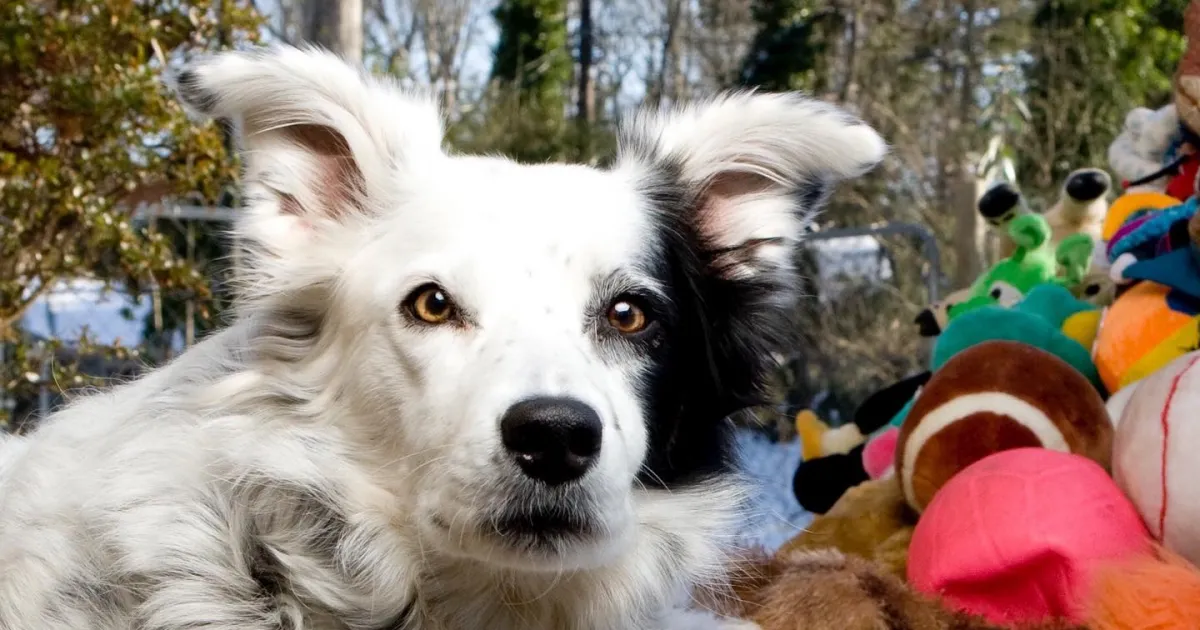
The Genius Canine Who May Acknowledge 1,022 Toys by Identify
A birthday gift became one of the most remarkable experiments in animal cognition. Chaser, a Border Collie from Spartanburg, South Carolina, held the largest tested memory of any non-human animal — and the method behind her learning offers a fascinating window into canine intelligence that’s still reshaping how we understand the animals closest to us.
How a Birthday Present Became a Scientific Breakthrough
Sally Pilley gave the puppy to her husband, John W. Pilley, a Wofford College Professor Emeritus of Psychology, as a 76th birthday present in June 2004. Chaser was eight weeks old.
“She came to me when she was eight weeks old and had been with us ever since,” Sally told GoUpstate. “We were playing with her out in the front yard one day, and a red Jeep came flying past us and she went flying out after the car, so we decided to name her Chaser.”
The name stuck. So did something else: Pilley’s curiosity about what a dog could actually learn when given sustained, structured attention.
Five Hours a Day, Five Days a Week, for Nine Years
Pilley’s approach wasn’t casual. He trained Chaser up to five hours a day, five days a week, for nine years. The results were staggering. Chaser could identify and retrieve 1,022 toys by name. She learned to differentiate between nouns and verbs. She understood simple sentences.
“She has the capabilities of a two-year-old,” Pilley told 60 Minutes in 2014.
That comparison — a dog matching the linguistic processing of a toddler — caught the attention of researchers studying how language works across species.
“This is a very serious science… we’re not talking about stupid pet tricks,” Brian Hare, an evolutionary anthropologist at Duke University, told 60 Minutes in 2014. “Chaser is learning tons, literally thousands of new things by using the same ability that kids use when they learn lots of words.”
Hare, who is also co-author of the book The Genius of Dogs, went further: “Chaser is the most scientifically important dog in over a century.”
What Chaser’s Story Revealed
The distinction between Chaser and a typical well-trained dog comes down to language comprehension versus command response. Chaser wasn’t just obeying sit-stay commands. She was processing noun-verb relationships and applying them to novel situations — the same cognitive architecture young children use during language acquisition.
Pilley published a book in 2013, Chaser: Unlocking the Genius of the Dog Who Knows a Thousand Words, which became a New York Times bestseller. Chaser appeared as a guest on Nova ScienceNOW with Neil DeGrasse Tyson and was featured on a 2014 episode of 60 Minutes with Anderson Cooper as “The Smartest Dog in the World.” Coverage spread across TIME, People Magazine, The New York Times, USA Today, Wall Street Journal, National Geographic, New Scientist, Popular Science, Modern Dog and The Huffington Post.
Pilley died in June 2018. Chaser died from natural causes in July 2019, at 15 years old.
What You Can Take From This
Chaser’s training wasn’t built on treats or tricks alone. It was built on consistency: structured daily sessions over years, focused on building language comprehension in small increments. The 1,022-toy vocabulary didn’t happen in a weekend.
If you’re rethinking how you engage with a pet, Chaser’s story is worth sitting with. The daily time investment Pilley made — and the cognitive gains that followed — suggests that the ceiling on what dogs can learn may be far higher than most people assume. The limiting factor, Pilley’s work implies, is often the training, not the animal.