
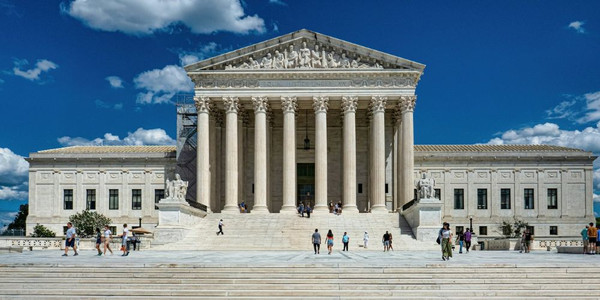
Supreme Court to consider ban on race-based congressional redistricting to narrow Voting Rights Act
If the Court ultimately rules that race-conscious redistricting is unconstitutional, it could significantly restrict how Section 2 of the Voting Rights Act is applied in future cases.
The Supreme Court will consider whether the intentional creation of majority-minority congressional districts violates the Constitution, a move that could significantly narrow the scope of the Voting Rights Act and reshape redistricting nationwide.
The case centers on Louisiana’s congressional map, which currently includes two majority-black districts out of six total seats. That map, adopted by the state legislature in 2024, came after a federal court ruled that the state’s prior 2022 map, with only one majority-black district, likely violated Section 2 of the Voting Rights Act by diluting the voting power of black residents, who make up about one-third of the state’s population.
A group of voters who identified themselves as non-black challenged the 2024 map in federal court, arguing it constituted an unconstitutional racial gerrymander. A three-judge district court agreed, but the Supreme Court later paused that ruling, allowing the 2024 map to be used in the election.
On Friday, the justices asked the parties involved to file new briefs on whether the “intentional creation of a second majority-minority congressional district violates the Fourteenth or Fifteenth Amendments to the U.S. Constitution.” Oral arguments were held in March, but the Court did not issue a decision before its summer recess. In June, it signaled it would revisit the case with additional questions for briefing.
If the Court ultimately rules that race-conscious redistricting is unconstitutional, it could significantly restrict how Section 2 of the Voting Rights Act is applied in future cases. That provision prohibits race-based discrimination in voting laws and has long been used to challenge district lines seen as weakening minority representation.
According to a report by Politico, striking down Louisiana’s current map could lead to Republicans regaining one of the state’s congressional seats. Currently, both majority-black districts are represented by Democrats, while the remaining four are held by Republicans.
While the Supreme Court’s decision to request further briefing does not guarantee a ruling to limit race-based redistricting, legal analysts say the case could have sweeping consequences beyond Louisiana if the Court redefines how race can be considered in drawing political maps. Such a ruling would likely lead to Republican gains in the House, particularly in southern states.