
Similarweb vs. Google Analytics | JP
Making informed decisions about your online presence is essential for staying competitive.
Understanding the differences between Similarweb vs. Google Analytics is crucial when choosing the right website analytics platform. Each one offers distinct approaches to understanding web traffic and user behavior. But what do you need the most?
Google Analytics has long been the standard tool for tracking website performance, providing detailed insights into user behavior on your own digital properties.
Similarweb, on the other hand, takes a broader approach, functioning as a comprehensive market intelligence platform that provides insights not just into you but also into your competitors’ digital strategies and industry-wide trends.
In this comparison, we’ll explore the key differences between the platforms. It’ll include:
- Data collection methods
- Scope of insights
- User accessibility
- Accuracy considerations
- Unique features
What tool has better data collection?
Comparing Similarweb vs. Google Analytics metrics? Their approaches to data collection and market intelligence are vastly different.
Understanding how they gather their data is crucial to interpreting the insights they provide.
Google Analytics
Google Analytics relies primarily on first-party data collection through JavaScript tracking codes installed on your website. When a user visits your site, this code activates and records their interactions, from pageviews to click events and conversion actions.
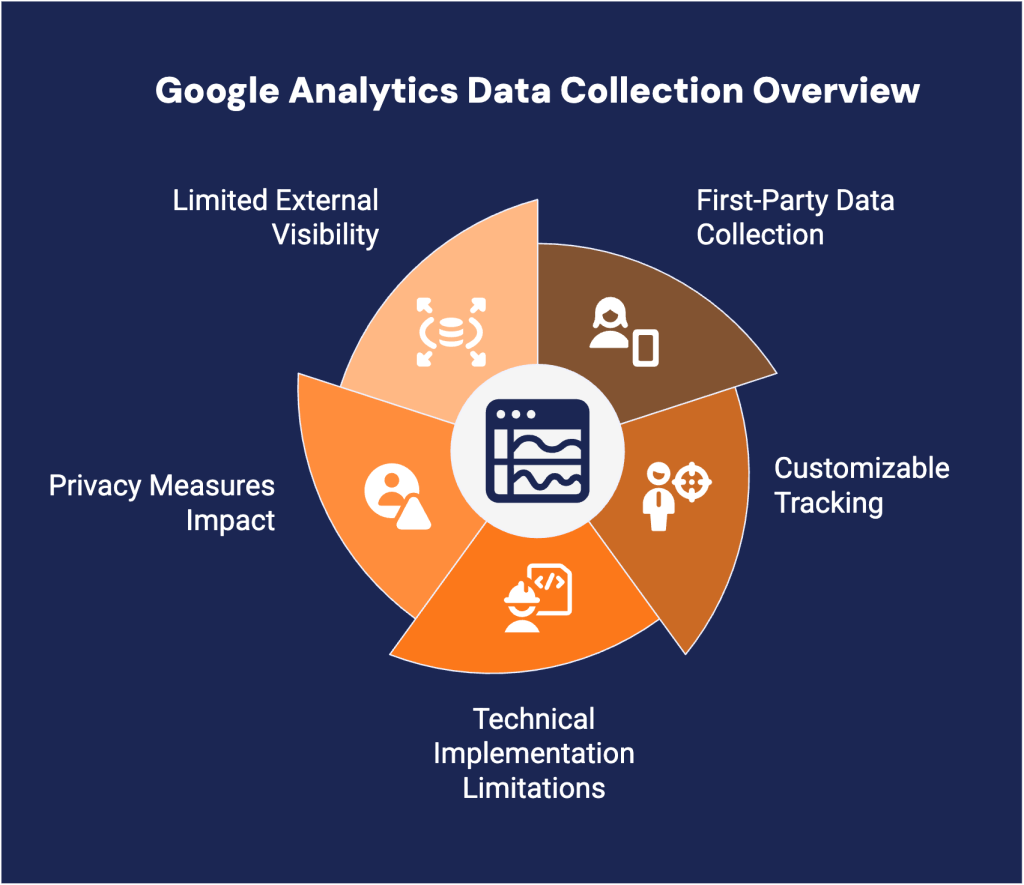
✅ Direct measurement of your own users
This approach delivers granular insights into exactly how users navigate your website, which buttons they click, and which conversion paths they follow.
✅ Customizable tracking
You can set up custom events, goals, and ecommerce tracking specific to your business objectives.
❌ Limited by technical implementations
The accuracy depends entirely on proper code implementation. Errors in setup can lead to incomplete or misleading data.
❌ Increasingly affected by privacy measures
With the rise of cookie restrictions, ad blockers, and privacy-focused browsers, Google Analytics’s data collection faces growing limitations. Studies suggest that Google Analytics may miss tracking between 20-40% of actual users due to these factors.
❌ No visibility beyond your own properties
Google Analytics can only tell you what happens on your own website, leaving you blind to competitive performance or broader market trends.
Similarweb
Similarweb employs a multi-layered data collection methodology that combines various sources to create a comprehensive view of the digital landscape.
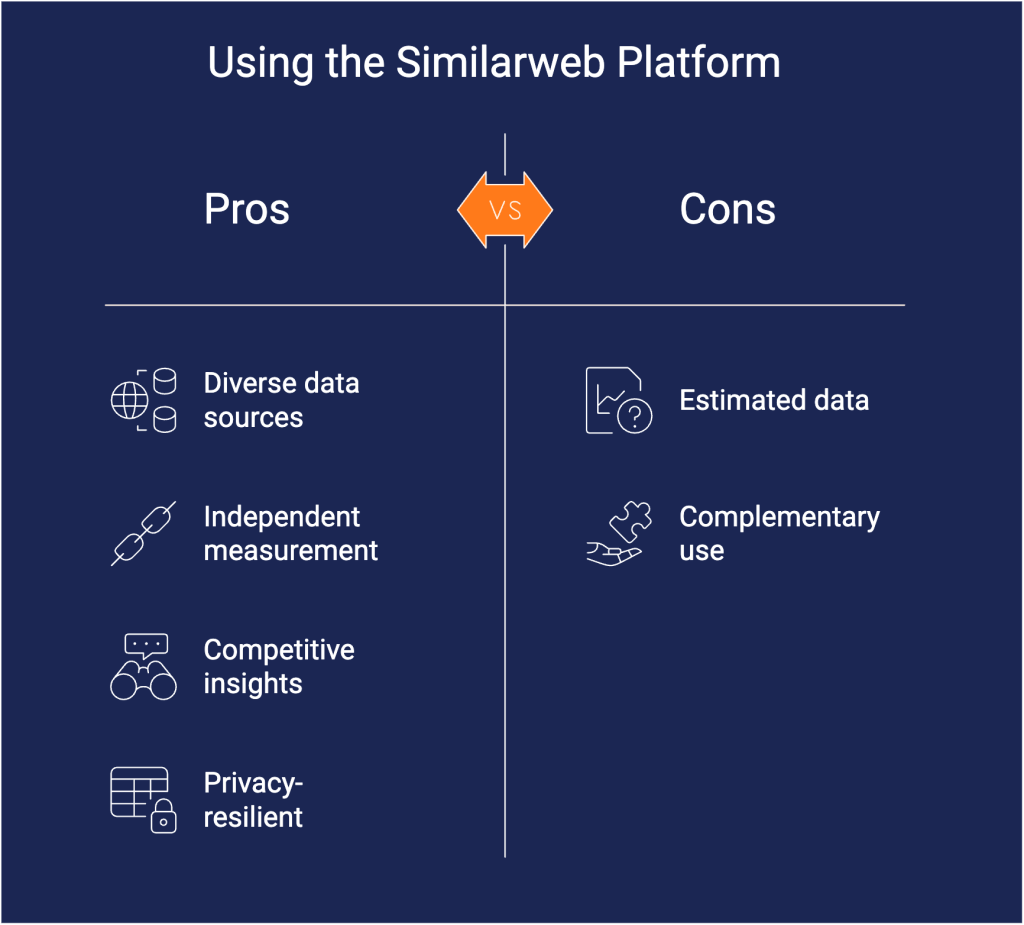
✅ Diverse data sources
Similarweb aggregates data from global ISP relationships, a contributory network of directly measured devices and extensions, public data sources, and partnerships with digital businesses.
✅ Independence from your own implementation
Because Similarweb doesn’t rely solely on tracking code on your site, its measurement isn’t affected by technical implementation issues that might plague your Google Analytics setup.
✅ Competitive visibility
The platform’s approach allows it to estimate traffic and performance metrics for virtually any website or app, including your competitors.
✅ Privacy-resilient methodology
By using multiple data sources, Similarweb’s methodology is less affected by individual privacy measures like cookie blocking.
❌ Estimation vs. direct measurement
Similarweb provides estimations of your site’s traffic.
The fundamental difference? Google Analytics gives you a microscope to examine user behavior on your own website.
Similarweb provides both a telescope to see the broader digital landscape and a periscope to peek into competitor performance.
For comprehensive digital intelligence, many businesses find value in using both platforms complementarily. Google Analytics tracks its own properties, and Similarweb provides the competitive and market context.
User interface and accessibility – which tool is easier to use?
The value of analytics data is directly tied to how easily teams can access, understand, and act upon it. Google Analytics and Similarweb take markedly different approaches to user experience and data accessibility. Unlike Google Analytics, which requires technical expertise, Similarweb metrics vs. Google Analytics are designed to be intuitive and accessible across teams.
Similarweb
Similarweb prioritizes accessibility and intuitive design to make competitive intelligence available to users across the organization.
✅ Intuitive visualization
The platform presents complex data through clear visualizations and straightforward metrics that business users can understand without technical training.
✅ Ready-to-use reports
Most insights are pre-organized into contextual reports that answer common business questions without requiring custom configuration.
✅ Consistent cross-site analysis
The standardized approach to measurement means you can compare websites using the same metrics, regardless of their individual implementations.
✅ Accessible to diverse teams
Marketing, product, sales, and executive teams can all navigate and extract insights without specialized training.
❌ Less customizable
The more structured approach means fewer options for building completely customized reports compared to Google Analytics’s exploration tools. Although the personalized home page provides a good amount of flexibility.
Google Analytics
Google Analytics offers comprehensive data but presents it within an interface that has grown increasingly complex over time.
✅ Extensive customization
Power users can create highly customized reports, dashboards, and explorations tailored to specific business questions.
✅ Integration with the Google ecosystem
Google Analytics connects seamlessly with other Google products like Google Ads, Search Console, and Data Studio.
❌ Steep learning curve
The platform’s depth comes with complexity. It can overwhelm new users or those without analytical backgrounds. Many organizations require specialized Google Analytics experts to extract meaningful insights.
❌ Technical language
Google Analytics reports use terminology that often requires translation for non-technical stakeholders, creating barriers to data democratization.
❌ Implementation-dependent views
The reports you can access depend entirely on the proper implementation of tracking code and event setup, meaning missing data can create blind spots.
The UI difference reflects the platforms’ distinct roles: Google Analytics is designed as a technical tool for analysts to dissect owned data, while Similarweb functions as a business intelligence platform accessible to stakeholders across the organization.
Many companies find that Google Analytics insights remain trapped within analytics teams, while Similarweb data more easily permeates decision-making across departments.
What tool provides more accurate data?
Understanding each platform’s accuracy parameters and limitations is essential for properly interpreting and applying their insights to your business decisions.
Similarweb
Similarweb uses statistical models and diverse data sources to estimate traffic and engagement metrics across the web.
✅ Consistent methodology across sites
The standardized measurement approach allows for valid comparisons between websites, regardless of their individual tracking implementations.
✅ Resilience to tracking prevention
By using multiple data sources beyond on-site tracking, Similarweb’s methodology is less affected by ad blockers and privacy measures.
✅ Trend accuracy
Independent evaluations have shown Similarweb’s trend data (showing directional changes and relative performance) to be highly reliable, even when absolute numbers may vary from internal analytics.
✅ Regular calibration
Similarweb continuously refines its algorithms and incorporates new data sources to improve estimation accuracy.
❌ Estimates vs. exact counts
Similarweb is unparalleled when it comes to competitor intelligence and what is happening on a macro level. It does not have direct access to your site’s traffic unless you connect it to Google Analytics.
Google Analytics
Google Analytics provides exact counts of the tracked interactions on your website, but certain metrics, like bounce rate, are calculated differently across platforms. For example, comparing Similarweb bounce rate vs. Google Analytics, Google Analytics measures it as single-page sessions, while Similarweb estimates it across a broader dataset.
✅ Precise counting of tracked events
For properly implemented tracking, Google Analytics provides exact counts of pageviews, events, and conversions that it successfully captures.
✅ Session-level detail
Google Analytics can reconstruct detailed user journeys for each tracked session on your site, showing exact navigation paths.
❌ Increasingly affected by tracking prevention
With the rise of ad blockers, privacy browsers, and cookie restrictions, Google Analytics increasingly undercounts actual traffic. Some studies suggest up to 40% of traffic may go untracked in certain industries.
❌ Implementation-dependent accuracy
Data quality directly depends on proper code implementation and maintenance. Configuration errors, delayed tag firing, and missing event tracking create permanent data gaps.
❌ Sampling issues with large datasets
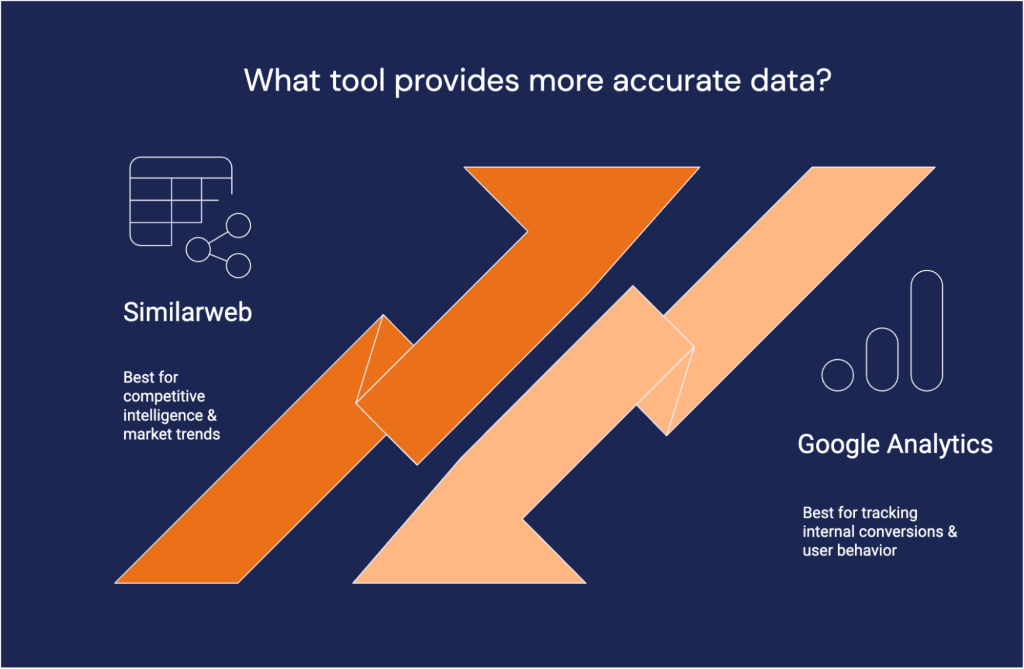
Google Analytics often applies data sampling for larger websites, providing extrapolated estimates rather than complete data for certain reports. The accuracy difference means Google Analytics serves as your source of truth for tracked conversions and analyzed user journeys on your own properties. While Similarweb provides the most reliable picture of competitive performance and market trends.
❌ Isolated data
All insights are limited to your own properties, creating a siloed view that lacks market context.
Most sophisticated digital businesses use both: Google Analytics for internal optimization and Similarweb for market intelligence and competitive strategy.
What platform offers the most unique features?
Beyond their core functionalities, both platforms offer distinct capabilities that serve different strategic purposes. Understanding these unique features helps determine which tool best serves specific business objectives.
Similarweb
Similarweb offers unique capabilities focused on competitive intelligence and market analysis impossible to obtain through on-site analytics alone.
✅ Website ranking and categorization
See where any website ranks within its industry category across countries and time periods with its Web Intelligence platform.
✅ Audience interest analysis
Understand audience affinities by seeing which other sites and categories your visitors and competitors’ visitors frequent.
✅ Keyword gap analysis
Identify valuable search terms driving traffic to competitors but not to your site, revealing untapped opportunities.
✅ Traffic source distribution
Compare traffic channel mix (direct, search, social, referral, display, email) for any website to identify successful acquisition strategies.
✅ Similar site identification
Discover emerging competitors or potential partners based on audience overlap and market positioning.
✅ Competitive conversion analysis
Estimate conversion rates across competitors to benchmark performance and set realistic goals.
✅ Content engagement benchmarking
Compare engagement metrics for content topics across competitors to identify winning content strategies.
Google Analytics
Google Analytics specializes in detailed tracking and analysis of user behavior within your own digital properties.
✅ Conversion funnel visualization
Google Analytics excels at showing exactly where users drop off in multi-step conversion processes, helping identify optimization opportunities.
✅ Custom event tracking
The platform allows tracking of specific user interactions like video views, form engagement, or custom actions unique to your business.
✅ Enhanced ecommerce tracking
Online retailers can access detailed product performance metrics, shopping behavior analysis, and checkout process optimization.
✅ Cross-domain tracking
Google Analytics can maintain session continuity for businesses with multiple domains as users navigate between properties.
❌ Limited to properties you own
All features apply only to websites where you’ve implemented tracking code, offering no competitive insights.
❌ No competitive benchmarking
Google Analytics provides no information about how your performance compares to competitors or industry standards.
The feature differentiation highlights the complementary nature of these platforms: Google Analytics provides the tools to optimize your own properties, while Similarweb delivers the competitive intelligence needed to inform higher-level strategy and identify new opportunities in the market. The most effective digital strategies leverage both for their respective strengths.
What are the biggest advantages of Similarweb over Google Analytics?
While both platforms deliver valuable data, Similarweb provides several distinct advantages that fill critical gaps in Google Analytics’ capabilities.
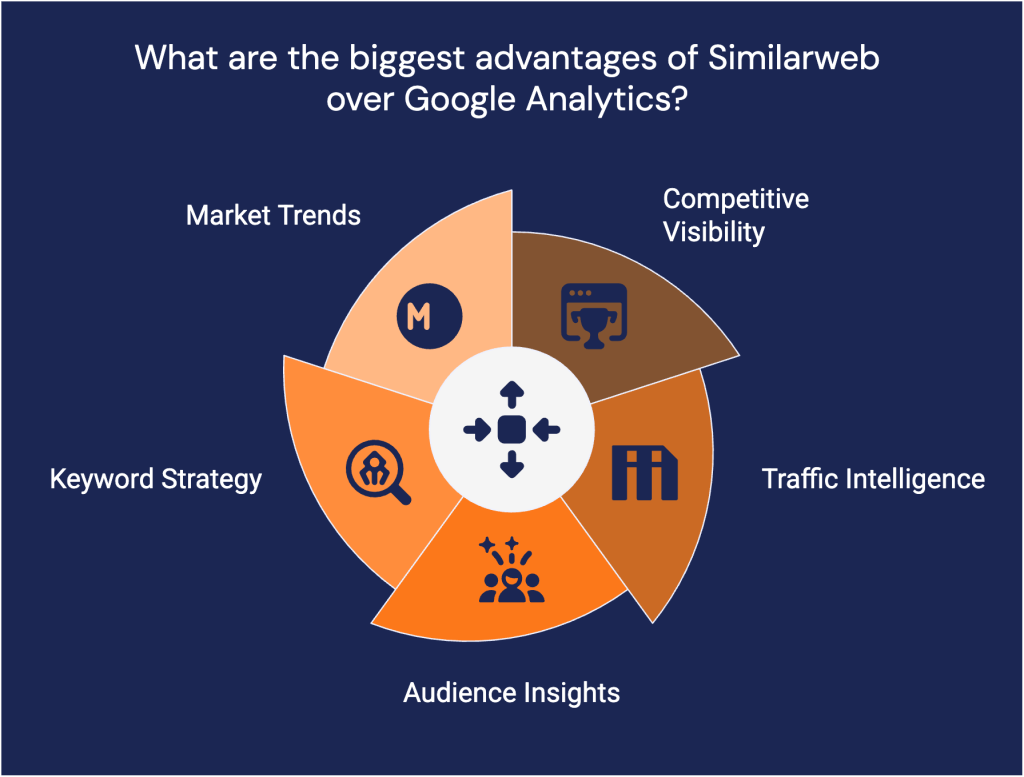
Here’s how it extends your digital intelligence beyond Google Analytics’s boundaries:
Comprehensive competitive visibility
Google Analytics leaves you operating in a vacuum with visibility limited to your own performance. Similarweb eliminates this blind spot by providing a complete view of your competitive landscape:
- Performance benchmarking: Understand how your traffic, engagement, and conversion metrics compare to industry averages and specific competitors
- Market positioning: Identify where you stand in your industry ecosystem and how your digital market share is trending over time
- Growth opportunity identification: Spot gaps between your performance and industry leaders to set realistic improvement targets
Complete traffic acquisition intelligence
While Google Analytics shows which channels bring visitors to your site, Similarweb reveals the entire acquisition funnel:
- Cross-competitor channel strategy: See which traffic sources work best for your competitors and identify untapped channel opportunities
- Traffic generation strategies: Analyze which specific tactics competitors use within each channel (which social platforms, publishers, keywords, etc.)
- Advertising intelligence: Uncover competitors’ paid strategy, including which keywords they bid on, which ad networks they use, and which creatives perform best
Audience insights that go beyond your own visitors
Google Analytics limits you to understanding only users who have already visited your site. Similarweb expands your audience intelligence:
- Total addressable market: Understand the full size and characteristics of your potential audience, not just current visitors
- Audience overlap analysis: Discover which other sites and categories your audience frequents to inform partnership and media opportunities
- Competitor audience profiling: Learn about the demographics, interests, and behaviors of competitors’ visitors to identify audience segments you may be missing
Keyword strategy enhancement and content recommendations
Google Analytics provides limited search data about queries that already bring you traffic. Similarweb delivers comprehensive search intelligence:
- Keyword gap identification: Discover high-value search terms driving traffic to competitors but not to your site using Similarweb’s Keyword Research tools
- Content performance analysis: Compare how specific content topics perform across competitors to inform your content strategy
- Organic vs. paid keyword distribution: Understand which terms competitors target organically versus through paid search SEO tools and PPC tools.
Market trend anticipation
While Google Analytics shows the historical performance of your site, Similarweb helps you anticipate where your market is heading:
- Emerging competitor identification: Spot fast-growing sites in your space before they become major threats
- Seasonal trend prediction: Analyze historical patterns across your industry to anticipate market shifts
- Category movement tracking: Monitor how traffic is shifting between different product/service categories in your industry
These Similarweb advantages don’t negate Google Analytics’ value for on-site optimization. Rather, they provide the essential market context needed to inform higher-level strategy and identify new opportunities that aren’t visible through the lens of your own properties alone.
The most sophisticated digital organizations leverage both platforms: Google Analytics for tactical optimization and Similarweb for strategic direction and competitive intelligence.
Similarweb vs. Google Analytics: which one should you choose?
The comparison between Google Analytics and Similarweb reveals they serve different but complementary purposes in a comprehensive digital strategy. The choice isn’t necessarily between one or the other, but rather understanding how each fits into your analytics ecosystem.
Google Analytics excels at:
- Tracking detailed user behavior on your own properties
- Measuring conversion funnel performance
- Providing granular data for on-site optimization
Similarweb distinguishes itself with:
- Comprehensive competitive intelligence
- Market trend identification
- Audience insights beyond your current visitors
- Channel strategy optimization based on competitor success
For most businesses, the ideal approach combines both platforms: Google Analytics for tactical optimization of your own digital properties, and Similarweb for strategic direction and competitive intelligence that places your performance in market context.
Small businesses with limited resources might start with Google Analytics for basic performance tracking, but should consider adding Similarweb as they grow and need to understand their competitive positioning.
Enterprise organizations typically need both platforms to support different teams and use cases, with Google Analytics serving analytics teams focused on conversion optimization and Similarweb supporting marketing, product, and executive teams with competitive insights.
Ultimately, the most successful digital strategies are built on comprehensive intelligence. In today’s competitive landscape, knowing only what happens on your own website is increasingly insufficient. The businesses that gain market share are those that can see the entire digital playing field, understand where opportunities exist, and anticipate market shifts before competitors do.
As digital competition intensifies, the question isn’t whether you need competitive intelligence alongside your own analytics, but how quickly you can integrate these complementary data sources to build more effective strategies.
FAQs
What is the main difference between Google Analytics and Similarweb?
Google Analytics focuses on tracking user behavior on your own website, while Similarweb provides market intelligence, including competitive insights and industry trends.
Can Google Analytics track my competitors’ traffic?
No, Google Analytics only provides data for your own website. Similarweb estimates traffic for competitors and industry benchmarks.
Which platform provides more accurate data?
- Google Analytics gives exact data for your own site, but can miss users due to cookie restrictions.
- Similarweb provides traffic estimates across all websites, making it useful for competitive benchmarking and trend analysis.
Which tool is easier to use?
- Google Analytics offers deep customization but has a steep learning curve.
- Similarweb presents insights in an intuitive, visually driven format, making it easier for various teams to use.
Should I use Google Analytics, Similarweb, or both?
For most businesses, the best approach is to use both:
- Google Analytics for detailed insights and optimization of your own website.
Similarweb for competitive intelligence, market trends, and benchmarking against industry leaders.