
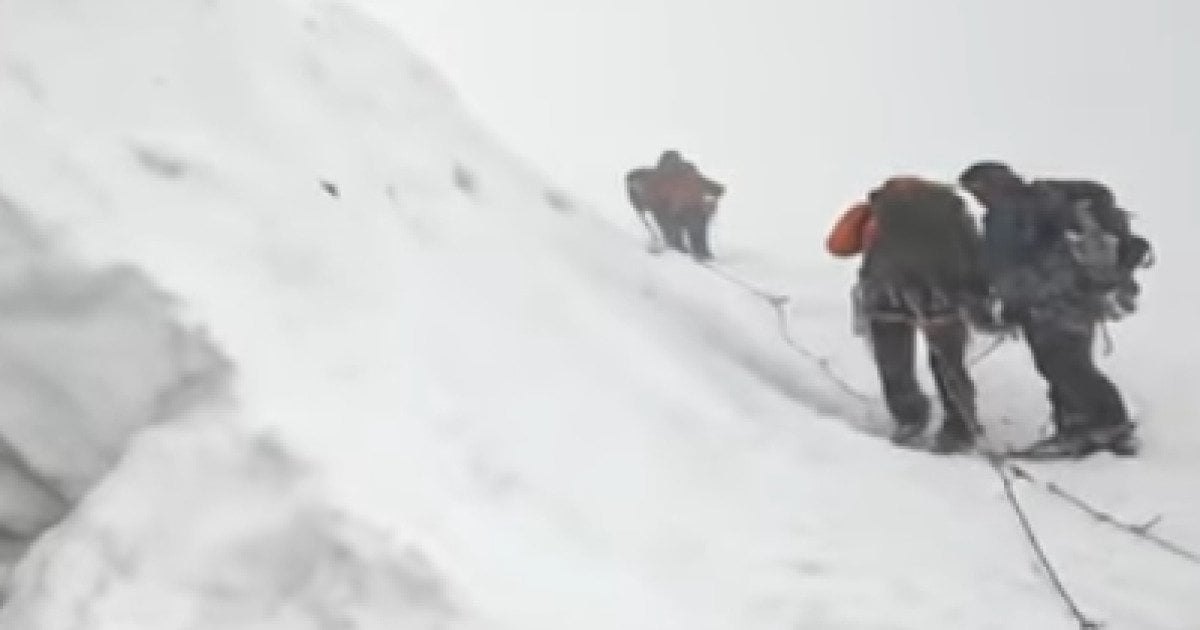
Mount Everest Tour Guides Allegedly Poisoned Meals Of Climbers In $20 Million Fraud Scheme
This is a twisted crime.
Mount Everest climber guides have allegedly poisoned the food of tourists in a multi-million dollar fraud scheme.
According to authorities in Nepal, over 30 guides have been arrested for poisoning the food of climbers in order to trigger expensive helicopter rescues.
The New York Post reported more on the fraud and how the operation was conducted:
Hima-liars.
Mount Everest guides have allegedly been secretly lacing tourists’ food to trigger costly helicopter rescues as part of a $20 million insurance scam, according to a new investigation.
Police in Nepal have charged 32 individuals with organized crime and fraud charges related to the plot, which involves trekking company owners, helicopter operators, and hospital executives, the Kathmandu Post reported.
Guides with the trekking agencies allegedly poisoned tourists by putting baking soda in their food to trigger severe gastrointestinal distress that mimicked altitude sickness or food poisoning, investigators said.
Once ill, the visitors were allegedly pressured into agreeing to costly emergency helicopter evacuations, with operators using forged medical and flight documents to bill international travel insurers for the cost, according to authorities in the Himalayan country.
Those ill-gotten gains were then allegedly split among the guides, helicopter companies, trekking agencies, and the hospitals where the tourists were taken for fake treatments.
The investigation began in January when six executives from three prominent mountain rescue firms were arrested.
The groups allegedly fraudulently obtained at least $19.69 million in insurance payouts, according to police.
One company is accused of faking 171 of its 1,248 claimed rescues, leading to more than $10 million in illegitimate payouts.
JUST IN: Authorities in Nepal accused Mount Everest guides of poisoning climbers to trigger helicopter rescues in an insurance scam
Investigators said guides allegedly put baking soda in food to cause symptoms that mimicked altitude sickness
Police said the groups then arranged… pic.twitter.com/1ubpmsX0Mp
— Unlimited L’s (@unlimited_ls) April 1, 2026
NDTV reported on the scam more in depth:
In a detailed report, The Kathmandu Post said rescue agencies routinely pressured foreign climbers to request helicopter evacuations for minor illnesses that could have been treated on site. In many cases, no evacuation was required at all. Yet climbers were convinced that their lives were in danger and that immediate airlift was the only option.
Authorities said the agencies falsified passenger manifests and medical reports, often in collusion with private hospitals in Kathmandu, allowing them to extract large sums from international insurance companies for rescues that were unnecessary or entirely fabricated.
In one instance, a rescue agency billed insurers for four separate helicopter evacuations, even though all four climbers were flown out in a single helicopter.
The three agencies named by investigators were Mountain Rescue, Everest Experience and Assistance, and Nepal Charter Service.
According to the CIB, fake rescues were triggered in two main ways. The first involved trekkers who simply did not want to walk back after completing strenuous routes such as the Everest Base Camp trek. Guides would suggest pretending to be ill and would handle all evacuation formalities.
The second method was more disturbing. At altitudes above 3,000 metres, mild symptoms of altitude sickness, such as headaches or low oxygen levels, are common and usually manageable with rest or descent. Investigators found that guides and hotel staff were trained to scare tourists, telling them they could die unless evacuated immediately. In some cases, Diamox tablets were administered alongside excessive water intake to deliberately worsen symptoms. In at least one documented case, baking powder was mixed into food to make tourists physically unwell, The Kathmandu Post reported.
Maybe the guides should spend more time cleaning up trash instead of scamming people:
Mount Everest is so overcrowded and full of trash that it has been called the “world’s highest garbage dump.” pic.twitter.com/rWOwo8l2A2
— History Defined (@historydefined) March 25, 2026
What’s your view?