
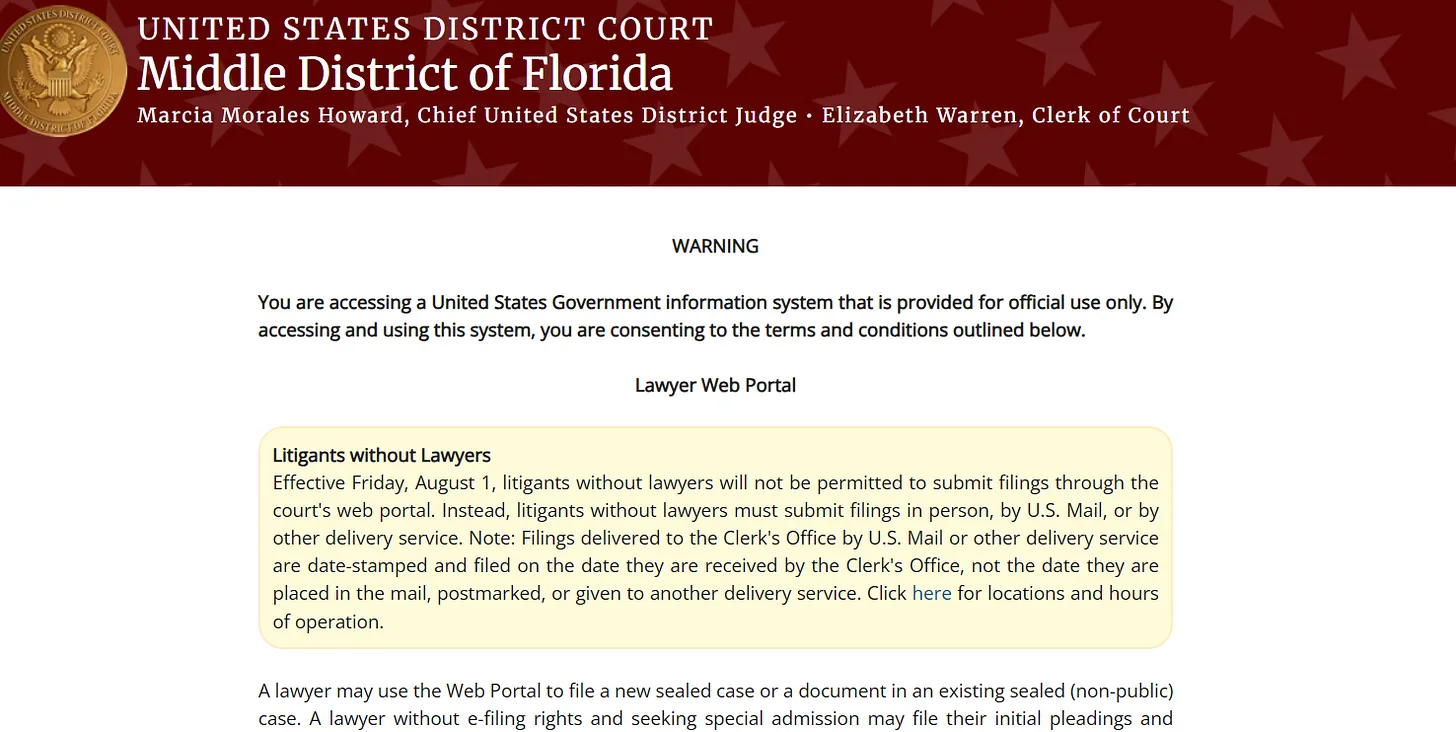
LITIGANTS WITHOUT LAWYERS… – JP
The United States District Court – Middle District of Florida wants you at a disadvantage.
Please Follow us on Gab, Minds, Telegram, Rumble, Truth Social, Gettr, Twitter, Youtube
This morning someone contacted me about a rather recent change to the “in-justice” system here in the Middle District of Florida…
Why would the United States District Court – Middle District of Florida want to create a significant disadvantage to pro se litigants?
After the lawfare of the 65 Project most attorneys are terrified to take on cases related to election corruption and election fraud. Try finding an attorney for an election challenge where you raise issues of fraud.
Ask Sidney Powell, Rudy Giuliani, Kurt Olsen, Dan Eastmen, and countless others lawyers who have faced significant attacks on their BAR licenses.
This has left candidates who were subjected to great in justices and election fraud that significantly impacted their elections very limited options. I just so happen to be one of those impacted as any of my readers know very well.
We live in a digital age, not the stone age. Everything is done online. So why should pro se litigants be deprived of equal access to the courts?
The U.S. District Court for the Middle District of Florida prohibited pro se litigants from using the CM/ECF (Case Management/Electronic Case Filing) system, raises serious constitutional and procedural concerns—particularly under the First, Fifth, and Fourteenth Amendments, and potentially violate federal access-to-court precedents.
Access to Courts – Fundamental Right
The U.S. Supreme Court has repeatedly affirmed that access to the courts is a fundamental constitutional right, protected under both:
- First Amendment (right to petition the government for redress of grievances), and
- Fifth and Fourteenth Amendments (due process and equal protection).Key Precedent:Bounds v. Smith, 430 U.S. 817 (1977): States and courts must ensure meaningful access to the courts, especially for unrepresented individuals.Lewis v. Casey, 518 U.S. 343 (1996): Clarifies that the right requires more than theoretical access—it must be practical and effective.Due Process Under Mathews v. EldridgeApplying the Mathews v. Eldridge, 424 U.S. 319 (1976) balancing test again, a federal court policy that excludes pro se litigants from electronic filing would likely fail scrutiny:
- Private Interest: Pro se litigants’ ability to prosecute or defend claims is impaired.
- Risk of Erroneous Deprivation: Increases likelihood of untimely filings, missed deadlines, and improper docketing.
- Government Interest: While maintaining orderly court operations is valid, blanket exclusion is overbroad and less restrictive alternatives exist (e.g., monitored access, training, or tiered efiling privileges).
Equal Protection and Discriminatory Treatment
Limiting efiling to attorneys creates a two-tiered system of justice, disadvantaging litigants solely on the basis of their financial or representation status. This could violate:
- Equal Protection Clause of the 14th Amendment, as applied to the federal judiciary via the 5th Amendment.
Even under rational basis review, courts must show that such restrictions are reasonably related to legitimate goals and not arbitrary.
If the U.S. District Court for the Middle District of Florida prohibits pro se litigants from filing documents via CM/ECF categorically or in practice, such a policy likely violates:
- Due process
- Equal protection
- Access to courts under the First Amendment
This is particularly true if the denial results in prejudice, such as missing deadlines, dismissal, or inability to respond.
YOU HAVE A RIGHT TO AN ATTORNEY…(In some cases)….NOT AN OBLIGATION TO ONE, IN ALL CASES…
In speaking with some of the most prominent and well heeled attorneys I know, many would never raise the issues that are key to these cases for fear of losing their BAR cards. They are beholden to their special little club membership. The end result is ultimately that issues that really should be raised aren’t.
Isn’t that really a system of justice or rather is it a system of “IN-JUSTICE” ?
THE SYSTEM IS TRYING TO PROTECT ITSELF
Those of us in the trenches have disabused ourselves that we have fair and impartial courts at this point. I have seen first hand in Florida and Federal courts, behavior by judges and attorneys that every American would agree is an abomination.
To any reasonably prudent person, with a shred of intellectual honesty, and an IQ over 80, the state of America’s legal system is not Constitutional, nor adheres to the rule of law.
On July 1, 2025 we saw the following go into effect:
SB 1652 — Public Records (Courts)
Senate Bill 1652 creates a public records exemption for certain information in documents stricken by a court in a noncriminal case.
The exemption applies if the court finds that the information is irrelevant, false, defamatory, or could potentially cause unwarranted damage to a person’s reputation. Let’s think about this for a minute…
Who gets to decide this?
The court?
Particularly, where the judges themselves are being implicated, in civil cases like election challenge cases?
You know in cases that they preside over cases that they themselves or their close relations are direct material witnesses, victims, participants or beneficiaries in?
How do you think this can be and will be abused by a corrupt court system intent on protecting itself from being held accountable?
These edict needs to be challenged, sooner rather than later…
Challenging this policy as:
- A violation of the First Amendment right to petition the government;
- A violation of the Fifth Amendment Due Process Clause;
- A violation of the Equal Protection guarantees under the Fifth and Fourteenth Amendments;
- A discriminatory barrier to court access without a rational basis or compelling justification.
Violation of First Amendment – Right to Petition the Government
The First Amendment protects the right of individuals to petition the government for redress of grievances, including access to the judiciary. Denying pro se litigants the right to use the same means of filing and docket access as licensed attorneys impedes the ability to meaningfully petition the court, especially in a system that is now functionally digital.
See California Motor Transport Co. v. Trucking Unlimited, 404 U.S. 508, 510 (1972).
Violation of Fifth and Fourteenth Amendment – Procedural Due Process
Under Mathews v. Eldridge, 424 U.S. 319 (1976), courts must weigh:
- The private interest affected (access to justice);
- The risk of erroneous deprivation (filing delays, missed deadlines);
- The government interest (administrative burden).
This policy fails under that test. The interest in ensuring access is fundamental. The risk of prejudice is substantial. And there are less restrictive means to preserve court efficiency (e.g., monitored accounts, training, or warnings).
Violation of Equal Protection – Arbitrary Discrimination
This policy discriminates between similarly situated litigants — attorneys and pro se individuals — based solely on status of representation.
See Plyler v. Doe, 457 U.S. 202 (1982) (government classifications must be rationally related to a legitimate state interest).
In a fully digital docketing system, requiring paper filings from unrepresented parties creates a two-tiered justice system, not justified by any compelling or even rational basis.
Violation of Court Access Doctrine
“Meaningful access to the courts is the touchstone of the right to access under the Constitution.” — Bounds v. Smith, 430 U.S. 817 (1977)
The Middle District’s effective exclusion of pro se litigants from CM/ECF violates this right in practice.