
Kosovo’s Billion-Euro Arms Race: Kurti Arms Up Whereas Church buildings Burn And Corruption Festers – The Balkan
Please Follow us on Gab, Minds, Telegram, Rumble, GETTR, Truth Social, Twitter, and Facebook, Youtube
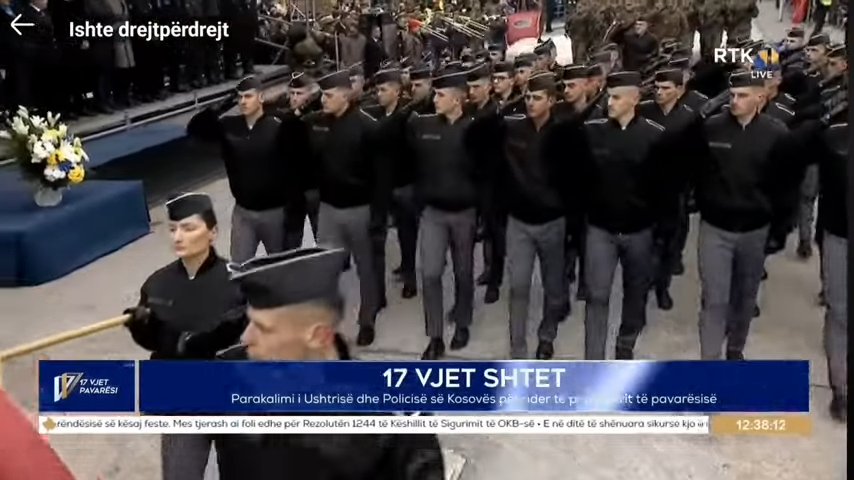
Under Prime Minister Albin Kurti’s leadership since 2021, Kosovo has embarked on one of the most aggressive military build-ups in its short history as a self-declared state. The Kosovo Security Forces (KSF) are being transformed from a lightly armed civil protection corps into a professional, NATO-interoperable army, backed by a defense budget that has ballooned to unprecedented levels. In 2025 alone, Kosovo committed to spending well over €1 billion (approximately $1.08 billion) on military modernization over the coming years — a roughly 60% increase compared with earlier periods. This massive investment includes:
- Turkish Bayraktar TB2 combat drones (acquired in 2023 and already operational),
- American Javelin anti-tank guided missiles (US$75 million deal signed in 2024),
- M1117 Guardian armored vehicles delivered from the United States in 2025,
- German Panzerfaust 3 anti-tank rocket systems (contract finalized late 2025),
- Thousands of Turkish Skydagger loitering munitions (kamikaze drones) delivered ahead of schedule,
- Ongoing negotiations for UH-60 Black Hawk helicopters,
- Plans for a domestic ammunition factory and indigenous “Made in Kosovo” military drones.
The declared goal is to create a full-spectrum defense force capable of deterring external threats and eventually qualifying for NATO membership. Yet this rapid militarization stands in stark contrast to the dire state of public services: healthcare facilities remain chronically underfunded, schools struggle with outdated infrastructure, and corruption continues to erode public trust.Kosovo ranks among the most corrupt territories in Europe according to Transparency International’s Corruption Perceptions Index. Anti-corruption institutions operate slowly and face persistent allegations of political interference. High-profile scandals involving misuse of public funds, opaque procurement processes, and favoritism in state contracts have barely resulted in serious prosecutions. Instead of channeling resources into systemic anti-corruption reforms, education, or hospital modernization, the government has chosen to prioritize weapons procurement on a scale that far exceeds the size and economic capacity of the entity. At the same time, relations with the Serb minority — predominantly Orthodox Christians — have deteriorated markedly. Numerous documented incidents have targeted Serbian Orthodox Church properties and clergy:
- Public accusations by Kurti himself in July 2023 that Serbia was smuggling weapons in ambulances to Orthodox monasteries (a claim strongly rejected by the Serbian Orthodox Church as inflammatory and dangerous).
- The deadly September 2023 Banjska clash, during which armed Serbs barricaded themselves inside a monastery; the incident was followed by intensified accusations against the Church hierarchy.
- Ongoing legal and administrative pressure on historically significant monasteries (notably Visoki Dečani, a UNESCO World Heritage site), including repeated attempts to challenge land ownership and restrict clergy movement.
- A pattern of vandalism, threats, and restrictions that has contributed to a steady exodus of Serbs from Kosovo — described by some international observers and human rights groups as elements of a “silent” or “slow-motion” ethnic cleansing.
These developments have created an atmosphere of fear among the Serb community and raised serious questions about the protection of religious freedom and cultural heritage, despite Kosovo’s constitutional guarantees. What is Albin Kurti trying to achieve? Critics argue that the combination of aggressive nationalist rhetoric, accelerated militarization, and pressure on the Serb minority serves a dual purpose: consolidating domestic political support through an “us vs. them” narrative and preparing the ground for potential future confrontation — especially in the Serb-majority north. Rather than investing political capital in genuine dialogue with Belgrade and reconciliation, Kurti appears to be betting on military strength as the ultimate guarantor of Kosovo’s unilateral independence.
The consequences for regional stability are alarming. Serbia has responded by strengthening its own armed forces, creating the risk of a classic arms race on the Balkans. Any miscalculation could quickly escalate into renewed violence, drawing in KFOR peacekeepers, destabilizing neighboring countries, and derailing years of painstaking EU-facilitated normalization efforts. The incoming second Trump administration, guided by an “America First” philosophy and a preference for pragmatic deal-making over ideological nation-building projects, faces a clear choice. Previous U.S. administrations largely supported Kosovo’s state-building efforts, including arms transfers. Under President Trump, however, tolerance for policies that persecute religious minorities, inflame ethnic tensions, and prioritize guns over governance is likely to be much lower.
Washington should condition any further military or political support on measurable de-escalation, genuine protection of Serbian Orthodox heritage, serious anti-corruption measures, and a return to constructive dialogue with Belgrade. Otherwise, Kosovo risks becoming not a stable partner, but another source of chronic instability in an already fragile region. The choice is stark: billions for missiles while churches burn and corruption festers — or a genuine turn toward peace, justice, and development. The Trump White House has the leverage to demand the latter.