
How Two Tiny Scraps Are Rewriting the Historical past of Human Clothes
The creation of this article included the use of AI and was edited by human content creators. Read more on our AI policy here.
What did the earliest Americans wear to survive brutal Ice Age winters? For decades, scientists could only guess. Clothing made from animal hides and plant fibers almost never survives millennia of decomposition. Now, two tiny scraps of elk hide from an Oregon cave are rewriting that story.
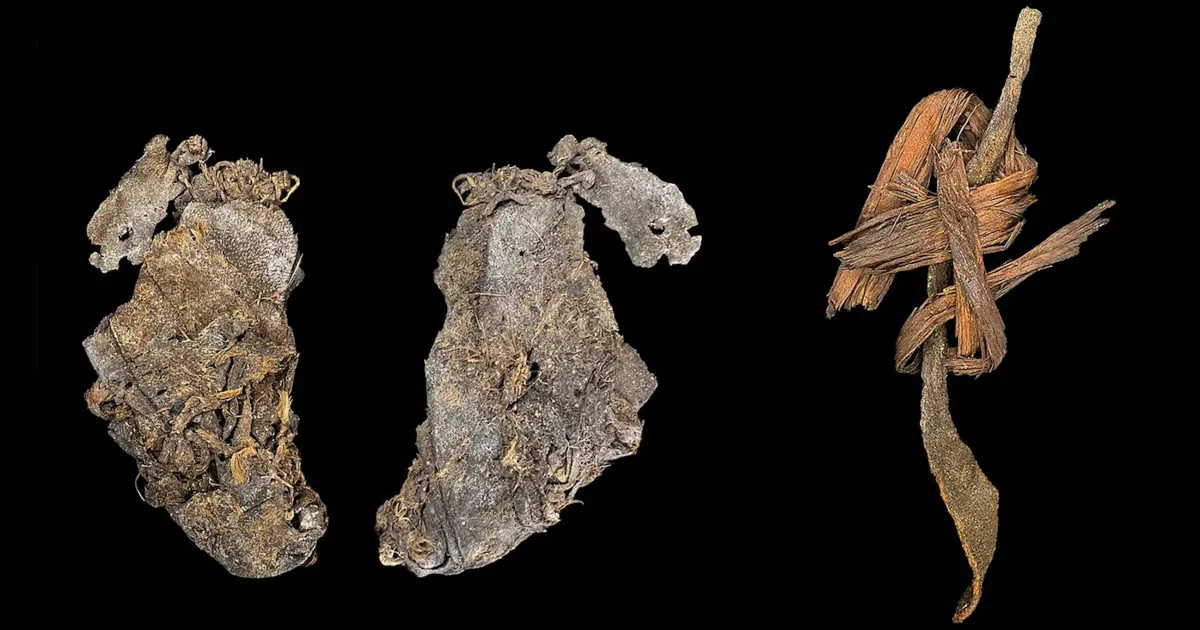
The fragments, joined by a cord of twisted fibers and preserved for roughly 12,400 years, appear to be the oldest sewn items ever discovered. They may also represent the world’s oldest known pieces of clothing, according to research posted to Science Advances on February 4, 2026.
What makes this find so unusual
The discovery challenges a fundamental limitation in archaeology: organic materials rot. Leather, plant fibers, woven textiles—the soft technologies that defined daily life for ancient peoples—almost never survive in the archaeological record. Stone tools endure. Bone needles persist. The actual garments people wore? They vanish.
These fragments beat those odds through a combination of geography and climate. Cougar Mountain Cave sits in Oregon’s high desert, where ultradry air created natural preservation conditions. The result: two small pieces of elk hide, just a few square centimeters each, connected by cordage made from twisted fibers.
“They are definitely sewn, because we have cordage sewn into a hide that comes right out and goes into another piece of hide,” says archaeologist Richard Rosencrance of the University of Nevada, Reno.
Radiocarbon dating places the hides at the end of the last Ice Age. Stone tools and bone needles recovered alongside them suggest the cave’s Native American inhabitants were actively making clothes—not just preserving random scraps of leather.
The artifacts spent decades in private hands
The items were originally recovered from Cougar Mountain Cave in the 1950s. They remained in private collections until recently, when they were made available to scientists for analysis alongside 54 other artifacts from the area.
That collection includes fragments of elk, bison, rabbit, hare, and fox hides. Researchers also found cords made from strips of hide and plant fibers—possibly a type of rush. The cords “could have been used for a huge range of things,” Rosencrance says.
One particularly intriguing item: a bundle of fibers that were twined (an early form of weaving) into a rough textile. The team suggests it may have been used to make a bag, basket, or mat.
Why the timing matters
The radiocarbon dates place these artifacts at a pivotal moment in Earth’s climate history. They roughly coincide with the onset of the Younger Dryas, a mysterious period when global temperatures dropped sharply after the planet had already begun warming at the end of the Pleistocene epoch.
Between roughly 12,900 and 11,700 years ago, colder and drier conditions prevailed across North America. For the people living through this climate reversal, clothing wasn’t a matter of comfort. It was survival technology.
The research team suspects the sewn elk hides are remnants of a garment designed to provide warmth and protection against these harsh conditions. While the fragments are too small to determine what kind of garment they came from, their construction suggests intentional design rather than accidental preservation.
A window into technologies we rarely see
“The sparse material record of those myriad technologies limits our ability to formulate nuanced models about this critical period in human history,” Rosencrance and his co-authors write in their paper, titled “Complex perishable technologies from the North American Great Basin reveal specialized Late Pleistocene adaptations.”
To analyze the artifacts, the team employed radiocarbon dating, zooarchaeological methods, mass spectrometry, and other approaches. They examined materials from both Cougar Mountain Cave and another Oregon site known as Paisley Caves.
The discovery offers archaeologists something exceedingly rare: direct physical evidence of the “perishable technologies” that early Americans relied upon but that almost never survive to be studied. Most understanding of Ice Age clothing comes from indirect evidence—the needles used to sew, the scrapers used to prepare hides, the artistic depictions carved into bone or painted on cave walls.
These fragments represent the actual product of that work.
What this tells us about early American ingenuity
The find adds to a growing body of evidence that the earliest inhabitants of North America possessed sophisticated technological capabilities. They weren’t simply surviving in a harsh landscape—they were adapting to it with complex, specialized tools and techniques.
Sewing requires planning. It requires processing raw materials into usable forms. It requires tools designed specifically for the task. The presence of bone needles alongside the sewn hides suggests a complete toolkit for garment production.
The variety of animal species represented in the artifact collection—elk, bison, rabbit, hare, fox—hints at strategic choices about which materials served which purposes. Larger hides from elk and bison might have formed the main body of garments. Smaller, softer furs from rabbits and foxes could have provided insulation or trim.
The plant-fiber cordage and twined textiles demonstrate that these early Americans weren’t limited to animal products. They understood how to process plant materials into functional forms, expanding their technological options.
For anyone fascinated by human adaptability and innovation, these scraps of ancient leather offer something remarkable: tangible proof that our ancestors faced extreme environmental challenges with creativity, skill, and sophisticated problem-solving abilities that their stone tools alone could never reveal.