
Traditionally Black schools and universities do greater than provide Black youths a pathway to alternative and success – I train criminology, and my analysis suggests one other profit
Historically Black colleges and universities, often known as HBCUs, are well known for their deep roots in U.S. higher education and proven effectiveness at graduating Black students who go on to become professionally successful.
HBCUs are colleges and universities that were established before 1964, with the mission of educating Black Americans, though now anyone can attend.
As a criminology instructor who has spent 13 years studying the relationship between educational trajectories and criminal justice – and a Black woman who grew up in the South and attended an HBCU – I believe that HBCUs offer another often overlooked benefit.
They give young people, especially Black people, a pathway in higher education that they might not otherwise receive. By opening doors to education, jobs and mentorship, HBCUs disrupt the conditions that can cause young people – especially Black people – to get lost in the criminal justice system.
The U.S. incarcerates approximately 1.6 million people. Black Americans are locked up at five times the rate of white Americans. This disparity starts young: Black teenagers are 5.6 times more likely to be placed in juvenile detention than white teenagers, and people who are incarcerated as juveniles are nearly four times more likely to be incarcerated as adults. Overall, the vast majority of Black people are not incarcerated.
Attending a HBCU, or any other university, does not guarantee a stable financial future. And not graduating from high school or college certainly does not not mean that someone will become incarcerated.
But research shows that education, especially a college degree, is closely linked to lower crime rates. College graduates who do commit crimes reoffend at rates below 6%, while people who drop out of high school return to prison at rates around 75%.
This is why I believe HBCUs in particular have an important role to play in helping young Black people avoid this path.
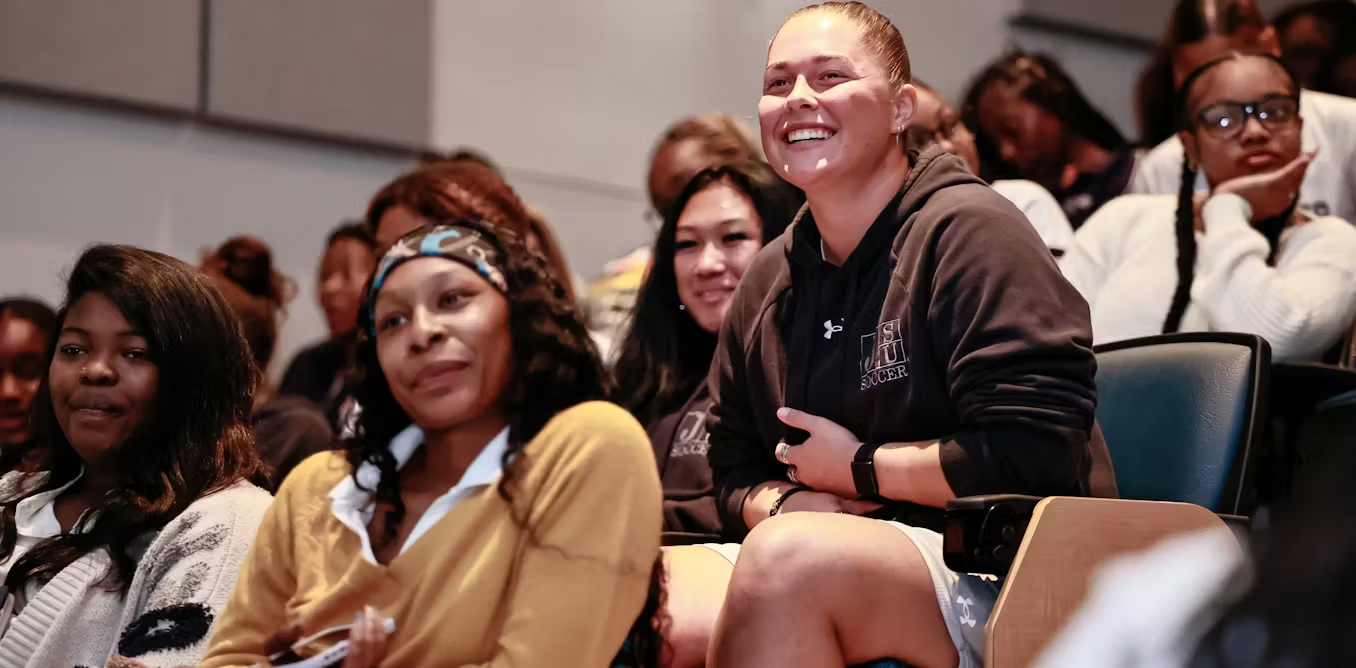
Paras Griffin/Getty Images
Understanding HBCUs
Today, there are roughly 100 HBCUs in 19 states, as well as the District of Columbia and the U.S. Virgin Islands. The schools are a mix of public schools and private, nonprofit colleges and universities.
HBCUs make up just 3% of the country’s colleges and universities. But their graduates include 40% of Black engineers, 50% of Black lawyers and 70% of Black doctors in the United States.
Most HBCUs are located in Southern and mid-Atlantic states – a legacy of when segregation barred Black students from attending most colleges and universities.
Many HBCUs are also located in rural Southern communities, in particular. Residents of these areas tend to live in poverty and have limited educational opportunities.
Attending a local HBCU is often one of the most practical ways these prospective students can get a degree – in part because HBCUs are often more affordable than other four-year college options.
The average annual tuition for an in-state student at a public HBCU is roughly US$7,700 per year – well below the national average, which ranges from $12,000 at public schools to $45,000 at private schools. Some public HBCUs charge as little as $1,000 in annual tuition for in-state students.
Schools like Coppin State University in Baltimore and the University of Maryland Eastern Shore also offer in-state rates to out-of-state students from places that do not have HBCUs nearby.
Despite their focus on Black students, HBCUs are increasingly diverse.
In 2022, non-Black students made up 24% of the student population at HBCUs. By comparison, 15% of non-Black students made up HBCU populations in 1976.
HBCUs also enroll low-income students, regardless of race, at three times the rate that predominantly white colleges do.
Upward mobility
Research shows completing high school reduces arrest rates by 11% to 12% for both property and violent crimes, regardless of race or economic background.
College takes this effect further.
Studies have found that college enrollment helps young people with histories of delinquency to stop committing crimes. Completing a four-year degree reduces the likelihood of criminal behavior by 43% to 48%, compared to those who started college but did not finish.
A few long-recognized reasons help explain this pattern. Education increases earning potential, making crime a riskier and less attractive option for people with a degree. Education also encourages long-term thinking, strengthens ties to employers and communities, and builds problem-solving skills that help people navigate challenges.
I have seen firsthand, through my own experiences growing up in the South and teaching students, how HBCUs can help move Black students out of poverty. These schools stand out among other colleges in terms of how effectively they graduate low-income Black students and move them into the middle class, outcomes that research links to reduced criminal behavior.
When researchers rank colleges by whether and how their students improve their socioeconomic status, income and wealth over time, more than half of the highest-performing schools are HBCUs.
Black students who attend HBCUs are 30% more likely to earn a degree than Black students who attend colleges that are not HBCUs. Black HBCU graduates are also likely to earn more money than Black non-HBCU college graduates.
This matters because poverty is one of the strongest predictors of whether someone will commit a crime.
When colleges and universities graduate students who earn middle-class incomes, they help break what researchers call the cycle of intergenerational poverty and incarceration. This pattern describes how children of incarcerated parents are six times more likely to end up in the justice system.
An ongoing money problem
Despite their benefits, HBCUs have chronically struggled with funding. In recent decades, state governments have not given Black land-grant universities – meaning public colleges originally created through federal legislation to serve Black students during segregation – at least $12.8 billion the federal government said they were owed.
Recent federal support for HBCUs has been mixed, as the Trump administration has made widespread cuts to many universities and colleges.
In April 2025, President Donald Trump signed an executive order renewing the White House Initiative on HBCUs, a federal effort to help support these schools. At the time, he said that Black colleges had no reason to fear cuts.
But days later, Trump’s proposed 2026 budget included $64 million in cuts to Howard University, one of the oldest HBCUs.
In September 2025, the Trump administration redirected $435 million to HBCUs by cutting funds from grant programs that had supported Hispanic-serving institutions and other colleges that have a large proportion of Hispanic or other minority students.
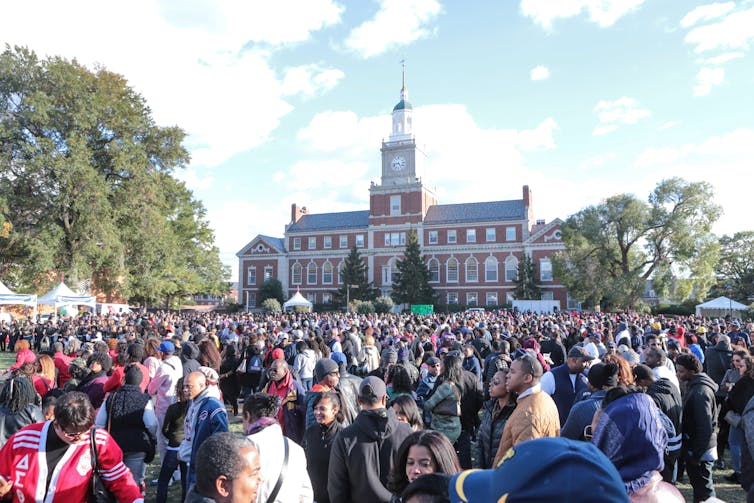
Cheriss May/NurPhoto via Getty Images
The context that matters
The U.S. criminal justice system disproportionately affects Black people at every stage – from arrests to incarceration. Black Americans make up about 13% of the U.S. population but account for roughly 37% of all people in U.S. jails and prisons.
According to the National Academies of Sciences, the lifetime risk of imprisonment for Black men born between 1975 and 1979, and with less than a high school education, was about 68% – meaning nearly 7 in 10 in that group experienced incarceration at least once.
I have seen firsthand that when Black students from low-income backgrounds enroll at HBCUs, they become more likely to complete a degree and achieve the kind of financial stability that research shows helps reduce the risk of becoming caught up in the criminal justice system.