
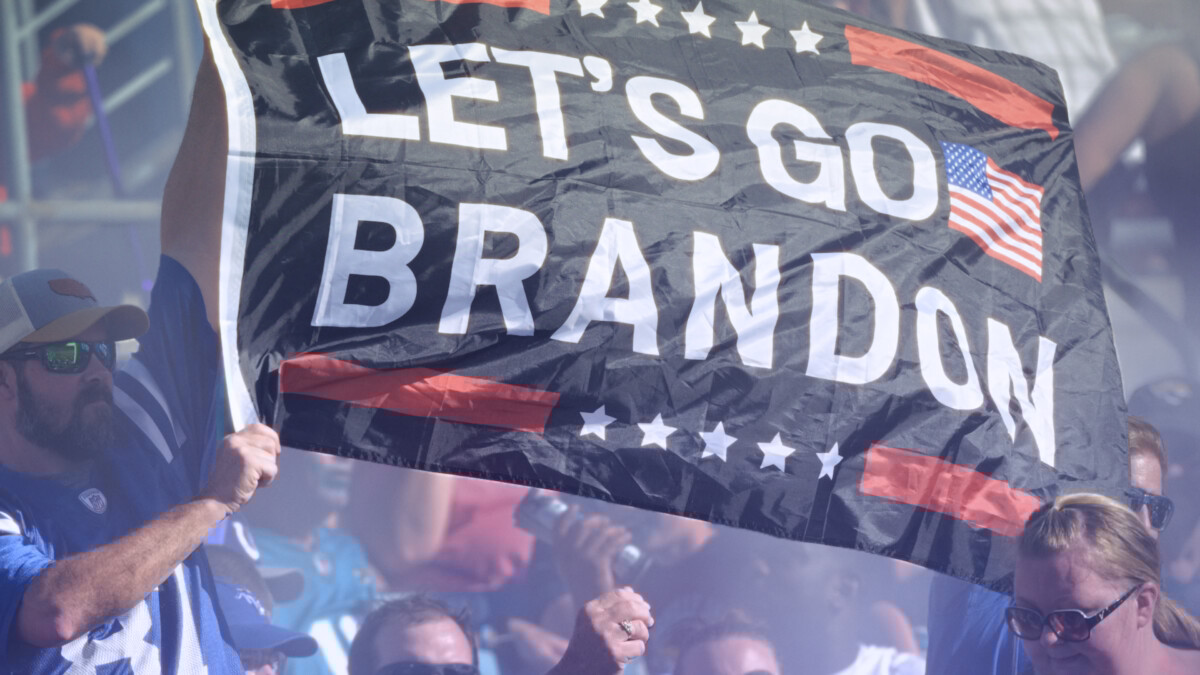
Federal Courtroom Upholds Faculty Ban on “Let’s Go Brandon” Shirts
A federal appellate court has upheld a ban on “Let’s Go Brandon” apparel in Michigan schools, ruling the phrase can be interpreted as profane and thus subject to school dress codes that prohibit disruptive or vulgar clothing.
The United States Court of Appeals for the Sixth Circuit issued the decision in B.A. v. Tri County Area Schools, affirming the lower district court ruling that school officials did not violate students’ First Amendment rights by prohibiting the clothing. The case involved two middle school boys in Howard City, Michigan, who were ordered to remove sweatshirts emblazoned with “Let’s Go Brandon,” a slogan broadly understood as a euphemism for “F*** Joe Biden.”
The phrase originated from a 2021 NASCAR interview in which NBC reporter Kelli Stavast misrepresented chants of “F*** Joe Biden” as “Let’s go Brandon,” giving rise to a politically charged meme heavily used as profanity against the Biden administration.
The panel, consisting of Judges John Nalbandian and Karen Nelson Moore, ruled that since schools can ban clothing containing explicit profanity, they can similarly restrict apparel that “can reasonably be interpreted as profane.” The court also noted that other political apparel, such as “Make America Great Again” hats, was allowed, emphasizing that the ban targeted vulgarity, not political expression.
Judge Nalbandian wrote, “Because Defendants reasonably interpreted the phrase as having a profane meaning, the School District can regulate wearing of ‘Let’s Go Brandon’ apparel during school without showing interference or disruption at the school.” The decision underscores schools’ authority to maintain an environment free from speech that could be disruptive or disrespectful.
“The Constitution doesn’t hamstring school administrators when they are trying to limit profanity and vulgarity in the classroom during school hours. Again, students do not “shed their constitutional rights to freedom of speech or expression at the schoolhouse gate.” But neither are school administrators powerless to prevent student speech that the administrators reasonably understand to be profane or vulgar. And so “the First Amendment gives a … student the classroom right to wear Tinker’s armband, but not Cohen’s jacket.” Schools are charged with teaching students the “fundamental values necessary to the maintenance of a democratic political system.” And avoiding “vulgar and offensive terms in public discourse” is one such value. After all, “[e]ven the most heated political discourse in a democratic society requires consideration for the personal sensibilities of the other participants and audiences.” …
[A] euphemism is not the same as the explicitly vulgar or profane word it replaces. “Heck” is not literally the same word as “Hell.” But the word’s communicative content is the same even if the speaker takes some steps to obscure the offensive word. The plaintiffs concede that a school could prohibit students from saying “Fuck Joe Biden” because “[k]ids can’t say ‘fuck’ at school.” And yet they insist that the euphemism “Let’s Go Brandon” is distinct—even though many people understand that slogan to mean “Fuck Joe Biden.” So it’s not clear that the school administrators acted unreasonably in determining that the euphemism still conveyed that vulgar message.
After all, Fraser—the first case that recognized the vulgarity exception—involved a school assembly speech that had a rather elaborate sexual metaphor instead of explicitly vulgar or obscene words. And yet the Supreme Court had no reservation in holding that the school was not required to tolerate “lewd, indecent, or offensive speech and conduct.” And it was up to the school to determine “what manner of speech in the classroom or in school assembly is inappropriate.” Because “[t]he pervasive sexual innuendo in Fraser’s speech was plainly offensive to both teachers and students—indeed to any mature person,” the school could discipline his speech despite the absence of explicitly obscene or vulgar words. And so Fraser demonstrates that a school may regulate speech that conveys an obscene or vulgar message even when the words used are not themselves obscene or vulgar.”
However, Judge John K. Bush strongly dissented from the majority opinion. He argued that the phrase was “purely political speech” and said he would have reversed the decision, emphasizing that the worn apparel did not cause any disruption in the school environment. Bush cautioned that suppressing political speech due to its offensive nature poses a threat to First Amendment protections:
“[T]he speech here—”Let’s Go Brandon!”—is neither vulgar nor profane on its face, and therefore does not fall into [the Fraser] exception. To the contrary, the phrase is purely political speech. It criticizes a political official—the type of expression that sits “at the core of what the First Amendment is designed to protect.” No doubt, its euphemistic meaning was offensive to some, particularly those who supported President Biden. But offensive political speech is allowed in school, so long as it does not cause disruption under Tinker. As explained below, Tinker is the standard our circuit applied to cases involving Confederate flag T-shirts and a hat depicting an AR-15 rifle—depictions arguably more offensive than “Let’s Go Brandon!” …
The majority says the sweatshirts’ slogan is crude. But neither the phrase itself nor any word in it has ever been bleeped on television, radio, or other media. Not one of the “seven words you can never say on television” appears in it . Instead, the phrase has been used to advance political arguments, primarily in opposition to President Biden’s policies and secondarily to complain about the way liberal-biased media treats conservatives. It serves as a coded critique—a sarcastic catchphrase meant to express frustration, resentment, and discontent with political opponents. The phrase has been used by members of Congress during debate. And even President Biden himself, attempting to deflect criticism, “agreed” with the phrase.
We cannot lose sight of a key fact: the students’ sweatshirts do not say “F*ck Joe Biden.” Instead, they bear a sanitized phrase made famous by sports reporter Kelli Stavast while interviewing NASCAR race winner Brandon Brown at the Talladega Superspeedway. The reporter said the crowd behind them was yelling “Let’s go, Brandon!” She did not report the vulgar phrase that was actually being chanted. The Majority even concedes Stavast may have used the sanitized phrase to “put a fig leaf over the chant’s vulgarity.” That is telling….”
The students’ mother had challenged the ban, asserting it infringed on her children’s constitutional rights, particularly freedom of expression. The school district countered that the dress code’s prohibition against “messages or illustrations that are lewd, indecent, vulgar, or profane” gave administrators ample grounds to act.
The decision to uphold the ban on “Let’s Go Brandon” shirts is a direct assault on the fundamental right of free speech, which must be absolute, especially in a country built on such principles. Political speech, no matter how provocative or offensive to some, is protected and essential to all discourse.