
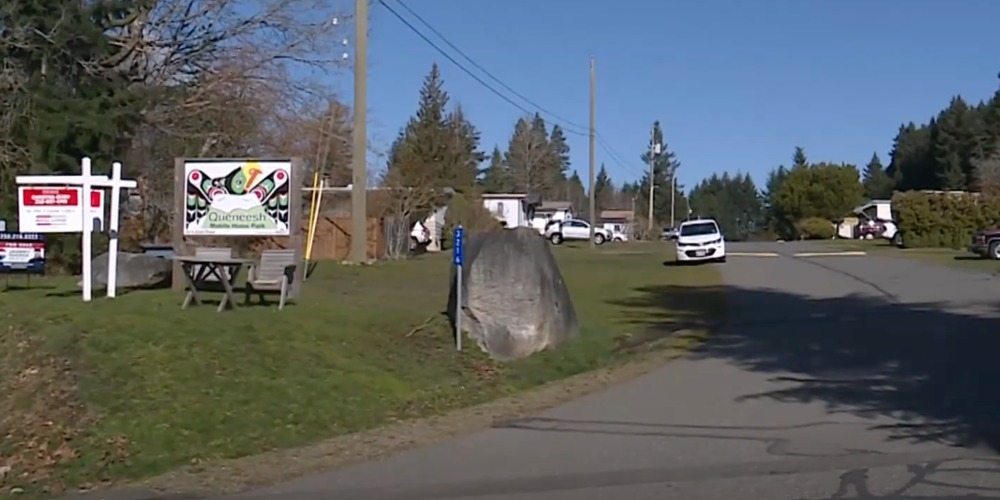
Canadian tribe evicting longtime residents from trailer park to ‘make way for much-needed housing, services for Nation members’
The K’ómoks First Nation announced that the Queneesh Trailer Park will be closing on January 31, 2028, “to begin to make way for much-needed housing and services for Nation members.”
A First Nation on Vancouver Island has given longtime residents of a trailer park on its reserve lands two years to get out so the First Nation can create housing for its own members.
The K’ómoks First Nation announced on Wednesday that the Queneesh Trailer Park will be closing on January 31, 2028, “to begin to make way for much-needed housing and services for Nation members.”
Longtime residents of the trailer park, on which 27 trailers are located housing over 100 people, told CHEK News that the First Nation is treating them unfairly, and they have limited options to relocate their homes due to costs and limited space on the island.
Kathy Jenkins, a park resident of 34 years, said, “There’s no place to move our trailers to on the Island. We are stuck. We have put our life savings into this trailer, and now we have to leave with nothing.”
Don Cropley, a park resident of 18 years, said, “I’m just really appalled at the First Nations for deciding to develop this land when they have a whole bunch of other tracts of land that are in really nice locations, and they’ve chosen to displace all us people.”
In October, the nation had warned that the park’s initial 50-year lease might not be renewed. Cropley said when he first moved onto his property, “I was not made aware of any kind of lease or anything like that.” When asked about such a lease, Cropley’s neighbors were similarly uninformed.
K’ómoks First Nation said that the landlord for the park is providing tenants “with an opportunity to have their monthly pad rental fees waived, to give tenants additional resources to secure alternative housing. We recognize that this transition affects current park tenants and will require tenants to make alternative living plans.” The nation said that the park “requires significant upgrades.”
Residents say the waived fee comes out to $11,000, while the cost to move a trailer can be upwards of $20,000. Some residents told the outlet that they’re worried about becoming homeless.
The First Nation said, “Taking the Nation’s lands back advances urgent and long-term housing priorities for the Nation. This aligns with KFN’s broader community planning efforts, and growing demand for housing among members, including housing for members currently experiencing housing insecurity. The Nation’s focus is on responsibly stewarding the Nation’s lands, while addressing the immediate and long-term housing needs of our members.”
This comes months after the British Columbia Supreme Court ruled that a fellow Vancouver Island First Nation, the Cowichan Tribes, held the Aboriginal title to about 7.5 square kilometers of land on Lulu Island, an area that includes private homes, farms, golf courses, and port facilities.
Brennan Day, the Member of the Legislative Assembly for the area covering the trailer park, noted that another nation is facing legal pushback for a similar situation.
“The Songhees is currently at appeal on a very, very similar issue and I certainly hope that the K’omoks First Nations work with the federal government to ensure that these people have somewhere to go. Many of them I’ve worked with previously are elderly, low-income and struggle with mental health issues, so there’s an absolute catastrophe in the making here if those groups can’t come together,” said Day.