
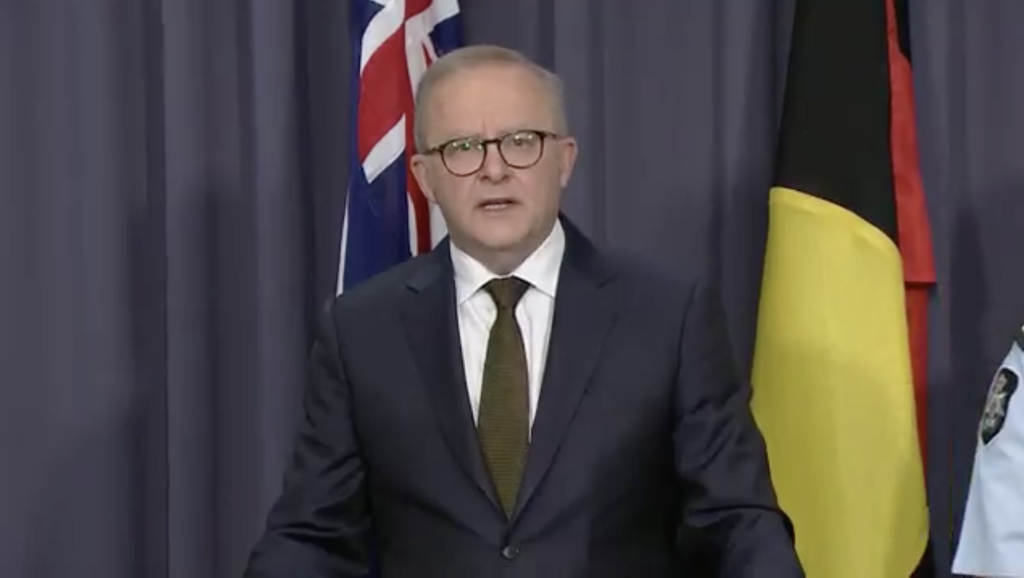
Australian PM Anthony Albanese Omits Jews in Assertion on Hanukkah Bloodbath
Australian prime minister Anthony Albanese released a statement after Sunday’s terror attack on a Hanukkah celebration in Sydney in which he made no mention of Jews or anti-Semitism.
Albanese wrote shortly after the shooting that “the scenes in Bondi are shocking and distressing” and that his “thoughts are with every person affected.”
Albanese was one of several world leaders to recognize a Palestinian state in September of this year in a move both President Donald Trump and Israeli prime minister Benjamin Netanyahu—as well as numerous Middle East experts—said would simply serve as a reward for Hamas and its allies after the Oct. 7, 2023, attack against Israel.
In a statement announcing Australia’s decision, Albanese said recognition of a Palestinian state was “part of a co-ordinated international effort to build new momentum for a two-state solution, starting with a ceasefire in Gaza and the release of the hostages taken in the atrocities of October 7, 2023.”
Hamas, for its part, welcomed Western calls for statehood. Ghazi Hamad, a senior official with the terror group, described the push for recognition as “the fruits of October 7” and said the attacks “caused the entire world to open its eyes to the Palestinian issue.”
Among the wounded in Australia on Sunday was Israeli human rights lawyer Arsen Ostrovsky, who grew up in the country after his family fled the Soviet Union. Ostrovsky had returned to Australia from Israel to help confront the rising tide of anti-Semitism in the country just two weeks before the shooting. He gave an interview on local television shortly after the shooting, covered in blood and bandages, and described the scene.
“There were children, there were elderly, families enjoying themselves, children and kids at a festival playing and then all of the sudden there’s absolute chaos,” Ostrovsky said. “There’s gunfire everywhere, people ducking. It was absolute chaos. We didn’t know what was happening, where the gunfire was coming from. I saw blood gushing from me, I saw people hit, people fall to the ground. My only concern was where are my kids, where is my wife, where is my family.”
Ostrovsky noted that he was living in Israel during Hamas’s Oct. 7 terror spree, saying, “We’ve lived through worse, we’re going to live through this, and we’re going to get the bastards who did this.”
Israeli foreign minister Gideon Sa’ar noted in a post on X that the words “Jews,” “Antisemitism,” and “Terror” were nowhere to be found in Albanese’s statement. In another post, Sa’ar said Sunday’s shooting represented “the results of the anti-Semitic rampage in the streets of Australia over the past two years, with the anti-Semitic and inciting calls of ‘Globalise the Intifada’ that were realized today.” He went on to say that “the Australian government, which received countless warning signs, must come to its senses!”
Netanyahu called the attack “cold-blooded murder” and noted the warning he gave to Albanese that recognizing a Palestinian state would only embolden anti-Semites.
“You let the disease spread and the result is the horrific attacks on Jews we saw today,” he said.
The shooting, which left at least 15 dead and another 40 injured, comes amid a torrent of anti-Semitism in Australia since Hamas’s Oct. 7 attack against Israel. In May of last year, Australia’s largest Jewish school in Melbourne was hit with graffiti, while several Jewish-owned businesses faced similar acts of vandalism in the ensuing months. A Jewish bakery in Sydney, for example, was defaced with anti-Semitic graffiti in mid-October and a note left for the owner stating, “be careful.”
The same month, arsonists set the Bondi-based Curly Lewis Brewing Company on fire, an incident followed by an arson attack at a neighboring kosher deli just days later. The violence continued into this year, with cars outside a formerly Jewish-owned business set on fire in January and an arson attack at a childcare center later in the month.
In February, two Sydney nurses were suspended after they published a TikTok video threatening to kill Jewish patients under their care, and in July, Jewish worshippers were forced to flee a Shabbat dinner in an East Melbourne synagogue after it was set on fire.
On Sunday at Bondi Beach, around 2,000 people were gathered for an annual Chabad-organized Hanukkah festival. At about 6:47 p.m. local time, two gunmen—alleged to be 24-year-old Pakistani Naveed Akram and his 50-year-old father, Sajid—opened fire. Among those killed were a 10-year-old girl, a Holocaust survivor, and a rabbi.
One of the alleged gunmen in Sunday’s attack was reportedly killed on the scene, while a second was wounded before being taken into custody. Video from the scene shows a bystander, identified as 41-year-old Ahmed al-Ahmed, tackling and disarming one of the attackers.
Authorities uncovered improvised explosive devices near one of the alleged gunmen’s cars as well. Israeli authorities are reportedly investigating whether Iran had any connection to the attack. Albanese said in August that the Islamic Republic was responsible for at least two arson attacks against Jews in Australia.
After the torrent of criticism, Albanese eventually gave remarks in which he described the shooting as “a targeted attack on Jewish Australians on the first day of Hanukkah.” When asked about his response to the wave of anti-Semitism in his country, Albanese said “we have taken it very seriously, and we’ve continued to act.”
President Donald Trump told Fox News’s Peter Doocy that his message to Jewish Americans in the wake of the attack was “be proud of who you are” and to “celebrate proudly.” In remarks at the White House, Trump denounced what he called a “purely anti-Semitic attack” and said he wanted to “pay [his] respects to everybody.”