
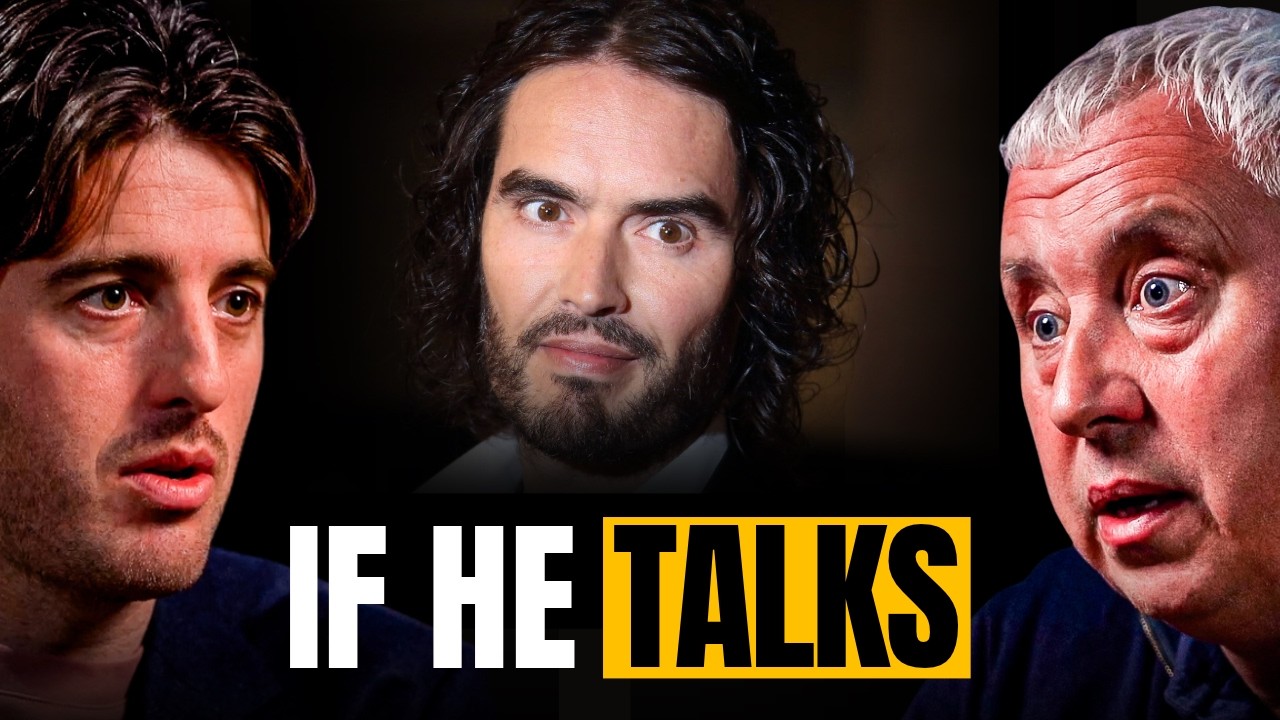
John Wedger: If Russell Brand Knows What I Suspect He Knows…
Exclusive Interviews, Videos
John Wedger: If Russell Brand Knows What I Suspect He Knows…
By
Matt Morgan – November 23, 2026
/script type=”text/javascript” src=”https://app.getresponse.com/view_webform_v2.js?u=S6bT5&webforms_id=A25R”>
Summary
Wedger argues that Russell Brand’s ten-and-a-half-year sentence for rape and sexual assault is standard for such convictions, not evidence of a deep-state conspiracy, and that Brand’s refusal to plead guilty to lesser charges cost him a 33% sentence discount. He contends that child abuse is the ultimate blackmail tool binding elites together, citing examples from boarding schools to care homes, and that the entertainment industry and the Epstein network represent the worst yet to come. Wedger believes Brand may now trade information as an informant to reduce his sentence, just as Hugh Edwards may have done to avoid prison entirely, and that public interest immunity hearings routinely shield informants from exposure in court.
Top 5 Key Topics
- Brand’s conviction and sentencing: Wedger states that Brand received eight to twelve years, the standard range for rape convictions, and that his barrister did a {{shocking job}} by attacking victims and issuing no defense. He explains that Brand should have pleaded guilty to all sexual assaults and dropped the rape charge, which would have earned him a 33% discount and likely resulted in only five years, but instead Brand put vulnerable witnesses through trial and received consecutive sentences totaling ten and a half years of which he must serve seven.
- Informants and sentence reductions: Wedger describes how serious criminals in trouble are visited by detectives who offer to help in exchange for information on bigger targets, a process that involves public interest immunity hearings where courts are cleared and judges receive sealed letters confirming a defendant’s value as an informant. He suggests that Brand, now in a position of potential power if he knows what Wedger suspects, could trade information to reduce his sentence through the appeal system, and that Hugh Edwards may have done exactly that to avoid prison despite possessing 2,000 high-level child abuse images.
- Child abuse as elite blackmail: Wedger asserts that child abuse is the dirtiest area of policing with immense blackmail value, the one crime that cannot be brushed over in any community, and that it is {{the glue that holds all this dirt together}} among elites. He recounts that the Paedophile Information Exchange received Home Office funding for three years in the 1970s and was supported by the National Campaign for Civil Liberties, and that he was ordered by the Intelligence Services to cancel a planned protest uniting abuse survivors because 30 to 40% of society has been touched by child abuse in some way.
- Boarding school abuse and the Greco-Roman model: Wedger explains that Robert Montague, son of Lord Montague of Beaulieu, was abused by his father and nine members of Winston Churchill’s cabinet at age nine, then sent to Eton where the fagging system operated as {{nothing more than a rent boy racket}}. He cites the book The Poisoned Bowl, which concluded that the beatings and buggery in elite schools followed the exact algorithm of Greco-Roman gladiator schools designed to shut people down emotionally, and that survivors including James O’Brien and Charles Spencer have spoken out about the same pattern of abuse.
- The Epstein list and future revelations: Wedger predicts that the worst is yet to come and that the entertainment industry in Britain will be the next major scandal, with celebrity comedians now {{bricking their pants}} because journalists are doing phenomenal work and rats will grass on each other. He reveals that the Epstein list came out by default when Miami Police found eight suitcases of documents during a raid, that there were nineteen planes not just the Lolita Express, and that Fred West was {{the pound land version}} of Epstein who also died in a prison cell under controversy after making twenty tapes naming elites involved in procuring and murdering children.
Posted in Exclusive Interviews, Videos