

NBC Lied About Maternal Mortality, After Texas Abortion Ban It Actually Declined
In September 2024, NBC News ran a headline under the “abortion rights” section of their website: “A dramatic rise in pregnant women dying in Texas after abortion ban.”
The article summarized an unpublished analysis from the Gender Equity Policy Institute (GEPI) discussing the Texas maternal mortality ratio (MMR). MMR counts how many women die during pregnancy or within 42 days after it ends, for every 100,000 live births. GEPI reported Texas MMR rose 56% from 2019 to 2022, compared with 11% nationwide.
GEPI president Nancy L. Cohen told NBC (emphasis added):
There’s only one explanation for this staggering difference in maternal mortality. All the research points to Texas’ abortion ban as the primary driver of this alarming increase.
Nancy L. Cohen, NBC, 9/20/24
This claim is bizarre, because GEPI’s own numbers show maternal mortality decreasing after the 2021 Texas Heartbeat law went into effect. GEPI’s framing was nonsense from the beginning. Research since then has continued to contradict Cohen’s conclusion.
Click here to sign up for pro-life news alerts from LifeNews.com
Per NBC (emphasis added):
The number of women in Texas who died while pregnant, during labor or soon after childbirth skyrocketed following the state’s 2021 ban on abortion care.
A dramatic rise in pregnant women dying in Texas after abortion ban, NBC, 9/20/24
The Texas Heartbeat Law went into effect in September 2021. Here’s the data from NBC’s own article (arrows added):
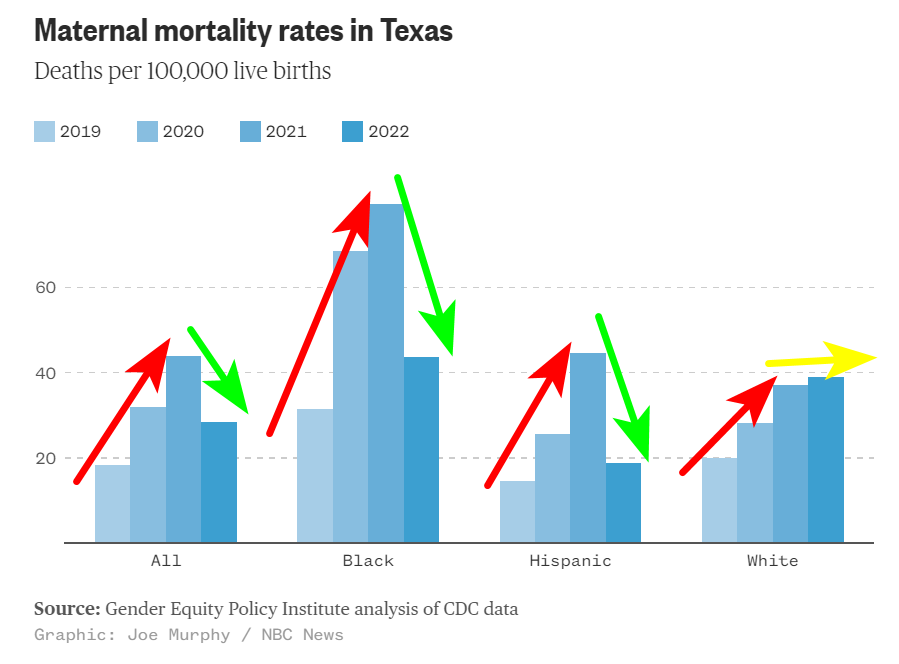
So what happened after the Heartbeat Law went into effect? Texas maternal mortality substantially decreased (green arrows) for all women, Black women, and Hispanic women. NBC’s headline should more accurately say “A dramatic decrease in maternal deaths after Texas abortion ban.”
The increase GEPI reports came during COVID, mostly before the abortion law took effect
NBC wrote an article about a law that took effect in September 2021, then compared Texas maternal deaths in 2022 to those in 2019. According to GEPI, maternal mortality in Texas increased (red arrows) from 2019 to 2020, and again from 2020 to 2021. So nearly all of the increase happened before the Texas Heartbeat Law went into effect in September 2021.
Bizarrely, here is how NBC explained their chart (emphasis added):
While maternal mortality spiked overall during the pandemic, women dying while pregnant or during childbirth rose consistently in Texas following the state’s ban on abortion.
A dramatic rise in pregnant women dying in Texas after abortion ban, NBC, 9/20/24
That’s the explanation for a chart that showed maternal deaths decreasing after the state’s ban on abortion.
[Read more – No, Texas maternal mortality didn’t “skyrocket” after heartbeat law]
Comparing Texas to the national average hides COVID’s bigger toll in Texas
GEPI contrasted Texas’ 56% rise in maternal deaths with an 11% rise nationwide.
National numbers followed the same basic pattern as Texas: MMR increasing from 2019 through 2021, then decreasing into 2022. This pattern makes sense, because every state in the country, regardless of their specific abortion laws, went through the pandemic.
But Texas had a bigger pandemic spike than the national average. The 2026 Texas maternal mortality report puts the state’s 2021 ratio at 39.1 deaths per 100,000 live births, or 23.5 without COVID deaths. That means COVID accounted for about 16 deaths per 100,000 births, or roughly 40% of Texas maternal deaths that year. Nationally, COVID contributed to about 34% of maternal deaths in 2021 (401 of 1,178, see Figure 2 of this GAO report).
The Texas report also notes that COVID maternal deaths were still declining even from 2022 through 2024, which means GEPI’s measurements in 2022 still included COVID deaths. A state with a bigger COVID spike will show a bigger 2019 to 2022 rise. That gap tells you about COVID, not about abortion law.
Texas’ 2026 report shows maternal mortality back in its pre-pandemic range
The “deaths are skyrocketing” framing never held up to begin with, but newer data have only widened the gap between abortion hyperbole and reality.
Texas’ Maternal Mortality and Morbidity Review Committee, a state panel of doctors and other experts, reports to the legislature every two years. Their newest report found that:
- “From 2022-2024 the MMR decreased as did maternal deaths due to COVID-19. By 2024, the MMR was 20.5 deaths per 100,000 live births, a similar rate as before 2020.”
- From 2013 to 2019, before COVID and before the Heartbeat Law, the ratio “fluctuated between 17.0 and 20.7.”
- The pregnancy-related mortality ratio (deaths caused or worsened by pregnancy, up to a year after it ends) fell from 30.0 in 2021 to 20.7 in 2024.
By 2024, nearly three years after the Texas Heartbeat Law and two years after Dobbs, maternal mortality had returned to the range Texas saw for most of the 2010s.
Both regional and national controlled comparisons find no increase in maternal deaths
Of course COVID contributed to maternal mortality rates. But apart from COVID, did Texas abortion laws also increase maternal deaths?
To answer this question, we need to compare Texas to places that also dealt with COVID but didn’t deal with similar abortion laws.
Lyman Stone, a demographer and director of research for Demographic Intelligence, ran exactly that comparison. He took a closer look at the data in 2024, specifically CDC data on all deaths related to pregnancy or childbirth, and excluded deaths of women who had COVID. He compared Texas to (pro-choice) Northeastern states. Once he omitted the impacts of COVID, Stone found no “skyrocketing” in maternal deaths in Texas compared to the pro-choice states, either after the Heartbeat Law (September 2021) or after Dobbs (June 2022).
A 2026 JAMA Network Open study got similar results. Researchers built a “stand-in Texas”: a weighted blend of states without restrictions whose death trends matched trends in Texas before 2022. Then the researchers compared actual Texas to the stand-in after the Heartbeat Law. They found no statistically significant change in Texas for pregnancy-associated, pregnancy-related, or maternal deaths. They did this same comparison for all 14 states with major post-Dobbs abortion restrictions, and they still found no statistically significant increase in maternal deaths. Their conclusion:
[A]bortion bans were not associated with statistically significant overall or state-specific increases in pregnancy-associated mortality.
Abraha et al., US Abortion Bans and Pregnancy-Associated Mortality, JAMA Network Open, 4/3/26
Reducing maternal deaths means examining the real causes, not blaming abortion restrictions
The US has one of the poorer MMRs for first world countries, and Texas has been infamous for high maternal mortality for years. And specifically, pregnancy-related deaths for Black women in Texas have been higher than for their Hispanic and white counterparts before, during, and since COVID. These outcomes aren’t necessary or inevitable. In the 2026 Texas report, the committee determined about 3 out of 4 pregnancy-related deaths were potentially preventable. The committee’s report points to mental health conditions, hypertensive disorders, gaps in care after birth, and racial disparities.
Not all states have these problems to this degree. After a spike in maternal deaths in the early 2000s, California created their Maternal Quality Care Collaborative, which introduced strategies like hemorrhage carts stocked with everything doctors need to treat bleeding after birth. And California successfully, sharply reduced maternal mortality over the years, even as rates rose nationally.
There are many potential improvements to maternal care that aren’t related to access to elective abortion, but it’s more difficult for society to identify and bridge these gaps if we’re too busy trying to remake all healthcare failures into a predetermined narrative about abortion restrictions.
GEPI decided on their explanation (in Cohen’s words, “only one explanation”) and worked backward from there. And that comes at a cost. Every headline blaming the Heartbeat Law for COVID deaths is a headline diverting people’s attention from actual, preventable danger.
[Read more – Maternal mortality rates in pro-life vs pro-choice states]
LifeNews.com Note: Monica Snyder is the executive director of Secular Pro-Life, an organization that uses non-religious arguments to promote the pro-life perspective. This appeared at Secular Pro-Life and is reposted with permission.
