
Governments Always Sell at the Bottom. Bitcoin Is Back There Now, But This Time Is Different.
/script type=”text/javascript” src=”https://app.getresponse.com/view_webform_v2.js?u=S6bT5&webforms_id=A25R”>
Written by Matt Morgan at The Daily Bell:
If you want to know when to buy hard money, watch for a government that’s selling it.
They have a remarkable talent for picking the bottom because Bitcoin just got knocked back to its bear market lows.
Germany’s Bitcoin Fire Sale
In the summer of 2024, the German state of Saxony unloaded a pile of bitcoin it had seized in a piracy case.
The Block reported the result:
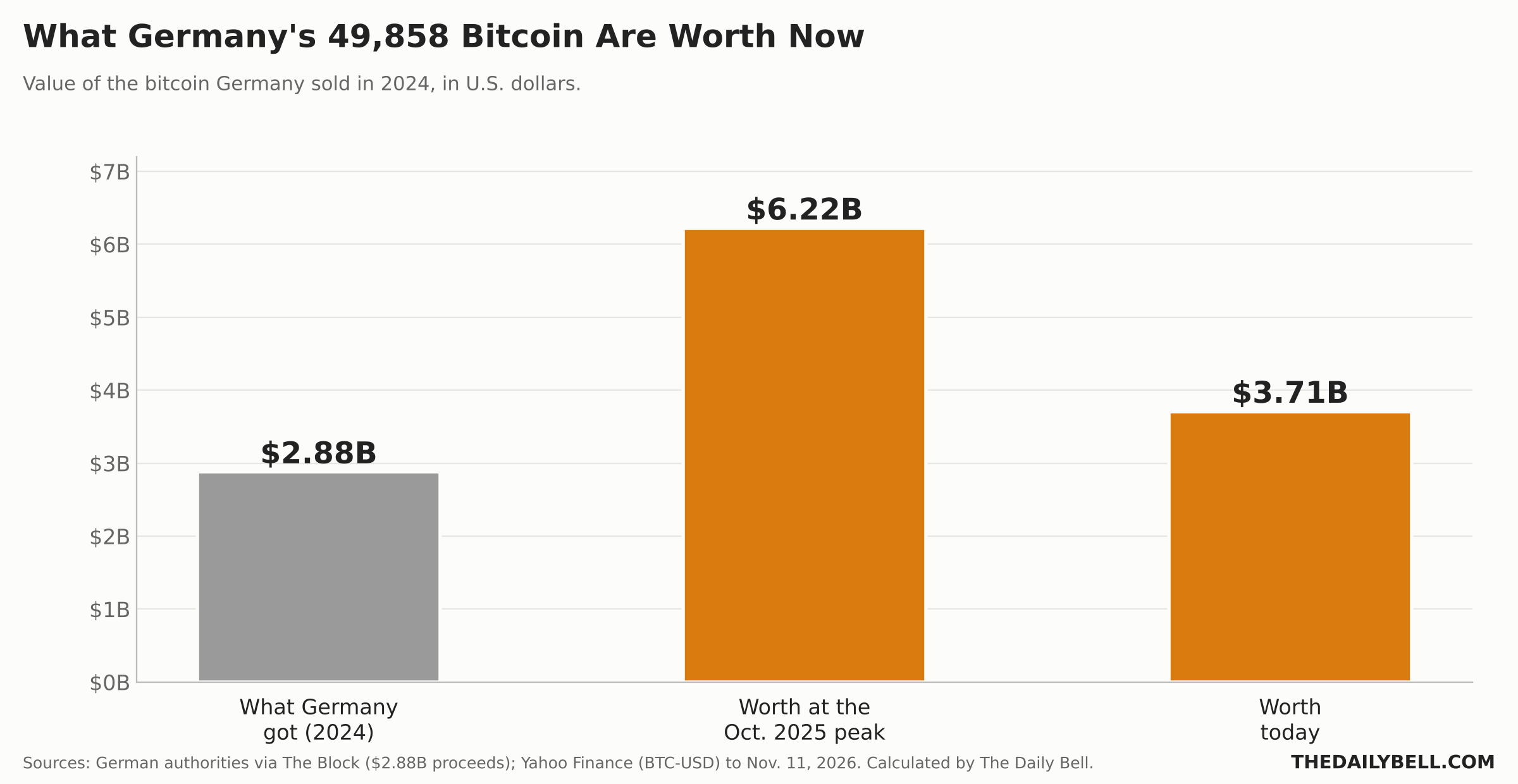
“German authorities announced on Wednesday that the sale of nearly 50,000 bitcoins had generated $2.88 billion.”
That works out to about $57,800 a coin, sold between June 19 and July 12, 2024. Unfortunately for Germany, fifteen months later Bitcoin hit a record near $124,750.
Officials treated it as an emergency sale, the kind of quick dump German law allows when seized property might lose value. In other words, they saw Bitcoin as a hot potato, not an asset.
Data: source
At that peak, Germany’s coins would have been worth about $6.2 billion. Even after this fall’s slide, they were still worth about $3.7 billion last week.
Data: source
Germany wasn’t the first European government to pull this move. It wasn’t even the most expensive.
Switzerland Did It First, With Gold
Swiss banker Ferdinand Lips watched his own country do the same thing with gold. In his book Gold Wars, he describes how the Swiss National Bank decided to sell 1,300 tonnes, about half its reserves. The sales started in May 2000, at roughly a tonne a day, with gold under $300 an ounce.
Lips quotes one observer who smelled something off:
“The decision of the Swiss National Bank to sell half of their reserves in the final stages of a very long bear market in precious metal has, to this observer of the gold market, always been a tad suspicious.”
Even at today’s price, just under $4,000 an ounce, those 1,300 tonnes would be worth roughly $165 billion.
In their arrogance, governments believe in their own currencies as their powerful and persuasive possession. Then they get rid of it while it’s cheap and unloved.
Then They Want It Back
The big punchline comes later, once the price has run.
In March 2025, the U.S. created a Strategic Bitcoin Reserve, and the White House fact sheet admitted the cost of selling too early:
“Premature sales of bitcoin have already cost U.S. taxpayers over $17 billion.”
So, the government track record on hard money is… sell low, regret it, and buy back high.
These aren’t the smartest traders in the room.
They’re the most predictable ones.
And right now, the market is back in exactly the kind of mood they sell into, but…
This time really is different.
Where We Are Now
Mark Jeftovic, publisher of The Daily Bell and The Sovereign Capitalist, sent a note to his readers over the weekend: Bitcoin has been “smashed back down to bear market bottom levels.” Gold has slipped under $4,000 too, with a hot inflation print and talk of more Fed rate hikes weighing on everything.
The clearest bottom signal is the mood:
Data: source
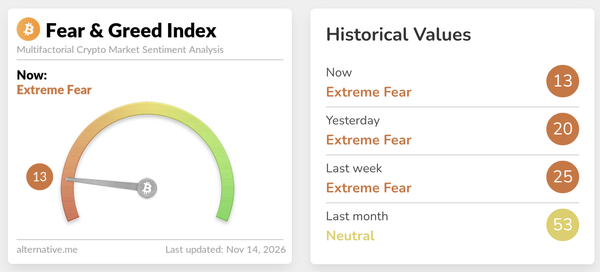
The Crypto Fear and Greed Index read 53 a month ago, dead neutral. On Friday it hit 13, which is “extreme fear,” the same mood Saxony’s officials were in when they hit the emergency button.
However, Mark doesn’t think we’re quite at the bottom yet. In his experience, this index bottoms in the single digits, around 7, 8 or 9. That doesn’t mean the price has to keep falling, but it does mean sentiment has a little further to collapse. He even said he wouldn’t rule out Bitcoin touching $58,000 “just for the sake of the meme.”
Look at Germany again… $58,000 is almost exactly what Germany got per coin in 2024. If Bitcoin gets there, the market will have handed Saxony’s price right back, one full round trip later.
We’re not at the bottom, but we’re close enough to see it.
What Governments Want Instead
There’s one more piece to this, and it explains why governments now want Bitcoin instead of dumping it.
In Repricing Sovereignty, Mark admitted he’d been wrong to expect nation states to fade as a result of Bitcoin’s (and cryptos) emerging economic power. Instead, he wrote, “The State and The Economy are in the process of merging.” A state like that wants hard assets on its balance sheet.
What it doesn’t want is for you to hold them without asking.
Right now, the fear isn’t only about prices. A string of software failures, from email outages to grounded flights, has people talking about a “cyber event” as the next COVID, the excuse for digital lockdowns and new controls. Mark doesn’t think anyone planned this mess, and I agree…
But a crisis doesn’t need to be planned to be used. Economic historian Robert Higgs showed in Crisis and Leviathan that government grows in emergencies and never fully shrinks back afterward. As he put it:
“…each genuine crisis has been the occasion for another ratchet toward Bigger Government.”
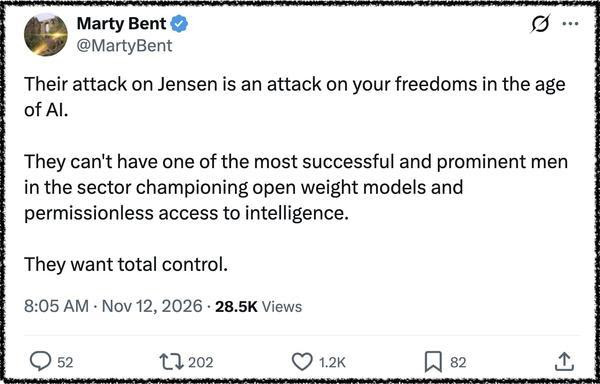
That’s why so many people read the attacks on Nvidia’s Jensen Huang, one of the loudest voices for open-weight AI models, as more than a stock story. Here’s how Bitcoin podcaster Marty Bent put it:
Source: Marty Bent on X
You don’t have to buy the conspiracy to see the incentive. Open-weight AI models and Bitcoin share one feature: nobody needs permission to use them. A government can hold Bitcoin in a reserve and still want to control who else holds it, and how.
The State wants the hard money. It’s far less keen on your freedom to own it.
The Takeaway
Governments make lousy traders. They sell when prices are low and the headlines are scary, because that’s when selling looks prudent. They buy back after the price has run. And when a crisis hits, they reach for more control.
The easiest way to copy it is with leverage.
Mark’s advice for this market: if you’re trading on margin anywhere, unwind it now. Borrowed money turns you into a forced seller, and a forced seller is just a private-sector Saxony. It sells because it has to, at the worst possible price.
As Mark put it:
“Nobody wants to sell at the bottom, and I don’t think we have to.”
Let the governments sell at the bottom. They’ve had plenty of practice.
Want the Full Picture?
In his next edition of The Sovereign Capitalist, Mark lays out how he’s positioning for this new regime, including which Bitcoin-related stocks he thinks are dead money and what he’s buying instead. Every month he breaks down Bitcoin, gold and the wider macro picture, including the charts he’s watching and his model portfolio.
Take The Sovereign Capitalist for a $7 test drive on your first month with promo code SOVTRIAL.