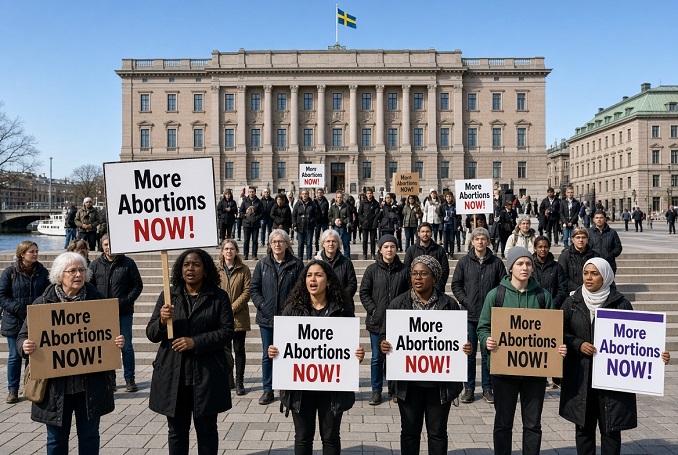

Sweden Creates Right to Kill Babies in Abortions
On November 11, 2026, Sweden’s Parliament decided its constitution urgently needed amending. Apparently, the country’s collapsing birthrate, shrinking families, and their increasingly uncertain demographic future could wait. It seems the national priority was to make abortion a constitutional right. So by a vote of 292 to 51 (with six members absent), the Riksdag gave its final approval to an amendment that will take effect on January 1, 2027.
I’ve spent way too many years watching virtue-signaling politicians perform clumsy intellectual gymnastics to defend and promote abortion, but Sweden’s latest plot twist deserves special recognition. It did next to nothing in practical terms, but it made a big show and statement about the country’s priorities. Worse, some politicians openly questioned the wisdom of the amendment, recognized its troubling implications, and then went and voted for it anyway.
Sweden has allowed abortion on demand through the eighteenth week of pregnancy since January 1, 1975. And the public healthcare system mostly covers the cost. Every political party represented in Parliament supports this framework, and no parliamentary majority was threatening to repeal it.
Click here to sign up for pro-life news alerts from LifeNews.com
So what, precisely, was the emergency?
The government’s justification, outlined in Proposition 2025/26:78, was almost comical. Abortion enjoyed strong public support, lawmakers agreed on its legality, and the interests it protected were supposedly so important that they deserved constitutional recognition. In other words, because abortion was already firmly established and politically secure, Parliament needed to make it even more secure. Why?
Seriously, Swedish lawmakers weren’t confronting an imminent ban or a serious legislative challenge. This was all in response to a “what if.” Those who promoted and pushed for this were responding to a hypothetical future in which someone might question their national enthusiasm for abortion. You know, the pro-life boogeyman that had France so quaking that they amended their constitution in 2024. Swedish abortion advocates evidently found the example irresistible. What better way to demonstrate a nation’s commitment to progress than to elevate the shredding and poisoning of unborn human life to a constitutional principle?
The new language declares that a “pregnant person” (their language) has the right to terminate a pregnancy according to provisions established by law. OK. It does not change Sweden’s eighteen-week framework or automatically eliminate existing restrictions. It does, however, give abortion constitutional standing and make future legislative challenges more complicated. The immediate practical effect may be modest, but the political and moral statement is unmistakable. And that’s the why.
Christian Democrats, the supporting actors in the theater of the macabre, deserve their own chapter in the annals of political capitulation.
Party leader Ebba Busch had previously questioned whether abortion belonged in the Constitution, comparing the proposal to writing a constitutional right to an appendectomy. An interesting, albeit typical, comparison, considering that an appendectomy removes a diseased organ while abortion intentionally ends the life of a developing human being. Apparently, the distinction escaped her medical analogy.
Christian Democrat Hans Eklind went further during the November 11 debate. He acknowledged that no parliamentary party threatened Sweden’s abortion law and questioned the wisdom of constitutionalizing a particular medical procedure. More significantly, he recognized the ethical conflict involving two individuals worthy of protection and warned that similar reasoning might eventually support a constitutional right to assisted dying.
One would hope that those concerns would lead to some type of resistance. But, alas, no. Eklind, with what I can only assume was a straight face, went on to announce that his party supported the amendment. Nothing quite captures political surrender like a lawmaker carefully explaining why a proposal deserves skepticism before helping it become law.
The government made that surrender considerably more awkward by adding additional and unrelated constitutional changes to the abortion language. Those changes involved citizenship revocation and restrictions on criminal organizations. Parliament gave the package its first approval on May 20, 2026, and completed the process on November 11.
Now here’s the rub: the liberal Left and Green parties supplied all 51 opposing votes, not because they objected to abortion, but because they opposed the other provisions.
Consequently, politicians who questioned the abortion amendment supported it, while politicians who rejected the package supported abortion rights themselves. Somewhere in that remarkable parliamentary arrangement, unborn babies disappeared entirely from consideration.
As expected, the Swedish Association for Sexuality Education, RFSU, welcomed the constitutional recognition but immediately demanded more. Chair Lina Fridén celebrated the broad political agreement while urging the government to modernize Sweden’s fifty-year-old abortion law. Even constitutional protection apparently failed to satisfy an organization determined to expand abortion access.
All this has unfolded against an extraordinarily troubling demographic backdrop.
According to Statistics Sweden, the country’s total fertility rate fell from approximately 1.99 children per woman in 2010 to 1.43 in 2024, then dropped to roughly 1.42 in 2025. Among Swedish-born women, fertility reached approximately 1.39 in 2024. Sweden recorded only about 97,500 births in 2025, its lowest annual number since 2002. Replacement fertility generally requires approximately 2.1 children per woman.
Sweden has fallen dramatically below replacement rates. And those consequences extend far beyond maternity wards. Fewer births today means far fewer Swedes entering the workforce tomorrow. This will place incredible pressure on pensions, healthcare, and public services. Economic uncertainty, delayed parenthood, housing costs, and changing family preferences all contribute to declining fertility. Abortion alone does not explain the trend, nor does constitutionalizing it prove that birthrates will fall further. But the contrast between Sweden’s demographic difficulties and its constitutional priorities could hardly be more disturbing.
Sweden must confront the uncomfortable arithmetic of an aging society with too few births and mounting demands on future taxpayers.
Children, however, are worth infinitely more than their eventual contribution to the treasury. They are not future revenue sources whose value depends on financing somebody’s pension. Their dignity begins long before they earn a paycheck, and any nation that measures its children solely through demographic or economic calculations has already misunderstood what makes human life precious.
That is the fundamental question Sweden’s constitutional debate neglected. The government spoke endlessly about “bodily autonomy,” individual freedom, and protecting abortion against possible future restrictions. Lost in the arguments (of which there were few) was the fact that pregnancy involves two human lives, and no serious discussion of abortion can simply pretend otherwise.
On November 11, Sweden’s lawmakers had an opportunity to consider what their constitution should say about the most vulnerable members of their society. Instead, they chose to give abortion greater constitutional protection, despite decades of broad legal access and overwhelming parliamentary support.
Sweden’s constitutional amendment will not change the abortion law overnight, but may eventually add to the country’s demographic decline. What it reveals is a political establishment more concerned with protecting abortion from imagined future threats than confronting the very real challenges facing Swedish families.
The Riksdag has spoken. The constitutional principle will take effect on January 1, 2027.
And the unborn child, whose life stands at the center of this entire debate, remains the one person Sweden’s politicians seem determined not to hear.
LifeNews.com Note: Raimundo Rojas is the Outreach Director for the National Right to Life Committee. He is a former president of Florida Right to Life and has presented the pro-life message to millions in Spanish-language media outlets. He represents NRLC at the United Nations as an NGO. Rojas was born in Santiago de las Vegas, Havana, Cuba and he and his family escaped to the United States in 1968.