
Fourth Turning: US Institutions Fight Over Real Money
/script type=”text/javascript” src=”https://app.getresponse.com/view_webform_v2.js?u=S6bT5&webforms_id=A25R”>
Written by Matt Morgan, Editor at The Daily Bell:
The Trump administration cannot decide which department gets to run its Strategic Bitcoin Reserve, and the fight has frozen the whole project. The US Treasury was meant to hold it. Now the Commerce Department wants the job, and the Justice Department has been pulled in to decide who has the legal authority to keep the coins at all. This looks like a paperwork snarl, but it is something older and larger.
When the monetary order cracks, the state reaches for the hardest money in the room and moves to control it. The US government did this with gold in 1933, in the depths of the last Fourth Turning. It is doing it with Bitcoin now, in the depths of this one.
A Good Fight
The order signed in March 2025 built the reserve out of Bitcoin the government had already seized through criminal and civil forfeiture. Its command on that Bitcoin was blunt: it “shall not be sold and shall be maintained as reserve assets.” Held forever, in plain words. Then the lawyers found the snag. Nobody is sure Treasury has the authority to sit on a volatile digital asset indefinitely, so the plan has pivoted toward Commerce, with the Justice Department’s Office of Legal Counsel refereeing.
Bloomberg reports:
Trump Bitcoin Reserve Faces Hurdles as Departments Seek Control
“The Trump administration’s plan to create a Strategic Bitcoin Reserve has been complicated by two government departments vying to run it, alongside questions about which has the legal authority to do so.
President Donald Trump ordered the reserve to be created last year as part of his promise to turn America into the “crypto capital of the world.” His plan intended to have it housed inside the US Treasury Department, with the Bitcoin coming from asset seizures conducted by different parts of the federal government, along with possible new purchases.
However, a concern arose about whether the Treasury Department was legally able to manage the crypto trove, according to people familiar with the matter who were not authorized to speak publicly.
Now, multiple parts of the administration are involved in crafting a plan to ensure the Strategic Bitcoin Reserve is legally viable. Putting it inside the US Commerce Department is one possibility, said the people, who were not authorized to speak publicly. An overarching issue is whether the Bitcoin can be housed indefinitely, as the executive order intended, given the volatile nature of the cryptocurrency.
“President Trump campaigned on a vision of cementing America as the global capital of cryptocurrency and other cutting-edge technologies,” White House spokesperson Liz Huston said in a statement on Monday. “To deliver on the president’s vision, the Trump administration continues to evaluate the best structure for a Strategic Bitcoin Reserve and U.S. Digital Asset Stockpile.”
The Justice Department said in a statement that its Office of Legal Counsel “is working closely with both the Treasury and Commerce departments to determine legally available options to accomplish the president’s policy of establishing a strategic Bitcoin reserve.”
Spokespeople for Treasury and Commerce did not respond to requests for comment. Trump had ordered the two departments to jointly develop strategies for buying more Bitcoin in budget-neutral ways.
The internal competition and legal quandaries have affected what’s intended to be a major pillar of the Trump administration’s pro-crypto agenda.”
The US government is one of the largest owners of Bitcoin globally when adding up all the components, worth more than $20 billion at current prices, according to Arkham Intelligence. The original cryptocurrency hit an all-time high in October, driven partly by enthusiasm about Trump, but is down nearly 50% since then.
The White House has said that premature sales of Bitcoin have cost taxpayers some $17 billion over the years, and that combining it into one reserve that holds Bitcoin indefinitely would give the country a strategic advantage.
“I am very positive and open minded to cryptocurrency companies, and all things related to this new and burgeoning industry,” the president said in a fact sheet related to his March 2025 order. “Our country must be the leader in the field.”
Departments do not knife each other over things that do not matter, and Bitcoin matters. Whoever administers the reserve controls an asset the state has decided is worth keeping out of private hands and off the market for good.
The Last Time, It Was Gold
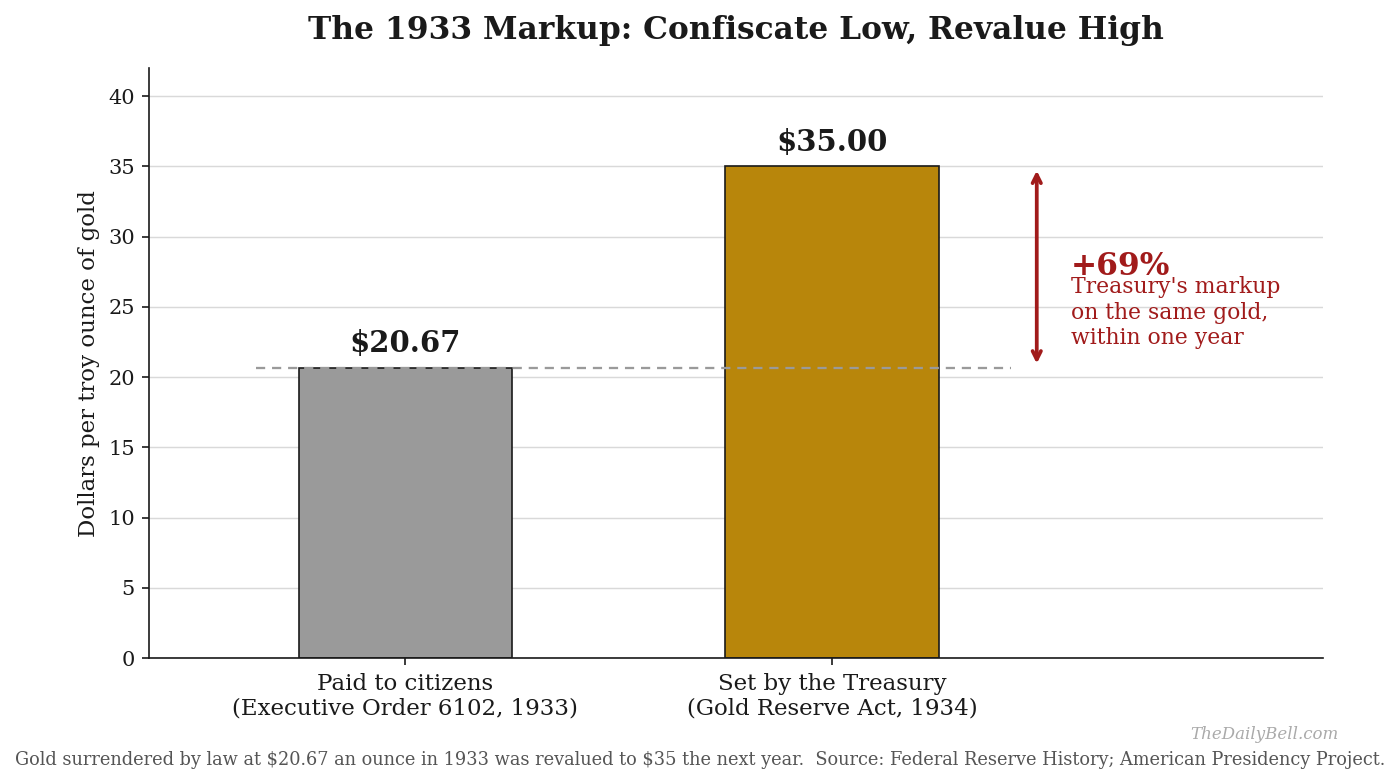
This happened during the last Fourth Turning. In April 1933, with the banks collapsing, Franklin Roosevelt ordered Americans to surrender their gold at $20.67 an ounce. Refusing meant a fine of up to $10,000 and up to ten years in prison. Once the metal sat safely in federal vaults, the Gold Reserve Act of 1934 moved it to the Treasury and reset the official price at $35. The citizen sold low under threat of prison. The Treasury marked the same gold up by two-thirds the next year and kept the gain…
The State could not produce sound money, so it took the sound money its citizens held, and then cancelled the public’s right to trade paper for gold at all. Hard money was nationalized and neutered in a single stroke. While owning gold stayed a crime for the next forty years.
Winter Comes On Schedule
Neil Howe’s Fourth Turning describes history moving in cycles of roughly eighty to a hundred years, each ending in a crisis era, a winter, when the old institutions break and a new order is forced into place. The 1930s were the last winter.
By that clock we are deep in another, and you need not swallow the whole theory to see what the two moments share:
- Collapsing trust in institutions
- Deteriorating public finances
- And a government reaching again for the hardest asset within reach
In 1933 that asset was gold, because gold was money the state could not print. Today it is Bitcoin, for the same reason. A supply capped at 21 million coins cannot be inflated by anyone, which is exactly what makes it useful to savers and dangerous to a government that funds itself by degrading its own currency. Against the money it prints, the state has run a slow confiscation of its own for a century.

The White House even calls Bitcoin “digital gold” in its own fact sheet. It has told us what it thinks it is buying.
Control is the Whole Point
What will the institutions do with the Bitcoin?
The Bitcoin is not to be spent or sold. It is to be gathered and held, with Treasury and Commerce told to find “budget-neutral” ways to buy more. Proposed legislation would go further and lock the holdings away for decades, or find some way to earn more on interest.
A Strategic Bitcoin Reserve is the State doing to a rival money what it once did to gold: turning a threat into a holding, and an escape route into an asset it administers. The fight is over who gets the keys, because whoever holds the keys holds the power to dictate what the next monetary system can look like.
A Fourth Turning Feud for the Future
A Fourth Turning is where old regimes are pulled down and new ones are installed, and the struggle over money sits near the center of it. Government reach for hard money when they can no longer be trusted to make their own. They will always move to control what they cannot print. And whoever holds the Bitcoin holds the power to shape what future institutions look like.