
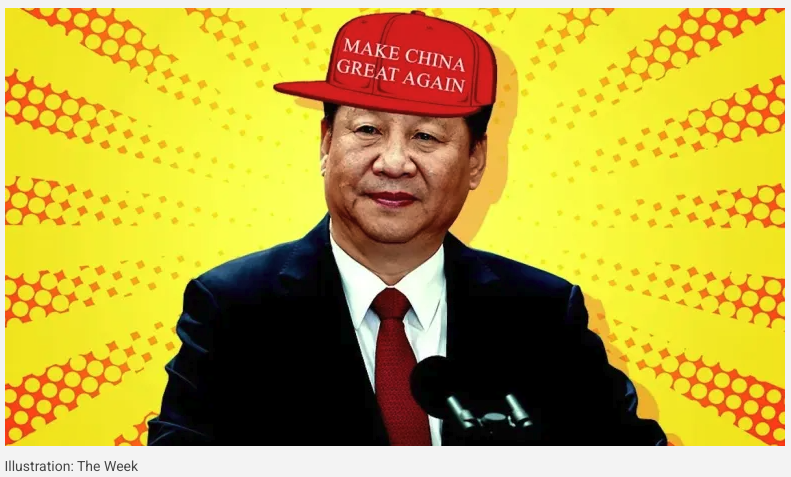
What Xi Jinping’s Reward of “Make America Great Again” Actually Means
/script type=”text/javascript” src=”https://app.getresponse.com/view_webform_v2.js?u=S6bT5&webforms_id=A25R”>
Written by Matt Morgan, Editor at The Daily Bell:
The “little guys” have become bargaining chips for peace between the United States and China.
In May, Donald Trump flew to Beijing and stood beside Xi Jinping while Xi praised the Make America Great Again movement and likened it to China’s “great rejuvenation of the Chinese nation.” Friendly observers were delighted. Here, they said, was a thaw, a de-ideologized foreign policy, a way out of the Thucydides trap. Two great powers pursuing two great projects in parallel, mutually beneficial, for the benefit of the world.
Asia Times reports:
Xi Jinping’s praise of ‘Make America Great Again’ a major signal
According to reports, Xi Jinping stated,
This year also marks the 250th anniversary of American independence, and more than 300 million Americans are revitalizing their patriotic, innovative, and pioneering spirit, propelling American development onto a new journey.
The people of China and the United States are both great peoples, and realizing the great rejuvenation of the Chinese nation and making America great again can be done in parallel, mutually beneficial, and for the benefit of the world.
Strip away the banquet language and look at what actually changed hands. The summit produced no agreement on Taiwan that anyone would sign in public. What it produced instead was a $14 billion arms package to Taiwan left, in Trump’s own word, in “abeyance,” with the decision, again in his own words, depending on China. Trump told reporters that Xi “would like us not to” arm the island, and that he had made “no commitment either way.” Within days, a senior Navy official confirmed the sale was paused.
That is the deal. Strip the ceremony and you find two states agreeing to leave one another’s collectivist ambitions undisturbed, and pricing a third party’s defense as a bargaining chip on the international table.
The “National Rejuvenation” Parallel
The friendly reading treats MAGA and the rejuvenation of the Chinese nation as two healthy patriotisms that happen to point in compatible directions. Both slogans describe the same thing: a state mobilizing a population behind the state’s own aggrandizement, and calling that aggrandizement, destiny.
Nationalism of this kind is not the opposite of statism but one of its purest expressions. The nation becomes an organism, the state becomes its will, and the individual becomes a cell whose interests are defined for him from above. “Great rejuvenation” is the Chinese Communist Party’s phrase for exactly this. It has nothing to do with three hundred million individuals getting on with their lives. Instead, it’s a regime that intends to absorb Taiwan, discipline Hong Kong, and present the result as the flowering of a civilization.
The Trade that was Praised as Peace
The friendly account leans hard on the idea that great-power detente is good for ordinary people because it lowers the odds of war. The lead is buried in there: a shooting war between the United States and China would be a catastrophe, and anything that makes it less likely is worth wanting.
But notice the dichotomy…
The argument quietly assumes that the only alternative to two states carving up spheres of influence is two states going to war. That is the entire menu. Either the empires fight or the empires agree. The possibility that is never on the table is this:
That the “little guys”, the people of Taiwan, or Hong Kong, or for that matter Ohio, might be left to manage their own affairs without being assigned a role in anyone’s rejuvenation.
What was sold as the lowering of tensions was in practice the quiet transfer of Taiwan from the column of “ally we are obligated to” to the column of “asset we can trade.” The island’s twenty-three million people were not consulted about their new status as a bargaining position. They were simply, repriced. Their elected government was told its defense now depends on the mood between two men in Beijing.
This is the bitter pattern that runs through every bargain between two great powers. The moment it’s convenient, the arrangement that is supposed to protect a small free society becomes the instrument for peace. Taiwan’s security, it appears, was never a guarantee. It was an option the larger state held and could exercise in either direction.
The Summit’s Real Achievement
So, what was actually achieved in Beijing?
Two states that had been striving against each other agreed to stop, and start coordinating. That is genuinely safer than the alternative of open conflict, and anyone who pretends otherwise is not being honest about how bad a great-power war would be. But coordination between empires is not the same thing as freedom for the individuals governed by them. Trump and Xi treated the two as identical.
As a result, the summit did not shrink either state. It did not return a single decision to the people whose lives those decisions govern. It enlarged the discretion of two governments and reduced the autonomy of a small democracy to a line item. Lawmakers in both American parties noticed, and pressed the point. The cameras recorded a friendship, while the “little guy” got sold off as a bargaining chip.
When Xi says,”Make America Great Again,” he means do your thing and let us do ours.